The Architectural Blueprint of a Modern Blockchain AI Market Solution

A comprehensive Blockchain AI Market Solution is not a single, off-the-shelf product but a sophisticated architectural stack that carefully weaves together the distinct layers of both technologies to create a cohesive and functional system. The anatomy of such a solution can be deconstructed into several key components, starting with the foundational blockchain layer and building up to the intelligent application layer. Understanding this layered architecture is crucial for appreciating how these solutions are built and how they solve specific business problems. The design of this stack is all about creating a secure and trusted data pipeline that flows from the real world, onto the blockchain, into an AI model, and back out as an intelligent action or insight, with each layer playing a distinct and critical role in the process.
The foundational layer of any Blockchain AI solution is the blockchain protocol itself. This is the decentralized ledger that provides the core features of immutability, transparency, and security. The choice of blockchain is a critical architectural decision. A solution might be built on a public, permissionless blockchain like Ethereum, which offers maximum decentralization and censorship resistance, making it ideal for applications like DAOs or public data marketplaces. Alternatively, it might use a private, permissioned blockchain framework like Hyperledger Fabric, which offers greater control, privacy, and higher transaction throughput, making it better suited for enterprise use cases like supply chain management where only authorized participants can join the network. This blockchain layer serves as the "trust anchor" for the entire solution, providing the secure and verifiable substrate upon which everything else is built. It is responsible for storing critical data, executing the core logic of smart contracts, and managing the state of the system.
The second crucial layer is the data and connectivity layer, which is often facilitated by "oracles." Blockchains are deterministic systems and cannot, by themselves, access external, real-world data. Oracles are the essential middleware that securely feeds off-chain data—such as IoT sensor readings, stock market prices, or the results of a background check—onto the blockchain so that it can be used by smart contracts. In a Blockchain AI solution, this is where the two worlds first meet. An AI model can act as part of the oracle, processing and verifying real-world data before it is submitted to the blockchain. For example, an AI could analyze satellite images to verify crop growth before an oracle reports this data to a crop insurance smart contract. This layer is the bridge that connects the isolated, on-chain world of the blockchain with the messy, data-rich off-chain world, enabling the creation of truly useful, real-world applications.
The third and most intelligent layer is the off-chain AI and computation layer. While some very simple AI logic can be run directly on a blockchain, performing complex machine learning training or inference on-chain is currently computationally infeasible and prohibitively expensive. Therefore, most of the heavy AI processing happens off-chain, on powerful cloud servers or specialized hardware. This is where the machine learning models are trained, evaluated, and run. The key is how this off-chain AI layer interacts with the blockchain. The blockchain is used to provide a tamper-proof record of the AI's inputs and outputs. For example, a model's training data might be hashed and stored on-chain to prove its provenance. The prediction or decision made by the off-chain AI model can then be cryptographically signed and submitted to the blockchain, where it can trigger a smart contract. This architectural pattern allows the solution to leverage the immense power of modern AI while still benefiting from the trust and auditability of the blockchain.
The final component is the application and user interface layer. This is the front-end that the end-user interacts with. It could be a web dashboard for a supply chain manager, a mobile app for a consumer interacting with a decentralized social network, or a set of APIs for other systems to connect to. This layer is responsible for presenting the data and insights generated by the Blockchain AI system in a clear and usable way. It abstracts away the underlying complexity of the blockchain and the AI model, providing a simple interface for the user to perform actions, view the status of transactions, and benefit from the intelligence of the system. The design of this user-facing layer is critical for adoption, as it must translate the powerful but complex back-end technology into a simple, intuitive, and valuable user experience.
Explore More Like This in Our Reports:
Categories
- Artificial Intelligence (AI)
- Technology
- Business
- Education
- Science
- Lifestyle
- Healthcare
- Entertainment
- Politics
- Environment
- Travel
- Finance
- Automobile
- News
- Art
- Causes
- Crafts
- career
- Dance
- Drinks
- Film
- Fitness
- Food
- Games
- Gardening
- Health
- Home
- Literature
- Music
- Networking
- Other
- Party
- Religion
- Shopping
- Sports
- Theater
- Wellness
Read More
The vacuum interrupter market is expanding steadily as technological advancements improve switching performance, durability, and operational efficiency. Innovations in vacuum arc technology, compact switchgear designs, advanced contact materials, and smart grid integration are enabling more reliable and efficient power distribution systems. According to Business Market Insights, the Vacuum...

The 5G in Healthcare Market is emerging as a transformative segment of the global healthcare technology industry. The market was valued at USD 3.64 billion in 2024 and is projected to reach USD 21.5 billion by 2032, expanding at a CAGR of 24.85%. This rapid growth is supported by increasing demand for faster connectivity, remote healthcare services, and real-time patient monitoring. 5G...
The Digital Agriculture Market is on the cusp of a transformation, with projections indicating a compound annual growth rate (CAGR) of 11.28% through 2035. As technology becomes increasingly integrated into agricultural practices, the market is expected to reach unprecedented levels. Various innovations, from precision farming to data analytics, are reshaping how agricultural operations are...

The United States carpet manufacturers market is segmented based on product type, material, application, and distribution channels. This segmentation allows manufacturers to target specific consumer groups and meet diverse market demands effectively. The significance of US carpet market segmentation analysis is reflected in its steady growth. As per analysis, the market is projected to grow...
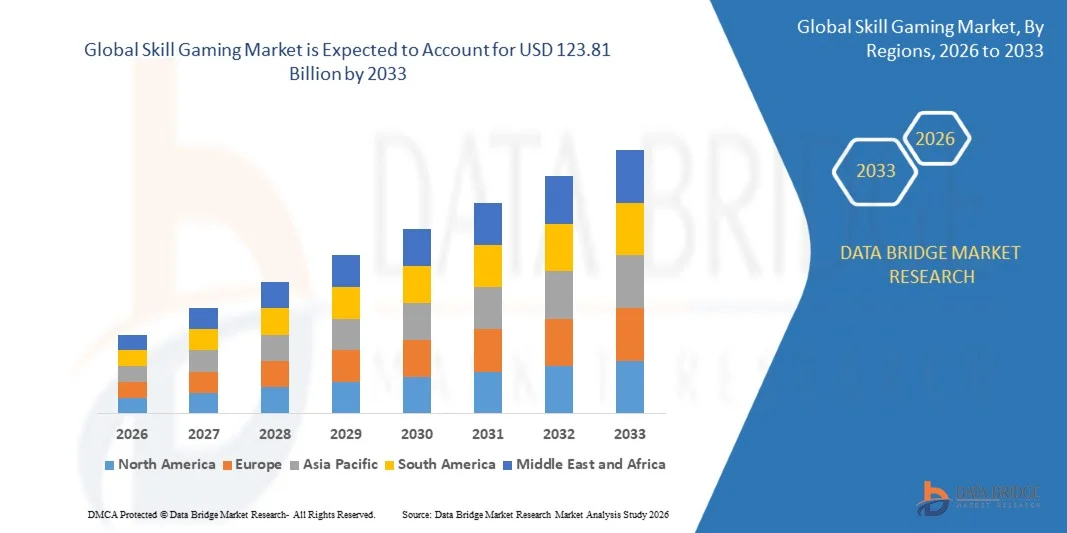
According to the latest report published by Data Bridge Market Research, the Skill Gaming Market CAGR Value As per Data Bridge Market Research Analysis The Skill Gaming Market was valued at USD 43.10 billion in 2025 and is projected to reach USD 123.81 billion by 2033, growing at a CAGR of 14.10% from 2026 to 2033. Winning Skill Gaming Marketresearch report deeply analyses the...