


A leak under the sink, a gap under the door, a bag of birdseed left in the garage, none of these feel like a big deal on their own.
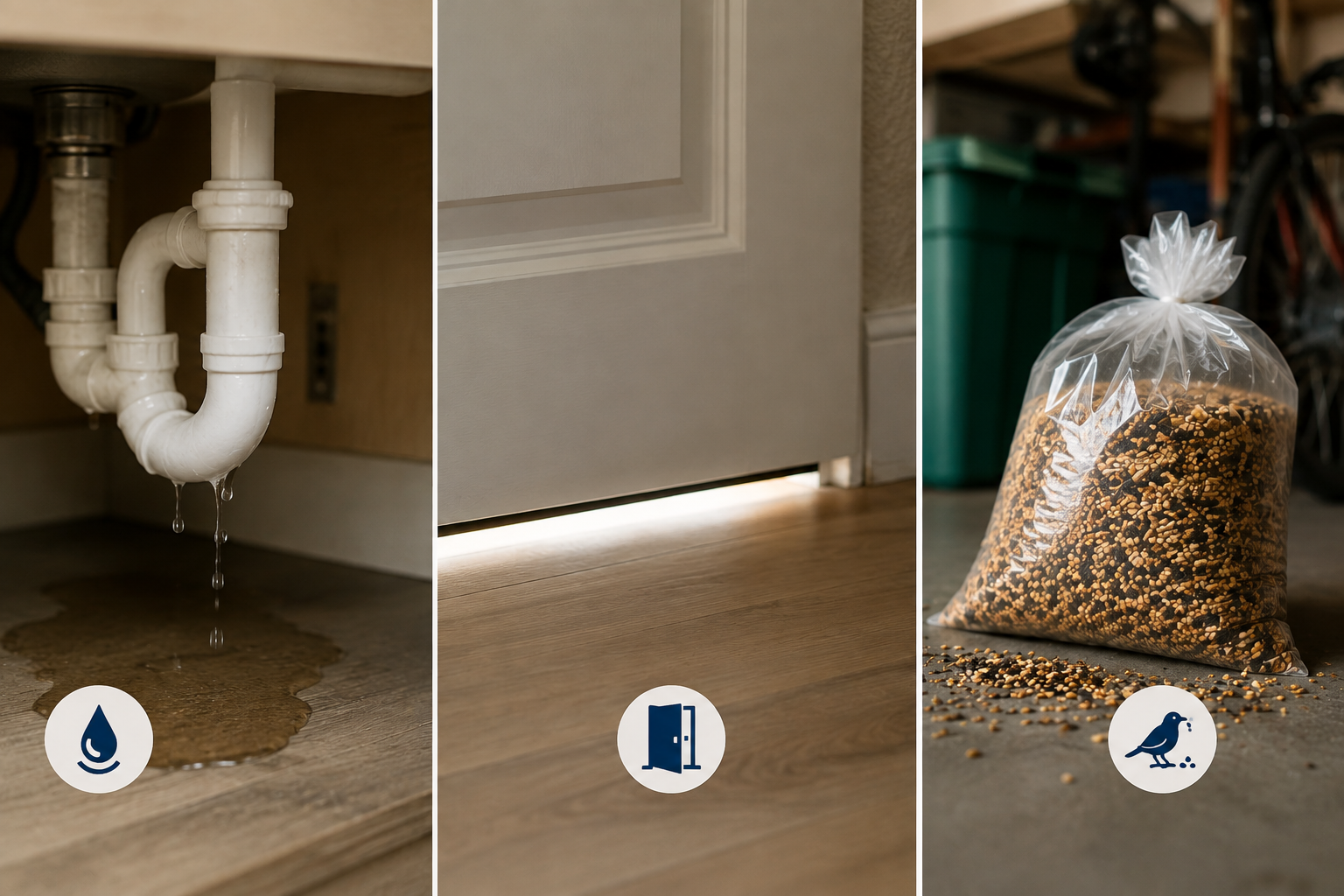
That's exactly the problem. Pest infestations rarely start with something dramatic. They start with small, easy-to-miss details that quietly add up until one day you're dealing with a full-blown problem instead of a five-minute fix.
Most homeowners don't think about pest prevention until they've already spotted something they wish they hadn't. But the earlier you catch the warning signs, the cheaper, faster, and less stressful the fix tends to be.
Why Small Signs Get Ignored
A single ant on the counter or a faint scratching sound in the attic doesn't feel urgent. It's easy to explain away, maybe it wandered in through an open window, maybe it's just the house settling. And often, that assumption is correct.
The trouble is that pests are opportunists. A single scout ant is often followed by a trail. A scratching sound that shows up more than once, especially at the same time each night, usually means something is nesting rather than just passing through. The signs that matter aren't necessarily the biggest ones, they're the ones that repeat.
Signs Worth Paying Attention To
Droppings in unexpected places. Small dark droppings near baseboards, in cupboards, or along walls are one of the clearest indicators of rodent activity, even if you haven't seen an actual mouse or rat.
Unusual smells. A persistent musty or oily odor in a specific area, particularly near walls or under appliances, can point to a nest or a colony that's been established for a while.
Damaged wood or packaging. Small holes in cardboard, gnawed corners on stored boxes, or fine wood shavings near baseboards and window frames are signs that something has been chewing where it shouldn't.
Nests in unlikely spots. Shredded paper, insulation, or fabric bunched into a nest-like shape in an attic, garage, or crawl space is rarely accidental.
Sounds with a pattern. Scratching, scurrying, or tapping that happens consistently, especially overnight, is worth investigating rather than dismissing.
Grease marks along walls. Rodents tend to travel the same routes repeatedly, and over time this can leave faint smudge marks along baseboards or entry points.
None of these signs guarantee a serious infestation on their own. But when two or three show up together, it's usually a strong indicator that something is established rather than passing through.
Where to Actually Check
Pests gravitate toward areas that offer three things: food, moisture, and a way in that doesn't get noticed. That means the highest-risk spots in most homes are consistent, regardless of the pest.
Kitchens and pantries are obvious food sources. Bathrooms and laundry rooms offer moisture. Basements, attics, and garages tend to have the most overlooked entry points — gaps around pipes, vents, or foundation cracks that are easy to miss during a normal walkthrough.
A quick seasonal check of these areas, even just a five-minute look every few months, catches most problems long before they become expensive ones.
Why Waiting Rarely Pays Off
It's tempting to wait and see if a sign repeats before doing anything about it. Sometimes that's a reasonable call. But pests that establish a foothold indoors, whether it's a rodent nest in insulation or an ant colony working through a damp wall stud, tend to grow their presence quietly while doing damage that isn't visible from the surface.
By the time a problem is obvious enough that no one in the house can miss it, the fix is almost always more involved, and more expensive, than it would have been at the first sign.
Frequently Asked Questions
How often should I check my home for pest warning signs? A quick seasonal check, roughly every three months, is usually enough to catch most issues early, with extra attention during spring and fall when pest activity tends to increase.
Is it normal to see the occasional bug or two? Yes. A single insect here and there isn't necessarily a sign of infestation. It's a repeated pattern, in the same spot, that's worth paying closer attention to.
Can I handle early signs myself, or do I need a professional right away? Minor food-source issues can often be managed with cleaning and sealing entry points. Signs involving structural damage, nesting, or rodents are usually better assessed by a professional early on.
What's the biggest mistake homeowners make with pest prevention? Waiting for visible, undeniable proof before taking action. By that point, the problem is typically more established than it appears.
Final Thoughts
Most pest problems don't arrive overnight. They build slowly, through small signs that are easy to overlook until they aren't. Paying attention to droppings, sounds, smells, and damage in the right areas of your home is usually enough to catch an issue while it's still small and manageable.
If something feels off and you're not sure whether it's worth a closer look, it usually is. Getting a second opinion from a licensed professional like 4K Pest Control early on tends to cost far less than waiting until the problem is impossible to ignore.
Categories
- Artificial Intelligence (AI)
- Technology
- Business
- Education
- Science
- Lifestyle
- Healthcare
- Entertainment
- Politics
- Environment
- Travel
- Finance
- Automobile
- News
- Art
- Causes
- Crafts
- career
- Dance
- Drinks
- Film
- Fitness
- Food
- Games
- Gardening
- Health
- Home
- Literature
- Music
- Networking
- Other
- Party
- Religion
- Shopping
- Sports
- Theater
- Wellness
Read More
The Diabetic Nephropathy Market is witnessing steady growth as the global prevalence of diabetes continues to increase and healthcare systems place greater emphasis on preventing and managing diabetes-related kidney complications. According to Market Research Future, the global market was valued at USD 6.10 billion in 2025 and is projected to reach USD 14.05 billion by 2035, expanding at a...

The Wire Harness Market refers to technologies and assemblies used to organize, route, protect, and connect electrical wires and cables across complex electrical systems. According to Business Market Insights, the global Wire Harness Market Size is anticipated to grow at a CAGR of 6.05% throughout the forecast period. The increasing adoption of electric vehicles, advanced driver-assistance...
Thrombopoietin Receptor Agonist Market was valued at USD 2.64 billion in 2025 and is projected to reach USD 6.8 billion by 2035, expanding at a CAGR of 9.9%. Rising prevalence of thrombocytopenia and demand for innovative therapies are supporting market development. Immune thrombocytopenic purpura represents a major therapeutic application, with the segment projected to reach USD 2.3 billion by...
Multichannel Order Management Market Insights According to a new report from Intel Market Research, the global Multichannel Order Management market was valued at USD 3.2 billion in 2025 and is projected to reach USD 5.8 billion by 2034, growing at a robust CAGR of 6.0% during the forecast period (2025–2034). This growth is driven by the convergence of omnichannel retailing,...
The global expansion of automated machinery, intelligent transportation systems, and electrified mobility is accelerating rapidly, with the Speed Sensor Market Growth reflecting an increasing dependence on high-precision velocity telemetry. As global automotive original equipment manufacturers (OEMs) shift production toward hybrid and fully electric vehicles (EVs), the demand for specialized...

