


Best OSHA Safety Videos for Workplace Compliance and Training
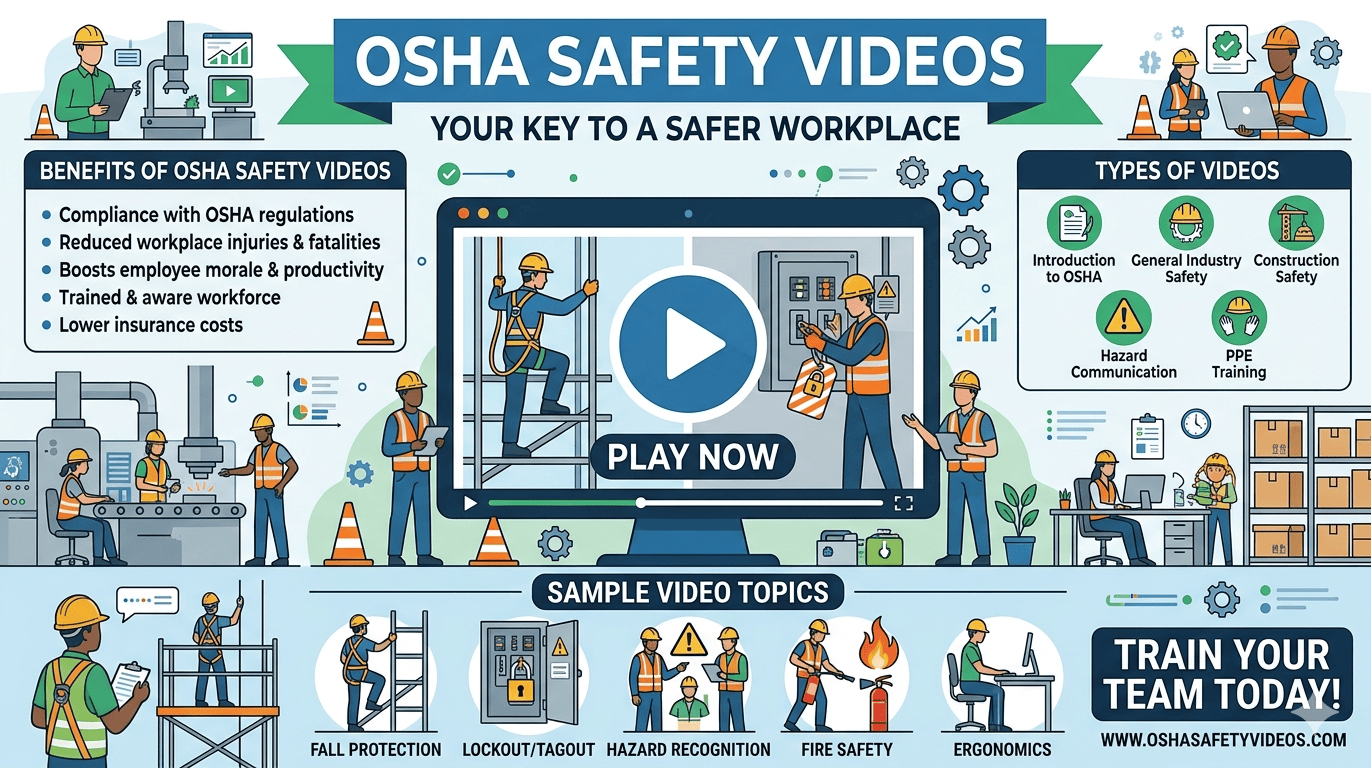
OSHA Safety Videos provide an effective way for employers to communicate essential workplace safety practices, explain common hazards, and reinforce compliance expectations. For businesses across the United States, visual training can make complex safety procedures easier for employees to understand and remember. From construction sites and warehouses to manufacturing facilities and offices, well-structured safety content can support a stronger workplace safety culture.
Why Workplace Safety Training Matters
Workplace accidents can result in employee injuries, operational disruptions, property damage, and significant financial costs. Employers have a responsibility to provide appropriate safety information and training based on the hazards employees may encounter.
Effective training should not simply provide information—it should help workers understand how to recognize hazards, follow established procedures, and respond appropriately during emergencies. Video-based education can make these concepts more engaging by combining demonstrations, narration, graphics, and real-world workplace scenarios.
How OSHA Safety Videos Support Compliance
OSHA Safety Videos can help organizations reinforce important safety requirements through consistent and accessible training materials. Instead of relying exclusively on written manuals, employers can use visual demonstrations to show employees how specific procedures should be performed.
Topics may include hazard communication, personal protective equipment, fall prevention, fire safety, emergency response, ladder safety, lockout/tagout, electrical hazards, and material handling. Selecting content that matches the actual risks within a workplace can make training more relevant and useful.
Employers should also remember that videos are a training resource, not a replacement for all employer responsibilities. Training programs should be appropriate for the employee's job duties, workplace hazards, and applicable OSHA requirements.
Key Features of Effective Workplace Training Videos
The best workplace training content should be clear, practical, and easy for employees to follow. High-quality training videos generally include several important characteristics:
- Straightforward explanations of workplace hazards
- Realistic examples and demonstrations
- Clear instructions for safe work practices
- Information about personal protective equipment
- Emergency response procedures
- Knowledge checks or discussion opportunities
- Content relevant to specific job responsibilities
- Easy access for new and existing employees
Short, focused lessons can also help employees retain important information without overwhelming them with unnecessary details.
Online Training for Modern Workplaces
Online Safety Training Videos give organizations greater flexibility when delivering employee education. Workers can access assigned lessons from computers or compatible devices, making online learning useful for companies with multiple locations, rotating shifts, or remote administrative teams.
Digital training can also simplify recordkeeping when paired with an appropriate learning management system. Employers may be able to track course assignments, completion dates, employee participation, and refresher training requirements.
However, employers should verify that their chosen training materials are suitable for the applicable OSHA standards and their specific workplace conditions.
Safety Orientation for New Employees
A strong onboarding process can establish safe work habits from the beginning. A Safety Orientation Course can introduce new employees to workplace policies, emergency procedures, hazard reporting, required protective equipment, and other essential safety expectations.
Orientation should be tailored to the employee's position. For example, a warehouse worker may need training on powered industrial trucks and material handling, while a construction employee may require instruction related to falls, scaffolding, electrical hazards, or personal protective equipment.
Choosing the Right Training Content
When selecting training materials, employers should first identify the hazards associated with their operations. A generic video may not address every risk employees face.
Consider factors such as industry, employee responsibilities, workplace equipment, regulatory requirements, and previous incidents or near misses. Training should also be reviewed periodically to ensure that information remains accurate and relevant.
Employers can supplement video-based learning with demonstrations, toolbox talks, written procedures, supervisor instruction, and hands-on practice where appropriate.
Building a Stronger Safety Culture
Safety Videos can become part of a broader workplace safety strategy when they are supported by active management involvement and employee participation. Supervisors should reinforce safe practices during daily operations and encourage workers to report hazards without fear of retaliation.
Regular refresher training can also help keep critical safety procedures familiar. When employees understand why a procedure matters—not simply what they are required to do—they are more likely to apply safe practices consistently.
Final Thoughts
Effective workplace training combines relevant information, practical instruction, and ongoing reinforcement. OSHA Safety Videos can help U.S. employers deliver consistent visual education covering important workplace hazards and safe operating procedures.
For the best results, organizations should choose training materials that align with their industry, employee duties, and applicable OSHA requirements. Combining video lessons with hands-on instruction, workplace policies, supervision, and regular safety communication can help businesses create a more informed and safety-conscious workforce.
Categories
- Artificial Intelligence (AI)
- Technology
- Business
- Education
- Science
- Lifestyle
- Healthcare
- Entertainment
- Politics
- Environment
- Travel
- Finance
- Automobile
- News
- Art
- Causes
- Crafts
- career
- Dance
- Drinks
- Film
- Fitness
- Food
- Games
- Gardening
- Health
- Home
- Literature
- Music
- Networking
- Other
- Party
- Religion
- Shopping
- Sports
- Theater
- Wellness
Read More
The 5G Electromagnetic Wave Shielding Film Market Analysis reveals a sector experiencing rapid evolution driven by the unique challenges of next-generation wireless communications. This comprehensive analysis highlights the critical role of shielding films in ensuring the reliable operation of 5G-enabled devices and infrastructure by managing electromagnetic interference in...

" According to the latest report published by Data Bridge Market Research, the Home Health Hub Market CAGR Value The global home health hub market size was valued at USD 514.01 Million in 2024 and is expected to reach USD 1,609.95 Million by 2032, at a CAGR of 15.34% during the forecast period The Home Health Hub Market analysis report helps...

The Urine Reagent Kit Market is expanding as healthcare providers increasingly rely on rapid and convenient urine-based diagnostic testing. Urine reagent kits are widely used for clinical diagnosis, diabetes monitoring, pregnancy testing, drug testing, and other applications. According to WiseGuyReports, the global market was valued at approximately USD 1.8 billion in 2024 and is expected...
As per Market Research Future analysis, the Border Security Market Size was estimated at approximately USD 406.22 Billion in 2024. The Border Security industry is projected to expand from nearly USD 433.12 Billion in 2025 to around USD 822.4 Billion by 2035, exhibiting a compound annual growth rate (CAGR) of 6.62% during the forecast period from 2025 to 2035. The global border security...
The Biosimilar And Biologics Market is expanding as healthcare systems seek cost-effective alternatives and broader access to advanced biological therapies. WiseGuyReports values the global market at USD 40.6 billion in 2025 and projects it to reach USD 100 billion by 2035, representing a CAGR of 9.4% during 2026–2035. Several structural factors are supporting this expansion. The...
