Chemical Distribution Market Growth: Why Specialty Chemicals, Compliance and Digital Platforms Are Changing the Industry
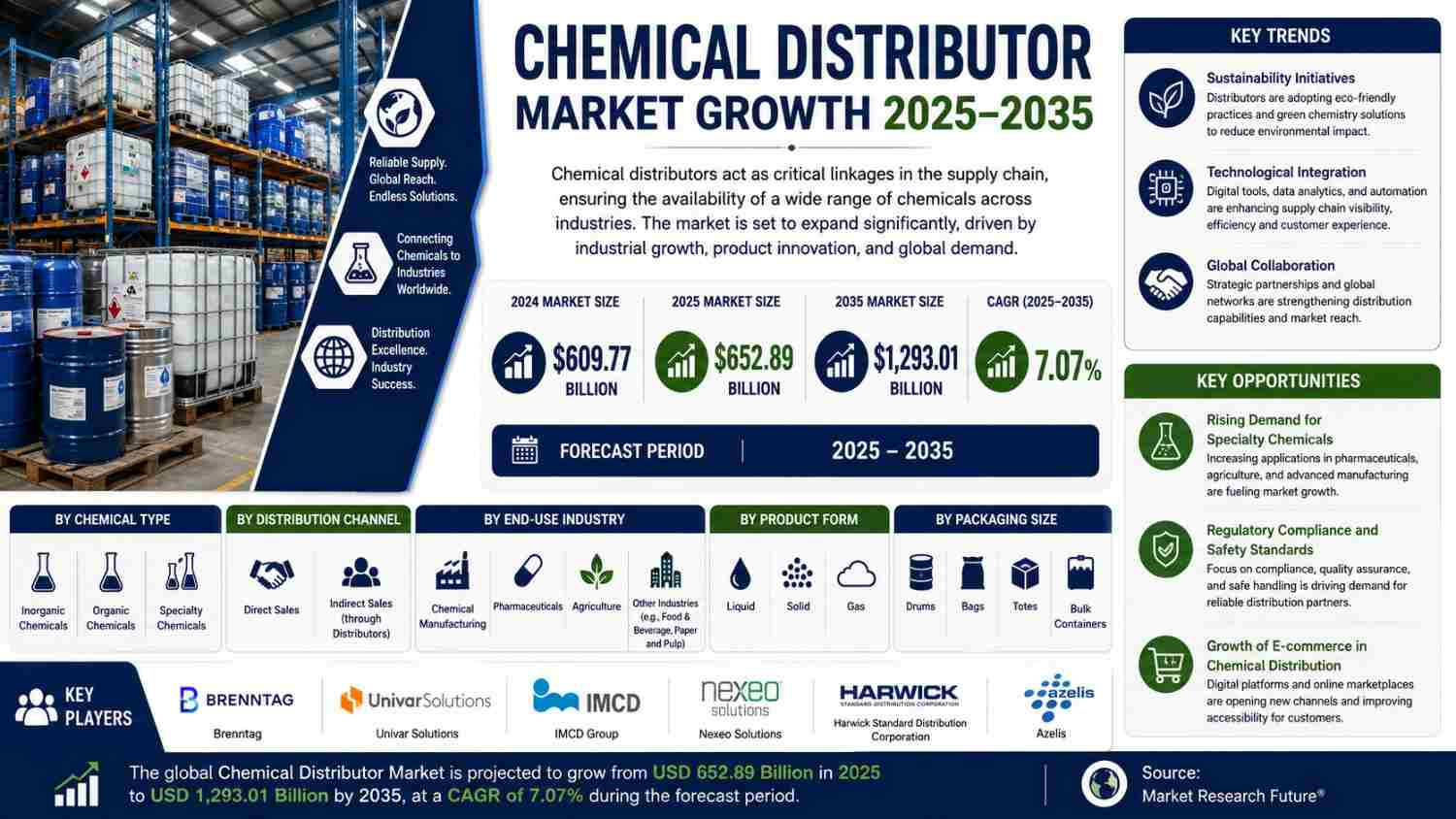
Chemical Distribution Is Becoming a Strategic Part of Industrial Supply Chains
The chemical industry depends on more than production capacity. Manufacturers also need the right materials delivered in the right form, quantity, packaging and compliance framework, often across complex international supply networks. The Chemical Distribution Market was valued at USD 609.77 billion in 2024 and reached USD 652.89 billion in 2025. It is projected to reach USD 1,293.01 billion by 2035, expanding at a CAGR of 7.07% from 2025 to 2035. Specialty chemical demand, tighter regulatory expectations, digital integration, sustainability initiatives and increasingly complex industrial supply chains are changing what customers expect from chemical distributors.
The market's expansion is therefore not simply about moving more chemicals. It reflects the growing role of distributors as intermediaries that solve sourcing, storage, logistics, compliance and formulation challenges for manufacturers.
Why Chemical Distribution Is Moving Beyond Simple Trading
Chemical distribution traditionally involved connecting producers with industrial buyers.
That function remains important, but the requirements surrounding chemical purchasing have become more complicated. Manufacturers may need smaller shipment quantities, specialized grades, reliable delivery schedules, technical assistance and documentation covering safety and regulatory requirements.
For many customers, purchasing directly from a large chemical producer is not always the most efficient option.
A distributor can consolidate products from multiple suppliers and provide access to a broader portfolio. This is particularly useful for smaller and mid-sized manufacturers that lack the purchasing volume or infrastructure to negotiate directly with every chemical producer.
Distribution consequently becomes a supply-chain service rather than simply a resale activity.
Specialty Chemicals Are Changing the Economics
One of the strongest opportunities lies in specialty chemicals.
Unlike commodity chemicals, specialty products are often selected because of specific performance characteristics. They may be used to improve formulation stability, processing efficiency, product durability or other application-specific requirements.
This changes the relationship between supplier and customer.
The buyer is no longer interested only in price per kilogram. Product consistency, technical support, regulatory documentation and delivery reliability can influence the purchasing decision.
For distributors, this creates opportunities to differentiate through application knowledge.
Companies that understand what a pharmaceutical manufacturer, agricultural producer, coatings company or food processor actually needs can provide more value than a distributor competing solely on logistics.
Manufacturing Remains a Major Demand Engine
Chemical manufacturing is naturally one of the core end-use industries because chemicals are often inputs into further processing.
But demand is much broader.
Pharmaceutical producers require specialized materials with strict quality and documentation requirements. Agriculture depends on chemical inputs that support crop production and protection. Food and beverage, paper and pulp, coatings and other industrial sectors also require a wide range of chemical products.
This diversity provides a degree of market resilience.
A slowdown in one industry does not necessarily eliminate demand across the distribution network. Instead, demand can shift between end-use sectors depending on production cycles, consumer spending and industrial investment.
The Form and Packaging of Chemicals Matter More Than They Appear
Chemical distribution involves liquids, solids and gases, each requiring different handling and transportation systems.
Packaging adds another layer of complexity.
Drums, bags, totes and bulk containers serve different customer requirements. Large manufacturers may prefer bulk deliveries, while smaller processors may need manageable quantities that reduce inventory commitments.
This creates a practical opportunity for distributors that can provide flexible packaging and shipment sizes.
Inventory management becomes especially important because chemicals can have specific storage requirements and because holding excessive inventory ties up working capital.
A distributor that balances availability with inventory efficiency can provide significant value to industrial customers.
Digitalization Is Reshaping the Buying Process
Technology is changing how customers search for and purchase chemicals.
Digital platforms can improve product discovery, order processing, inventory visibility and communication between suppliers and buyers.
E-commerce also has potential to simplify transactions for standardized products and smaller-volume purchases.
However, chemical distribution cannot become entirely transactional.
Industrial buyers may need documentation, safety information, technical specifications and guidance before selecting a material. Digital tools are most valuable when they make this information easier to access and integrate into purchasing workflows.
The strongest digital platforms will therefore combine convenience with the technical complexity inherent in chemical procurement.
Compliance Is Becoming a Commercial Capability
Chemical products operate within extensive safety and regulatory frameworks.
Distributors have to manage product documentation, labeling, transportation requirements, storage practices and customer-specific compliance expectations.
This creates both cost and competitive differentiation.
A distributor that handles regulatory information efficiently can reduce administrative work for customers.
For multinational manufacturers, the challenge can be even greater because requirements may vary across jurisdictions.
As chemical supply chains become more international, regulatory expertise can become an important part of the distributor's value proposition.
Sustainability Creates Pressure Across the Network
Sustainability in chemical distribution is not limited to reducing packaging.
Transportation emissions, warehouse energy use, waste management, product selection and supply-chain efficiency all influence environmental performance.
Customers are also increasingly interested in chemicals that support lower-impact manufacturing processes.
This creates opportunities for distributors to expand portfolios of specialty products aligned with sustainability goals.
At the same time, sustainability can increase operating complexity. Alternative products may cost more, require new storage conditions or need additional technical validation.
The industry's challenge is to make sustainability commercially practical rather than treating it as a standalone marketing objective.
Regional Demand Reflects Industrial Structure
Asia-Pacific is important because of its large manufacturing base, expanding industrial activity and growing consumption of chemical inputs.
The region's diverse production ecosystem creates demand across manufacturing, agriculture, pharmaceuticals and other industries.
North America benefits from established chemical manufacturing, pharmaceuticals, industrial production and sophisticated distribution infrastructure.
Europe combines strong industrial demand with stringent environmental and safety expectations. These conditions can encourage distributors to develop stronger compliance capabilities and specialized product portfolios.
South America, the Middle East and Africa provide opportunities connected to industrialization, agriculture, infrastructure and the development of regional supply chains.
The key difference between regions is therefore not simply market size. It is the industrial structure determining which chemicals are needed, in what quantities and under what regulatory conditions.
Competition Is Moving Toward Service Depth
The competitive landscape includes Brenntag, Univar Solutions, IMCD Group, Nexeo Solutions, Harwick Standard Distribution Corporation and Azelis.
These companies operate in a market where scale can provide purchasing and logistics advantages, but scale alone does not guarantee customer loyalty.
Specialization is increasingly important.
A distributor with strong technical expertise can support customers in selecting products and optimizing formulations. Another may differentiate through geographic reach, warehousing or digital ordering capabilities.
This creates several competitive paths.
Large distributors can use broad portfolios and infrastructure, while specialized companies can build stronger positions in particular industries or chemical categories.
Where the Next Opportunities Are Emerging
Specialty chemicals offer one of the clearest growth areas because customers increasingly need materials designed for specific performance requirements.
Regulatory compliance creates another opportunity. Distributors capable of simplifying documentation and maintaining reliable product information can reduce procurement complexity.
E-commerce offers a further opening, particularly for standardized products and smaller buyers.
There is also room for supply-chain optimization.
Better demand forecasting, inventory management and digital visibility can help distributors reduce shortages while avoiding unnecessary stock.
These capabilities become increasingly valuable as customers seek reliable supply without carrying excessive inventory themselves.
The Challenges Behind the Growth
The industry faces several constraints.
Chemical transportation can be expensive and operationally complex. Storage requirements can vary considerably between products. Regulatory obligations can increase administrative costs.
Commodity price volatility can also affect margins, particularly when distributors cannot quickly pass changes through to customers.
Supply disruptions represent another risk.
Distributors increasingly need diversified supplier relationships and better visibility into upstream markets to respond when production or transportation is interrupted.
The challenge is to maintain flexibility without creating an inefficient cost structure.
What to Watch Through 2035
The next decade will likely be shaped by four connected developments: specialty chemical demand, digital purchasing, sustainability requirements and regulatory complexity.
The role of the distributor could become more integrated with the customer's procurement process.
Rather than simply delivering a chemical, distributors may increasingly provide inventory visibility, technical information, compliance support and application-specific guidance.
This would change the economics of the sector by shifting competition from product availability toward service quality and supply-chain intelligence.
Market Outlook
The projected rise from USD 652.89 billion in 2025 to USD 1,293.01 billion by 2035 reflects more than expanding chemical consumption.
It points to a broader industrial need for flexible and reliable chemical supply.
Manufacturers are operating across increasingly complex product portfolios and supply chains. They need partners that can manage small and large orders, navigate regulatory requirements, maintain product availability and support specialized applications.
The chemical distributor of the future may therefore look less like a traditional intermediary and more like an integrated supply-chain partner.
That shift could be one of the defining characteristics of the market through 2035.
Another Trending Topics
Categories
- Artificial Intelligence (AI)
- Technology
- Business
- Education
- Science
- Lifestyle
- Healthcare
- Entertainment
- Politics
- Environment
- Travel
- Finance
- Automobile
- News
- Art
- Causes
- Crafts
- career
- Dance
- Drinks
- Film
- Fitness
- Food
- Games
- Gardening
- Health
- Home
- Literature
- Music
- Networking
- Other
- Party
- Religion
- Shopping
- Sports
- Theater
- Wellness
Read More
The Light Therapy Market has experienced significant growth in recent years, driven by increasing recognition of photobiomodulation's therapeutic potential across dermatology, psychiatry, sleep medicine, and pain management. These non-invasive treatment modalities utilize specific wavelengths of light including blue, red, and near-infrared to stimulate cellular function, regulate circadian...

Hydrochloric acid (HCl), a strong and highly corrosive mineral acid, serves as a fundamental chemical building block across various industrial sectors. Primarily produced as a byproduct of chlorination reactions in the manufacturing of organic chemicals like vinyl chloride monomer (VCM) and polyurethanes, HCl is essential for a wide range of applications. Its utility spans from the steel...
Coworking Spaces Market Overview The Coworking Spaces Market Report is a comprehensive and meticulously developed research study designed to provide in-depth insights into the evolving dynamics of the Coworking Spaces market. Prepared through extensive primary interviews, secondary research, and detailed data analysis, this report evaluates critical factors influencing market...
Hexapeptide 2 Market Report Overview The Hexapeptide 2 Market report provides a comprehensive and analytically structured examination of the Hexapeptide 2 market. Based on rigorous primary and secondary research methodologies, it evaluates competitive dynamics, technological advancements, regulatory environments, and evolving consumer expectations. The study delivers a data-driven...
Peptide therapy has become an increasingly popular option in modern weight management because it supports metabolism, appetite regulation, fat breakdown, and energy balance at a biological level. As interest grows, many people search for Peptide Treatments Cost specifically in relation to weight loss programs, hoping to understand what influences pricing and what they are actually...