SOC Audit: Critical India Guide to Audit Readiness
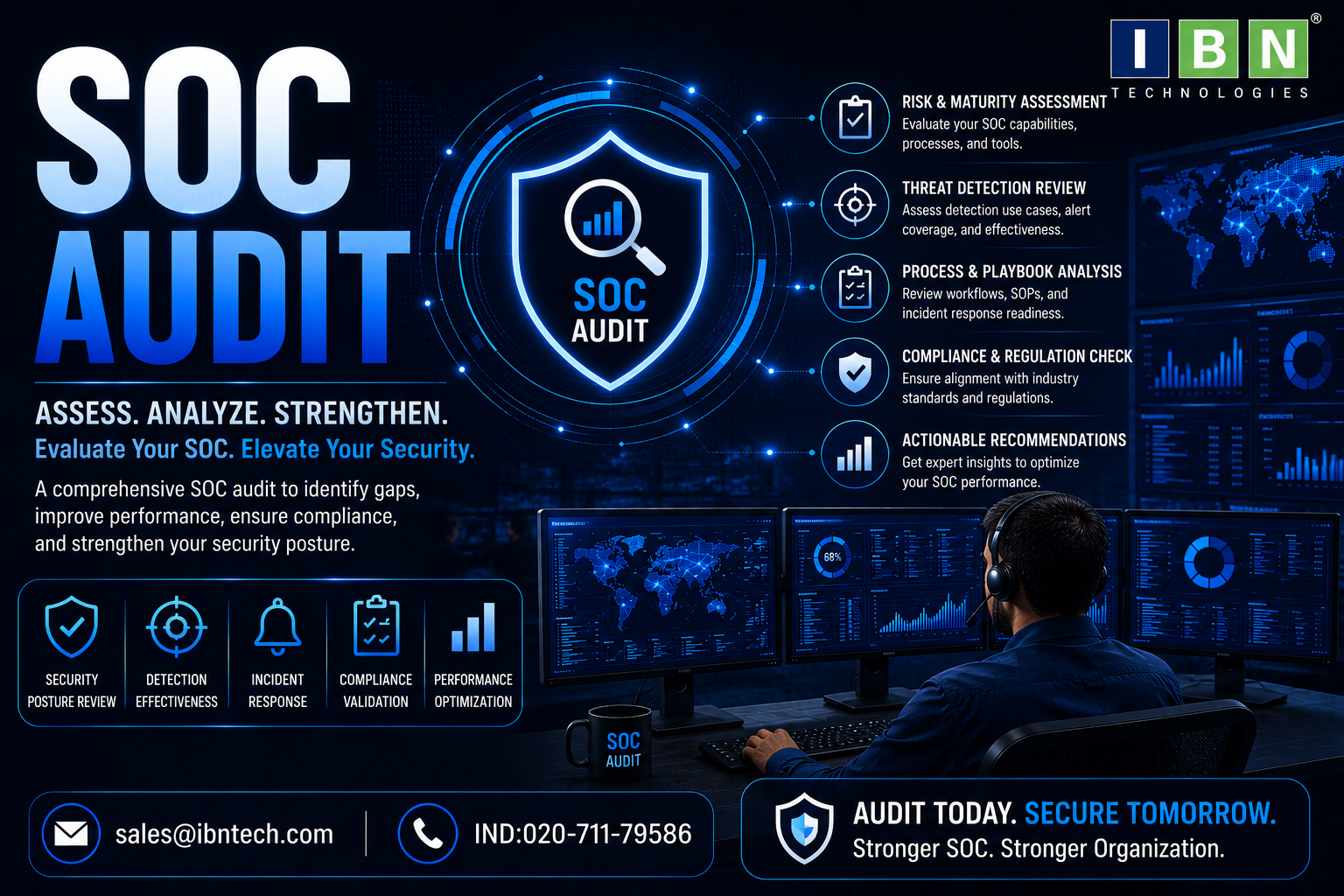
Why an IT Business Should Treat a SOC Audit as a Security Exercise
For an IT company, soc audit preparation is not simply about producing documents when an assessor asks for them. It is an opportunity to examine whether security controls actually operate as intended across systems, people, policies, and monitoring processes.
A useful audit identifies weaknesses that may otherwise remain hidden inside everyday operations. It can expose inconsistent access controls, incomplete evidence, unclear incident procedures, or gaps between documented policy and actual practice.
That distinction matters for Indian technology businesses serving enterprise customers, handling sensitive information, or operating in environments where security assurance influences commercial relationships.
What Does a SOC Audit Actually Examine?
A SOC audit evaluates whether relevant security controls are appropriately designed and, depending on the engagement, whether they operate effectively over the required period. In practical terms, it connects policies and technical controls with evidence showing how security is managed.
For an IT business, the review can touch areas such as access management, monitoring, incident response, data protection, change management, risk processes, and control documentation.
Why Evidence Matters as Much as the Control
A security control that exists but cannot be demonstrated consistently creates an audit-readiness problem. Evidence gives reviewers a way to establish that a process was performed, reviewed, approved, or monitored.
This is where organizations often discover that security maturity is uneven. A company may have strong technical tooling while maintaining weak documentation, or excellent policies without enough operational evidence to demonstrate execution.
How to Assess SOC Audit Support Without Choosing on Price Alone
When evaluating top soc providers, an IT company should look beyond a list of tools or a generic promise of compliance assistance.
The more useful questions concern the provider's ability to connect security operations with audit requirements. Can the team identify control gaps? Can it organize evidence? Does it understand continuous monitoring? Can it help translate technical findings into practical remediation actions?
IBN Technologies provides cybersecurity audit and compliance services covering security audits, gap and risk analysis, continuous compliance monitoring, and audit-ready documentation. Its compliance support includes SOC 2 among other standards and regulatory requirements, depending on the client's needs.
For an IT organization, that combination is more useful than treating audit preparation as a one-time documentation project.
Where Traditional Audit Preparation Falls Short
A spreadsheet-driven approach can create the appearance of readiness without improving the underlying control environment.
Common weaknesses include:
-
Policies that no longer reflect operational reality
-
Evidence collected manually at the last moment
-
Security alerts without clear ownership
-
Access reviews that are inconsistent
-
Incident procedures that have not been tested
-
Technical findings without assigned remediation owners
-
Separate compliance and security processes that do not communicate
These issues make an audit unnecessarily disruptive. They also reduce the business value of the exercise because the organization learns about weaknesses only when external scrutiny begins.
A Practical Audit-Readiness Framework
|
Area |
What to examine |
Useful outcome |
|
Governance |
Policies, responsibilities, approvals |
Clear accountability |
|
Identity |
Access rights and privileged accounts |
Reduced unnecessary access |
|
Monitoring |
Logs, alerts, investigation workflows |
Better security visibility |
|
Incident response |
Escalation and response procedures |
Faster decision-making |
|
Change management |
Approvals and evidence of changes |
Greater control consistency |
|
Risk management |
Identified risks and treatment actions |
Prioritized remediation |
|
Evidence |
Records supporting control operation |
Stronger audit readiness |
The objective is not to create paperwork for its own sake. Each evidence item should help demonstrate that a control is understood, assigned, performed, and reviewed.
The IT Use Case: Growing From Startup to Enterprise Supplier
Consider an Indian software company that has moved from serving smaller customers to pursuing larger enterprise contracts.
Its technology stack may already be sophisticated. The challenge is proving that security processes operate consistently as the organization grows.
An audit-oriented review can reveal that employee access is not reviewed with enough regularity, incident records lack a consistent format, or security monitoring produces alerts without an established escalation process.
Addressing those weaknesses before a formal audit can make the organization more prepared for customer due diligence as well as formal assurance requirements.
Compliance Should Be Connected to Operations
Compliance should not become a separate layer that employees maintain only for audit season.
The appropriate framework depends on an IT company's customers, services, data, contractual obligations, and operating environment. The practical goal is to map those requirements to controls that the business can operate continuously.
IBN Technologies supports cybersecurity compliance initiatives involving standards and regulatory environments such as SOC 2, ISO 27001, GDPR, HIPAA, PCI DSS, DPDPA, RBI, and SEBI, where applicable to the engagement.
For an IT company, selecting the right compliance approach starts with understanding which obligations genuinely apply rather than pursuing certifications simply because they are widely recognized.
Questions to Ask Before an Audit
-
Are security policies aligned with current systems?
-
Can important controls be demonstrated with reliable evidence?
-
Who owns each security control?
-
Are access rights reviewed consistently?
-
Are security events monitored and investigated?
-
Is there a defined incident escalation process?
-
Are identified risks tracked through remediation?
-
Can the organization respond quickly to evidence requests?
The answers reveal more than a compliance checklist. They indicate whether security governance is embedded in daily IT operations.
A well-run soc audit should ultimately help an IT business understand its control environment rather than simply prepare for an assessment. For Indian technology companies, that means turning audit readiness into a repeatable security discipline that supports customer trust, operational resilience, and sustainable growth.
Contact Us:
IND- 02067680404
IBN Technologies Ltd.
E-mail: - sales@ibntech.com
Categories
- Artificial Intelligence (AI)
- Technology
- Business
- Education
- Science
- Lifestyle
- Healthcare
- Entertainment
- Politics
- Environment
- Travel
- Finance
- Automobile
- News
- Art
- Causes
- Crafts
- career
- Dance
- Drinks
- Film
- Fitness
- Food
- Games
- Gardening
- Health
- Home
- Literature
- Music
- Networking
- Other
- Party
- Religion
- Shopping
- Sports
- Theater
- Wellness
Read More
According to Market Research Future®, the Aluminum Market was valued at USD 195,126.7 Million in 2024 and is projected to grow from USD 205,592.1 Million in 2025 to USD 347,442.9 Million by 2035, registering a CAGR of 5.385% during the forecast period. The market continues expanding due to rising demand from construction, automotive, transportation, renewable energy, packaging, and...

Market Overview The 3D Laser Scanning Services Market is experiencing significant growth as industries increasingly adopt precision-based digital mapping and measurement technologies. These services are widely utilized across architecture, engineering, construction, manufacturing, and cultural heritage preservation projects where accurate spatial data and real-time visualization are essential....
Clamshell Labelling Machines Market Overview The Clamshell Labelling Machines Market is changing as demand shifts across applications, industries, and regions. Technology adoption, industrial activity, customer expectations, production costs, and sustainability considerations are influencing how the market develops. These changes are supporting established uses while also opening space for...
NEWARK, Del. — August 28, 2026 — The demand for citrus molasses in South Korea is projected to grow from USD 30.1 million in 2026 to USD 56.7 million by 2036, expanding at a CAGR of 6.6% during the forecast period, according to a new market analysis by Future Market Insights (FMI). The market's growth is being supported by rising consumer preferences for natural and...

The Pet Clothing Market is evolving as pet ownership increasingly becomes connected with lifestyle, wellness, and consumer fashion trends. Pet owners are looking beyond basic necessities and are showing greater interest in products that combine comfort, protection, functionality, and appearance. Clothing for dogs, cats, and other companion animals is becoming an important part of the broader...