


managed soc services for Indian Businesses: Critical Guide to Choosing a SOC
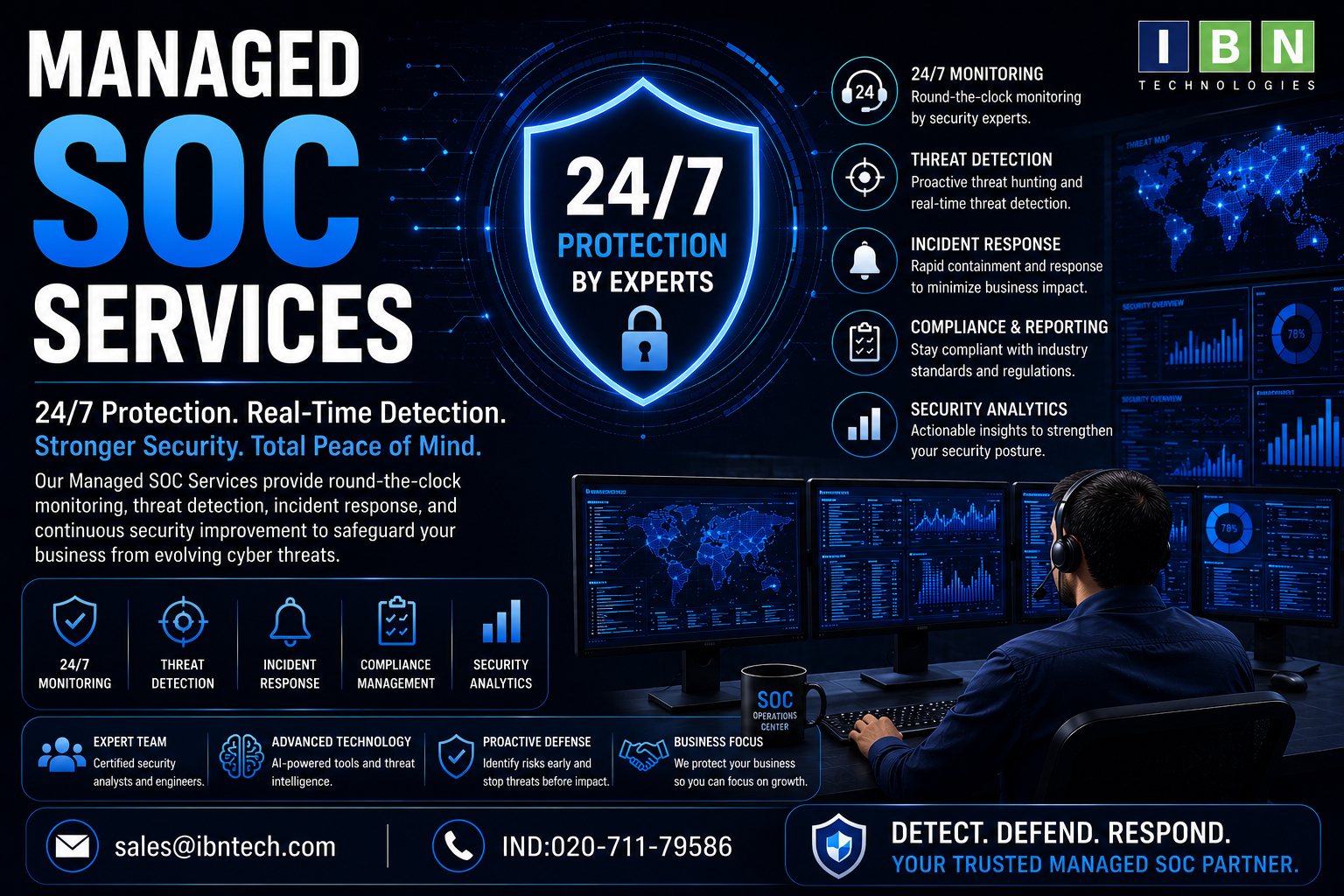
Why managed soc services matter for Indian IT businesses
Security operations have become an increasingly important part of IT management. Applications, endpoints, networks, cloud environments, identities, and business systems continuously generate security information that needs to be interpreted and acted upon.
For many Indian IT businesses, maintaining continuous security oversight internally can be difficult. Security specialists may have competing responsibilities, while the technology environment continues to expand.
This is where managed soc services can provide an alternative operating model. Instead of building every element of security operations internally, an organization can work with an external security operations team for defined monitoring, analysis, investigation, and escalation activities.
The important consideration is not simply whether a managed service exists. IT leaders need to determine whether its scope, operating model, expertise, and responsibilities match the organization's actual security requirements.
What a SOC solution provider should deliver
A SOC solution provider supports security operations by helping organizations monitor technology environments and identify potentially suspicious activity. The exact scope varies between service models, which makes evaluation essential.
At a minimum, an IT organization should understand what systems can be monitored, how security events are analyzed, how potentially significant alerts are prioritized, and how incidents are escalated.
A SOC is not valuable merely because it collects security information. Its practical purpose is to turn security signals into useful decisions.
For example, an alert from an endpoint may require additional investigation before an IT team can determine whether it represents ordinary activity or a potential security issue. A managed security operation can provide the analyst attention needed to make that distinction.
The provider should also establish clear communication channels. When an event requires customer involvement, internal teams should know what information they will receive and what action is expected from them.
Why traditional IT monitoring may not be enough
Traditional IT monitoring and security monitoring have different objectives.
Infrastructure monitoring may focus on availability, performance, capacity, and service health. Security operations look for activity that could indicate unauthorized access, malicious behavior, policy violations, or other security concerns.
An organization can therefore have excellent IT monitoring while still lacking dedicated security visibility.
The challenge becomes greater when security alerts arrive from multiple technologies. Internal teams may receive information from endpoints, networks, applications, identity systems, and other sources. Reviewing each alert independently can make it difficult to recognize relationships between events.
A managed SOC can provide a centralized operational layer for security monitoring and analysis. Rather than expecting general IT personnel to continuously examine security signals alongside their normal duties, the organization can assign defined security operations responsibilities to a specialist team.
How managed SOC services typically fit into an IT environment
A managed SOC arrangement begins with defining the technology environment that requires security visibility.
Relevant systems and security technologies are identified, and appropriate information is made available for monitoring. The SOC then receives security events and applies established detection and analysis processes.
Analysts review relevant alerts, investigate suspicious activity, and determine whether escalation is appropriate. Events requiring customer attention are communicated through agreed procedures.
The organization's internal team remains important throughout this process. Internal personnel understand the business context, technology architecture, operational priorities, and appropriate response authority.
The managed SOC therefore works best as an extension of the organization's security capability rather than as a complete replacement for internal ownership.
How to evaluate a managed SOC before signing an agreement
The strongest evaluations begin with requirements rather than provider claims.
IT leaders should first identify the systems that require monitoring and determine the level of coverage expected. They should then establish what they need from the provider when an alert is detected.
A practical evaluation should cover:
-
Monitoring scope: Which systems, environments, and security technologies can be included?
-
Security analysis: How are potentially suspicious events investigated?
-
Alert prioritization: How are significant events distinguished from routine activity?
-
Escalation: What triggers communication with the customer?
-
Reporting: What information is provided to IT and security leadership?
-
Integration: What technical work is required to connect existing systems?
-
Internal responsibilities: Which response activities remain with the organization's team?
-
Scalability: Can the service adapt when the IT environment changes?
-
Operational coverage: What monitoring schedule is provided?
-
Service boundaries: Which activities are included and which require separate arrangements?
These questions help turn an abstract service description into an operating model that can be assessed.
The business value of outsourcing security operations
The main advantage of managed security operations is access to a structured security capability without requiring the organization to develop every component internally.
This can be particularly useful for IT businesses whose internal teams have limited capacity for continuous security monitoring.
A managed SOC may also provide greater consistency. Defined procedures can help ensure that security events are reviewed and escalated according to an established process rather than depending entirely on individual availability.
Another potential benefit is operational flexibility. As the technology environment grows, the organization can review whether its monitoring scope needs to expand.
However, these benefits depend on service quality and scope. Outsourcing does not automatically produce stronger security. The organization must select a service that fits its environment and establish clear expectations from the beginning.
An IT use case: supporting a distributed technology environment
Consider an Indian IT business with employees working across multiple locations and a technology environment that includes endpoints, applications, network infrastructure, and cloud-based systems.
Its internal IT team is responsible for supporting users, maintaining infrastructure, managing applications, and responding to operational problems. Security alerts are also arriving from several technologies, but the team cannot consistently devote the same level of attention to every event.
A managed SOC can provide dedicated monitoring and analysis. Security analysts can review relevant events and investigate activity that requires additional attention. If an event meets established escalation criteria, the internal team can be notified with appropriate context.
This model allows the IT organization to maintain ownership while assigning defined security operations activities to a specialized external team.
The value lies in creating a repeatable process rather than relying on ad hoc alert review.
Common mistakes when selecting a managed SOC
One of the most common mistakes is choosing a provider based on a broad service description without establishing the actual monitoring scope.
A second issue is assuming that security monitoring automatically includes incident response. These are related but distinct activities, and the contract should explain where monitoring ends and customer-led response begins.
Another mistake is overlooking onboarding. Existing technologies may require configuration or integration work before the SOC can receive useful security information.
IT organizations can also underestimate the importance of communication. If escalation procedures are unclear, even a technically capable monitoring service can become difficult to use during a serious event.
Finally, organizations should avoid treating the SOC as a static deployment. Technology environments change, and monitoring requirements may need periodic review.
Governance and compliance considerations
A managed SOC should fit within the organization's broader information-security governance framework.
IT businesses should document responsibilities for monitoring, investigation, escalation, reporting, access, and incident coordination. Where contractual or regulatory obligations apply, the managed service should support those requirements rather than operate separately from them.
Outsourcing security operations does not transfer the organization's overall accountability for security. Internal stakeholders still need appropriate oversight of the service and should understand their responsibilities when an incident is escalated.
A clear operating agreement can reduce ambiguity by establishing who monitors, who investigates, who communicates, and who authorizes relevant actions.
Making a confident SOC decision
The right managed soc services arrangement is not necessarily the one with the broadest feature list or the lowest commercial price.
For Indian IT businesses, the stronger decision comes from matching the service to actual security requirements. Define the technology environment, establish monitoring expectations, clarify escalation responsibilities, evaluate analytical capability, and understand what internal resources will remain necessary.
The right soc solution provider should make those responsibilities clear rather than leaving important details to assumptions.
When managed security operations are treated as an operational partnership, the organization can better understand what it is purchasing and how the service contributes to its wider security program. For IT leaders in India, that clarity is often more valuable than choosing a SOC based on a generic list of capabilities.
Contact Us:
IND- 02067680404
IBN Technologies Ltd.
E-mail: - sales@ibntech.com
Categories
- Artificial Intelligence (AI)
- Technology
- Business
- Education
- Science
- Lifestyle
- Healthcare
- Entertainment
- Politics
- Environment
- Travel
- Finance
- Automobile
- News
- Art
- Causes
- Crafts
- career
- Dance
- Drinks
- Film
- Fitness
- Food
- Games
- Gardening
- Health
- Home
- Literature
- Music
- Networking
- Other
- Party
- Religion
- Shopping
- Sports
- Theater
- Wellness
Read More
Polaris Market Research has introduced the latest market research report titled Aircraft Flight Control Systems Market Share, Size, Trends, Industry Analysis Report, By Component (Flight Control Computers, Cockpit Control, Sensors, and Others); By Technology; By Platform; By Fit; By Region; Segment Forecast, 2023 - 2032 that highlights the major revenue stream for the forecast period....

The Unstoppable March to the Edge The single most powerful trend driving the modular data center market is the architectural shift towards edge computing. The centralized cloud model, where all data is processed in a few massive, remote data centers, is insufficient for a growing number of applications that require real-time processing and low latency. This is one of the most...

Saint Vanity Clothing Brings Comfort to Daily Fashion Finding clothing that feels comfortable from morning until night is important for people with busy schedules. Saint Vanity Clothing has become a popular choice because it combines comfort with a clean and modern look. Whether someone is heading to work, meeting friends, or spending time with family, wearing clothes that feel soft and fit...

Rotary Dryers Market Summary According to Market Research Future®, Rotary Dryers Market Size is expected to register a CAGR of 3.23% from 2025 to 2035. Market growth is being supported by evolving industry requirements, technological advancements, expanding application areas, and increasing investment activity across global markets. Rotary dryers are used...
The synthetic rope market is expanding steadily as technological advancements improve fiber strength, durability, and operational safety. Innovations in ultra-high molecular weight polyethylene (UHMWPE), aramid fibers, protective coatings, and advanced braiding techniques are enabling manufacturers to produce lighter, stronger, and longer-lasting rope solutions. According to Business Market...
