


SIEM Monitored 24x7 by a SOC for Faster BFSI Security Response
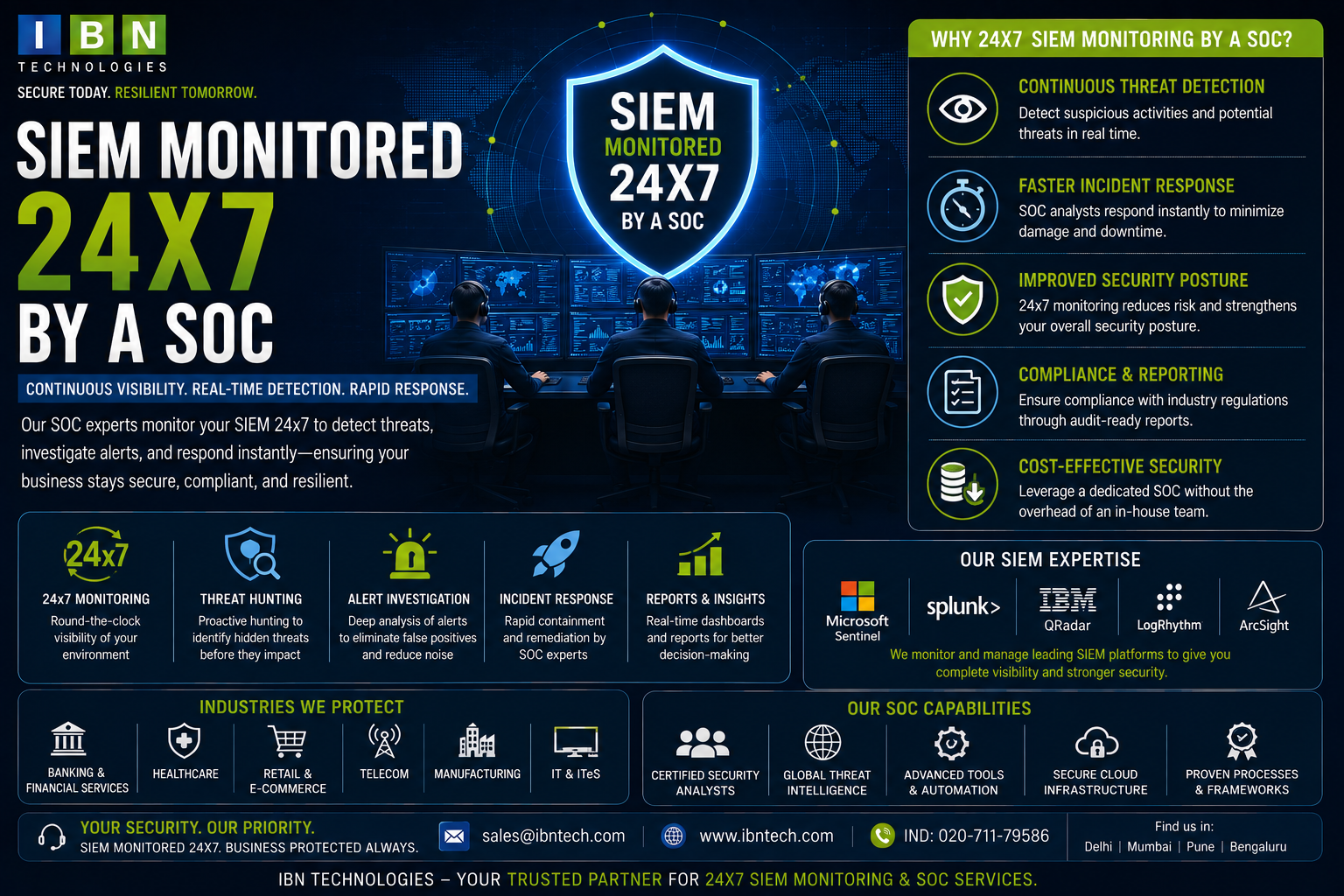
When Every Alert Matters: SIEM Monitored 24x7 by a SOC for BFSI
Financial services organizations cannot treat security monitoring as an occasional activity. Digital banking platforms, financial applications, employee systems, identity infrastructure, and connected technology environments can generate security signals throughout the day. siem monitored 24x7 by a soc gives BFSI organizations a way to combine centralized security visibility with continuous analyst-led monitoring.
The purpose is not to assume that every alert represents an attack. It is to ensure that potentially significant events have a defined path from detection to investigation and, when necessary, escalation.
What Does SIEM Monitored 24x7 by a SOC Mean for BFSI?
SIEM monitored 24x7 by a SOC means that security information collected through a SIEM is continuously monitored by security operations personnel. Analysts review relevant alerts, investigate suspicious activity, correlate available information, and escalate incidents according to established procedures.
For BFSI organizations, this model can support a more disciplined approach to security operations because monitoring does not depend entirely on internal teams being available to review events at a particular moment.
Continuous oversight is especially useful when security activity needs to be evaluated alongside the organization's broader operational and risk-management processes.
Why Real-Time SOC Management Matters to Financial Operations
real-time soc management focuses on maintaining an active security operation in which alerts can be assessed as they arise rather than being left for periodic review.
The phrase "real-time" should be understood within the specific service model. Security detection, analyst investigation, and escalation can have different operational timings depending on the environment and agreed service levels.
For BFSI organizations, the key consideration is whether the monitoring process provides a dependable path for potentially important events to reach the right people.
That process is more valuable than simply having a dashboard displaying security alerts.
The Problem With Waiting for Someone to Review Alerts
A security event that remains unexamined can create uncertainty.
Internal teams may have legitimate reasons for delayed review. They may be handling system maintenance, application issues, operational incidents, or other security responsibilities.
Meanwhile, security alerts can continue to accumulate.
A delayed review does not automatically mean an organization has suffered a security incident. However, it can reduce the organization's ability to understand what is happening across its environment.
A 24x7 SOC creates dedicated operational capacity for reviewing security events according to agreed monitoring procedures.
How SIEM Monitored 24x7 by a SOC Supports Faster Decisions
The process starts with relevant security information entering the SIEM environment.
Detection mechanisms identify events that warrant analysis. SOC analysts then examine the alert and surrounding context.
They may review related authentication activity, endpoint information, network events, or other available security data. The objective is to determine whether the event appears routine, suspicious, or significant enough to escalate.
If escalation is required, the SOC communicates the relevant information to designated internal stakeholders.
This approach separates alert generation from incident determination. The SIEM provides visibility, while analysts provide investigation and judgment.
Why Continuous Monitoring Can Benefit BFSI Teams
A well-designed SOC operation can support financial organizations in several ways.
Consistent security oversight: Monitoring continues according to the agreed service model.
Focused investigation: Analysts can dedicate operational attention to security events.
Contextual analysis: Related security information can be assessed together.
Structured escalation: Significant findings can follow predefined communication procedures.
Reduced alert burden: Internal teams do not have to manually review every security notification themselves.
Improved visibility: Security stakeholders can gain a clearer picture of notable activity.
Operational consistency: Investigation processes can be applied systematically rather than depending solely on individual availability.
The objective is not to eliminate every security alert. It is to improve the organization's ability to determine which events deserve attention.
A BFSI Scenario: Anomalous Account Activity
Consider a financial organization where an administrative account generates an unusual authentication event.
The event may have a legitimate explanation. An analyst can examine the available context rather than immediately treating it as a confirmed security incident.
Additional authentication activity, endpoint signals, or related events may provide evidence that changes the assessment.
If the investigation identifies a concerning pattern, the event can be escalated through the agreed process.
Internal stakeholders then determine the appropriate action based on organizational procedures and authority.
This type of investigation illustrates why continuous monitoring is valuable. The goal is not simply to detect unusual activity but to understand what that activity means.
Where Traditional Internal Monitoring Can Become Difficult
An internal security team can provide strong organizational knowledge, but maintaining continuous monitoring requires sustained resources and operational discipline.
BFSI organizations may also have security specialists focused on governance, risk management, technology projects, access controls, vulnerability management, and other responsibilities.
Adding constant alert monitoring to those duties can create competing priorities.
A managed SOC can supplement internal personnel by taking responsibility for agreed monitoring and investigation activities.
The model works best when internal teams and the SOC have clearly defined responsibilities. The provider should know which events require escalation, while internal stakeholders should understand what information they will receive and which decisions remain with them.
How to Evaluate Real-Time SOC Operations
BFSI leaders should assess the operational model before selecting a provider.
- Review the monitoring environments covered by the service.
- Understand the detection and alert-triage process.
- Ask how analysts investigate suspicious activity.
- Establish escalation criteria for significant events.
- Identify internal contacts for urgent notifications.
- Define actions requiring customer authorization.
- Review security reporting capabilities.
- Determine how monitoring changes are handled.
- Understand how new systems are brought into the SOC.
- Review threat hunting capabilities where relevant.
- Clarify vulnerability management responsibilities.
- Establish procedures for periodic service reviews.
- Document the division of responsibility between internal teams and the provider.
These considerations help organizations evaluate the actual security operation rather than focusing only on technology names.
Reducing Alert Fatigue Without Reducing Visibility
More monitoring does not automatically mean better monitoring.
If every low-value event receives the same attention as a potentially serious security signal, analysts can struggle to prioritize their work.
Effective SOC operations therefore depend on meaningful detection and alert-handling processes.
The objective should be to maintain broad enough visibility while ensuring that analysts can focus their attention on events that require investigation.
For BFSI organizations, this balance can be particularly important because security operations must support both technical teams and broader business risk management.
Governance and Compliance Considerations
Security monitoring should be incorporated into the organization's wider governance structure.
BFSI organizations need to consider applicable regulatory obligations, internal controls, contractual requirements, incident-management processes, and information-security policies when establishing monitoring responsibilities.
A managed SOC can support monitoring, investigation, reporting, and incident-response processes within the agreed scope.
It does not, however, remove the organization's responsibility for governance and compliance. Internal leadership should retain authority over risk decisions, security policies, access governance, remediation, and applicable regulatory obligations.
The SOC's responsibilities should be documented clearly so that operational monitoring and organizational accountability remain aligned.
Making Continuous Security Monitoring More Useful
For BFSI organizations, continuous monitoring should ultimately support better decisions rather than simply produce more notifications.
A siem monitored 24x7 by a soc model can provide the operational structure required to detect potentially suspicious activity, investigate it with relevant context, and escalate meaningful findings.
When supported by real-time soc management, the organization can establish a clearer process for handling security events as they emerge.
The most effective approach combines appropriate SIEM coverage, analyst expertise, defined escalation, internal ownership, and regular operational review. That combination allows financial organizations to move from passive security visibility toward a more responsive and accountable security operation.
Contact Us:
IND- 02067680404
IBN Technologies Ltd.
E-mail: - sales@ibntech.com
Categories
- Artificial Intelligence (AI)
- Technology
- Business
- Education
- Science
- Lifestyle
- Healthcare
- Entertainment
- Politics
- Environment
- Travel
- Finance
- Automobile
- News
- Art
- Causes
- Crafts
- career
- Dance
- Drinks
- Film
- Fitness
- Food
- Games
- Gardening
- Health
- Home
- Literature
- Music
- Networking
- Other
- Party
- Religion
- Shopping
- Sports
- Theater
- Wellness
Read More
Le Piattaforme Preferite Dagli Italiani Negli ultimi anni, il modo in cui gli italiani scelgono le piattaforme di intrattenimento online è cambiato notevolmente. La crescita delle tecnologie digitali ha reso più semplice confrontare diverse proposte, controllare le caratteristiche disponibili e scegliere un ambiente che risponda alle proprie esigenze. Oggi non conta soltanto la...

The European air cargo industry is supported by a broad network of airports, logistics hubs, manufacturers, retailers, and international trading companies. Within this network, individual countries contribute through different combinations of industrial activity, consumer demand, infrastructure, and geographic advantages. The Europe Air Freight Market is expected to reach USD 31.48 billion by...

Many people experience drooping eyebrows and sagging eyelids at the same time as part of the natural aging process. These changes can make the eyes appear tired, heavy, or older than they actually are. While an eyebrow lift focuses on raising the position of the brows and smoothing the forehead, eyelid surgery addresses excess skin and tissue around the upper or lower eyelids. Combining these...

The Custody Services Market represents a vital segment in the financial ecosystem, currently valued at approximately USD 41.59 billion. With a growth forecast projecting the market to reach USD 99.21 billion by 2035, this sector is poised for significant transformation. Market dynamics reveal how integrated solutions and technological advancements are driving demand and reshaping service...

The transparent conductive film market is expanding rapidly as technological advancements improve conductivity, flexibility, and manufacturing efficiency. Innovations in graphene, silver nanowires, carbon nanotubes, conductive polymers, and flexible substrates are enabling manufacturers to develop high-performance films for next-generation electronic devices. According to Business Market...
