


1120S Outsourcing Service: How CPA Firms Can Manage S-Corporation Tax Work More Efficiently

Tax season often exposes weaknesses that remain hidden during the rest of the year.
A process may seem perfectly manageable when the team has plenty of time. Then the return volume increases, deadlines get closer, and every small inefficiency becomes noticeable.
A missing document takes longer to resolve.
A return waits in the preparation queue.
A reviewer has too many assignments.
Staff spend more time chasing information than preparing returns.
For CPA firms handling a growing S-Corporation portfolio, an 1120s outsourcing service can provide additional preparation capacity while helping the firm build a more organized operating model.
The key is to use outsourcing strategically.
It should make the workflow easier to manage, not simply move work from one crowded queue to another.
Why S-Corporation Workflows Become Difficult to Manage
An S-Corporation engagement involves more than completing a tax form.
The preparation process can include financial records, shareholder information, prior-year data, supporting schedules, depreciation details, distributions, K-1 information, and state requirements.
Each item can create another potential delay.
For example, a preparer may begin working on a return and discover that the information needed to complete a particular section is missing.
The assignment stops.
Another return takes its place.
When the missing information finally arrives, the preparer has to return to the earlier assignment.
This creates what can be called workflow friction.
In simple terms, workflow friction means small obstacles that repeatedly slow down a process.
Reducing those obstacles can make a major difference during a busy filing season.
What Is an 1120S Outsourcing Service?
An 1120s outsourcing service allows a CPA firm to delegate agreed-upon S-Corporation tax preparation work to an external professional team.
The scope can vary.
Some firms may outsource complete preparation.
Others may outsource selected production tasks such as:
-
Workpaper preparation
-
Supporting schedules
-
K-1 preparation
-
Document organization
-
Return preparation
-
Preliminary checks
-
Review-note corrections
The CPA firm can retain responsibility for final review and client communication.
This creates a useful division of labor.
The external team handles defined preparation activities.
The internal team focuses on professional oversight.
Why Firms Should Look Beyond Simple Cost Savings
Cost is an important consideration.
But it should not be the only one.
An outsourcing arrangement can create value in several ways.
For example, it may help the firm:
-
Increase preparation capacity
-
Reduce overtime
-
Improve turnaround
-
Handle seasonal workload
-
Free senior staff
-
Reduce preparation backlogs
-
Accept additional clients
The real question is not simply:
"How much does outsourcing cost?"
A better question is:
"What does the firm gain from the capacity created by outsourcing?"
That perspective gives management a more complete picture.
Where Does an Outsourced Team Fit Into the Workflow?
A simple workflow might look like this:
Client documents → File review → Preparation → Quality check → CPA review → Corrections → Final approval
The external team can work primarily in the preparation stage.
It may also assist with the initial file review and corrections.
The CPA remains involved in the stages requiring professional judgment.
This structure keeps accountability clear.
Start With a Clear File-Readiness Process
One of the simplest improvements a firm can make is deciding when a return is actually ready for preparation.
Create a checklist based on your firm's requirements.
Depending on the client, this could include:
-
Prior-year return
-
Current-year financial statements
-
Trial balance
-
General ledger
-
Fixed asset records
-
Payroll information
-
Shareholder information
-
Distribution details
-
Relevant tax documents
-
State information
Not every client will need every item.
The checklist should be flexible enough to accommodate differences while still creating a consistent starting point.
How an 1120S Outsourcing Service Can Help With Missing Information
Missing information can be identified before the return enters active preparation.
An 1120s outsourcing service can include a preliminary completeness check.
The external team can flag items that need clarification or additional documentation.
This gives the CPA firm a chance to contact the client early.
It also prevents preparers from spending time trying to work around information gaps.
That can reduce interruptions later in the process.
Why Workpaper Standards Matter
Workpapers should help the reviewer understand the return.
If every preparer organizes information differently, the review process becomes slower.
A firm can establish standards for:
-
File naming
-
Folder structure
-
Supporting documentation
-
Workpaper formats
-
Notes
-
Review comments
-
Outstanding items
These standards make the work easier to navigate.
They also make it easier for an external team to integrate into the firm's existing workflow.
How Can Firms Prevent Repeated Errors?
Repeated errors are expensive.
Not necessarily because each error is difficult to fix.
The problem is the repetition.
If the same issue appears on 50 returns, the firm may spend many hours correcting something that could have been addressed through a simple process change.
An 1120s outsourcing service should therefore operate with clear preparation instructions and quality checks.
A checklist can cover areas such as:
-
Prior-year comparisons
-
Financial information
-
Shareholder details
-
Supporting schedules
-
K-1 information
-
Workpapers
-
Missing documents
The goal is to catch routine issues before the return reaches the CPA.
Does Outsourcing Mean Less CPA Involvement?
No.
Outsourcing preparation and outsourcing professional responsibility are two different things.
The CPA firm can continue to handle:
-
Technical review
-
Tax planning
-
Client discussions
-
Complex issues
-
Professional judgment
-
Final approval
The external team provides preparation support.
This distinction allows the firm to use its senior professionals where their expertise provides the greatest value.
Why Senior Staff Time Is So Valuable
Senior tax professionals are often among the busiest people in the firm.
Their time may be needed for complex returns, client questions, planning, review, and team management.
If they spend hours performing routine preparation tasks, those other responsibilities compete for their attention.
An 1120s outsourcing service can shift suitable production work away from senior professionals.
The goal is not to eliminate their involvement.
It is to make their involvement more focused.
Onshore vs. Offshore S-Corporation Outsourcing
CPA firms often consider two broad models.
Onshore outsourcing
The external team operates within the United States.
Potential benefits include convenient business-hour overlap and easier geographic coordination.
Offshore outsourcing
The external team operates outside the United States.
Potential benefits include access to additional professional capacity and potentially lower operating costs.
The right choice depends on the firm's priorities.
Important considerations include:
-
U.S. tax expertise
-
Communication
-
Security
-
Turnaround
-
Cost
-
Scalability
-
Quality control
KMK & Associates LLP's approach to onshore and offshore S-Corporation outsourcing considers these factors rather than treating location as the only deciding factor.
Can an Offshore Team Work During Your Off-Hours?
Yes.
Time-zone differences can provide additional working coverage when properly managed.
An offshore team can work on preparation while the U.S. team is outside normal business hours.
The completed work may then be ready for review when the internal team starts its day.
However, this model requires clear communication.
Establish:
-
Communication windows
-
Response-time expectations
-
Escalation procedures
-
Daily status updates
-
Review-note processes
When these expectations are clear, the time difference can become an operational advantage.
What About Client Confidentiality?
Tax files contain sensitive information.
CPA firms should understand how an outsourcing provider handles that information before beginning an engagement.
Questions should cover:
-
Secure file transfer
-
Data storage
-
User permissions
-
Access controls
-
Confidentiality procedures
-
Employee access
-
Security incidents
The firm should also establish which employees are authorized to access client information.
Good security is not a feature added after implementation.
It should be part of the outsourcing workflow from the beginning.
How Should Outsourcing Be Scaled?
Start small.
A firm does not need to transfer its entire S-Corporation portfolio immediately.
Choose a defined group of suitable returns.
Then evaluate the results.
Look at:
-
Preparation quality
-
Turnaround
-
Review time
-
Corrections
-
Communication
-
Internal staff workload
If the process performs well, increase the volume gradually.
This reduces disruption and gives the firm time to improve its procedures.
What Should You Measure?
An outsourcing relationship should have measurable goals.
Consider tracking the following:
Preparation turnaround
How long does it take to prepare a complete file?
Review time
How much time does the CPA spend reviewing each return?
Rework
How many returns require significant corrections?
Backlog
How many returns remain waiting at each stage?
Internal capacity
How much staff time has been recovered?
Additional volume
How many more returns can the firm handle?
These metrics can show whether outsourcing is producing meaningful operational improvements.
When Is Outsourcing Most Useful?
There is no single situation where outsourcing makes sense.
It can be useful when a firm:
-
Experiences seasonal workload spikes
-
Has difficulty recruiting tax professionals
-
Has a growing S-Corporation client base
-
Wants to reduce preparation backlogs
-
Needs additional short-term capacity
-
Wants senior CPAs focused on higher-value work
-
Is trying to improve turnaround times
The important factor is whether external preparation solves a real business problem.
What Should You Ask a Potential Provider?
Before selecting an 1120s outsourcing service, ask practical questions.
What type of S-Corporation preparation experience does the team have?
You want a provider familiar with U.S. tax preparation requirements.
Can the team follow our firm's procedures?
A good provider should be able to adapt to documented processes.
How are quality checks performed?
Understand what happens before work reaches the CPA.
How are questions handled?
There should be a clear communication channel.
How is client information protected?
Ask specific questions rather than relying on general assurances.
Can capacity increase during peak periods?
Scalability matters when workload fluctuates.
How are review notes handled?
Corrections should move through the workflow without unnecessary delays.
How KMK & Associates LLP Can Support Your Firm
KMK & Associates LLP provides outsourced tax preparation support for U.S. CPA firms.
Its S-Corporation outsourcing approach considers the practical differences between onshore and offshore models, including cost, communication, security, scalability, and U.S. tax preparation expertise.
If your firm is evaluating different delivery models, explore KMK's 1120s outsourcing service to understand how onshore and offshore options compare.
The objective is to provide additional preparation capacity while allowing the CPA firm to maintain control over professional review and client relationships.
Frequently Asked Questions
What is an 1120S outsourcing service?
It is a service arrangement where an external professional team supports a CPA firm with Form 1120-S preparation and related production work.
What tasks can be outsourced?
Depending on the firm's requirements, tasks can include return preparation, workpapers, supporting schedules, K-1 preparation, document organization, preliminary checks, and corrections.
Can outsourcing reduce tax preparation backlogs?
It can. Additional preparation capacity may help firms process more returns and reduce the number of assignments waiting in an internal queue.
Should CPA firms outsource complex S-Corporation returns?
It depends on the firm's workflow and the provider's capabilities. Many firms begin with routine returns and expand after evaluating quality and turnaround.
Can an offshore team support U.S. CPA firms?
Yes. An offshore team can support U.S. tax preparation when it has suitable tax expertise and works within clearly defined communication, security, and quality procedures.
Does outsourcing affect the CPA's final review?
The CPA firm can retain its established final review process. Outsourcing preparation does not require the firm to give up professional oversight.
How can a firm start outsourcing without major disruption?
Begin with a pilot group of suitable returns. Establish procedures, measure results, address issues, and expand gradually.
What is more important: cost or quality?
Both matter. A low-cost arrangement that creates substantial corrections may not provide real savings. Firms should evaluate total value, including internal time, turnaround, quality, and scalability.
Final Takeaway
A more efficient S-Corporation tax process is not necessarily about making people work faster.
It is about designing the work better.
Complete files should reach preparers quickly. Preparation should follow consistent procedures. Reviewers should receive organized work. Questions should have clear owners. Corrections should move quickly.
An 1120s outsourcing service can provide the additional capacity needed to make that model possible.
But outsourcing should be deliberate.
Define the scope. Choose suitable assignments. Establish quality standards. Protect client information. Set communication expectations. Measure performance.
Then scale the relationship based on results.
If your CPA firm is comparing onshore and offshore S-Corporation preparation models, learn more about KMK & Associates LLP's 1120s outsourcing service and explore how external preparation support can fit into your firm's existing workflow.
Categories
- Artificial Intelligence (AI)
- Technology
- Business
- Education
- Science
- Lifestyle
- Healthcare
- Entertainment
- Politics
- Environment
- Travel
- Finance
- Automobile
- News
- Art
- Causes
- Crafts
- career
- Dance
- Drinks
- Film
- Fitness
- Food
- Games
- Gardening
- Health
- Home
- Literature
- Music
- Networking
- Other
- Party
- Religion
- Shopping
- Sports
- Theater
- Wellness
Read More
According to WiseGuy Reports, the Fibreglass Filler Market was valued at USD 4.65 billion in 2024 and reached USD 4.84 billion in 2025. The market is projected to expand to USD 7.2 billion by 2035, registering a CAGR of 4.1% during the 2026–2035 forecast period. Increasing construction activity, rising automotive production, growing adoption of composite materials, and advancements in...

Before the move begins, take time to review everything that needs to be transported. Create an inventory of furniture, appliances, electronics, clothing, kitchenware, documents, and other household possessions. This is also a useful time to decide which belongings should be kept and which can be donated, sold, recycled, or discarded. Reducing unnecessary items can simplify packing and make the...

According to the latest report published by Data Bridge Market Research, the Next-Generation Memory Market The global next-generation memory market size was valued at USD 11.74 billion in 2025 and is expected to reach USD 94.65 billion by 2033, at a CAGR of 29.8% during the forecast period. Quality and transparency has been strictly maintained while carrying out research studies to...

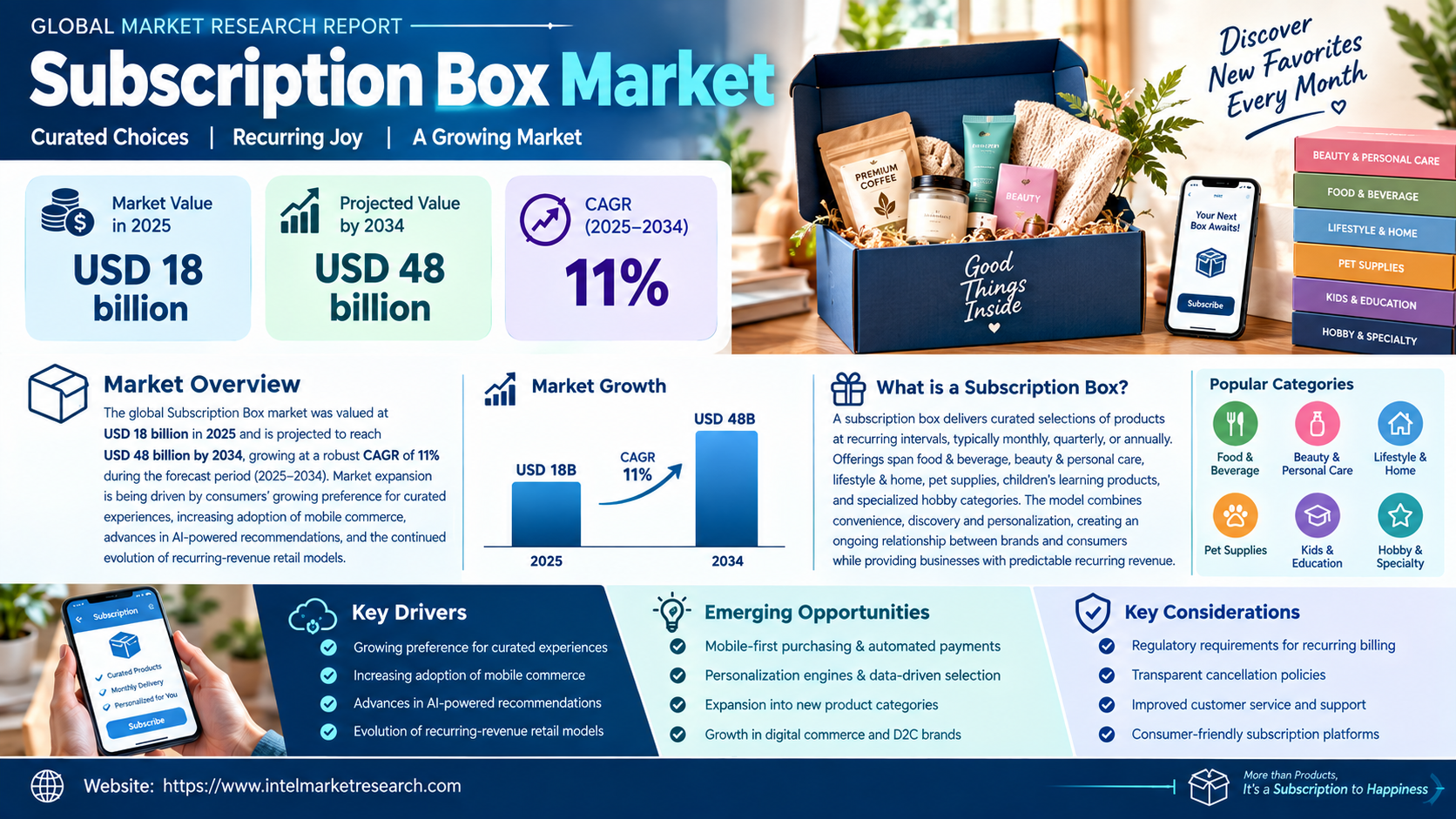
According to a new report from Intel Market Research, the global Subscription Box Market was valued at USD 18 billion in 2025 and is projected to reach USD 48 billion by 2034, growing at a robust CAGR of 11% during the forecast period (2025–2034). Market expansion is being driven by consumers’ growing preference for curated experiences, increasing adoption of mobile commerce,...
Moving to a new home is a major task that requires proper planning, organization, and professional support. Shifting household belongings such as furniture, appliances, electronics, and personal items involves several activities, including packing, loading, transportation, unloading, and arranging goods at the new location. Without proper experience, the entire process can become...

