


Analog Semiconductor Industry Set for 6.3% CAGR Through 2034
Analog Semiconductor Industry to Reach USD 187.9 Billion by 2034
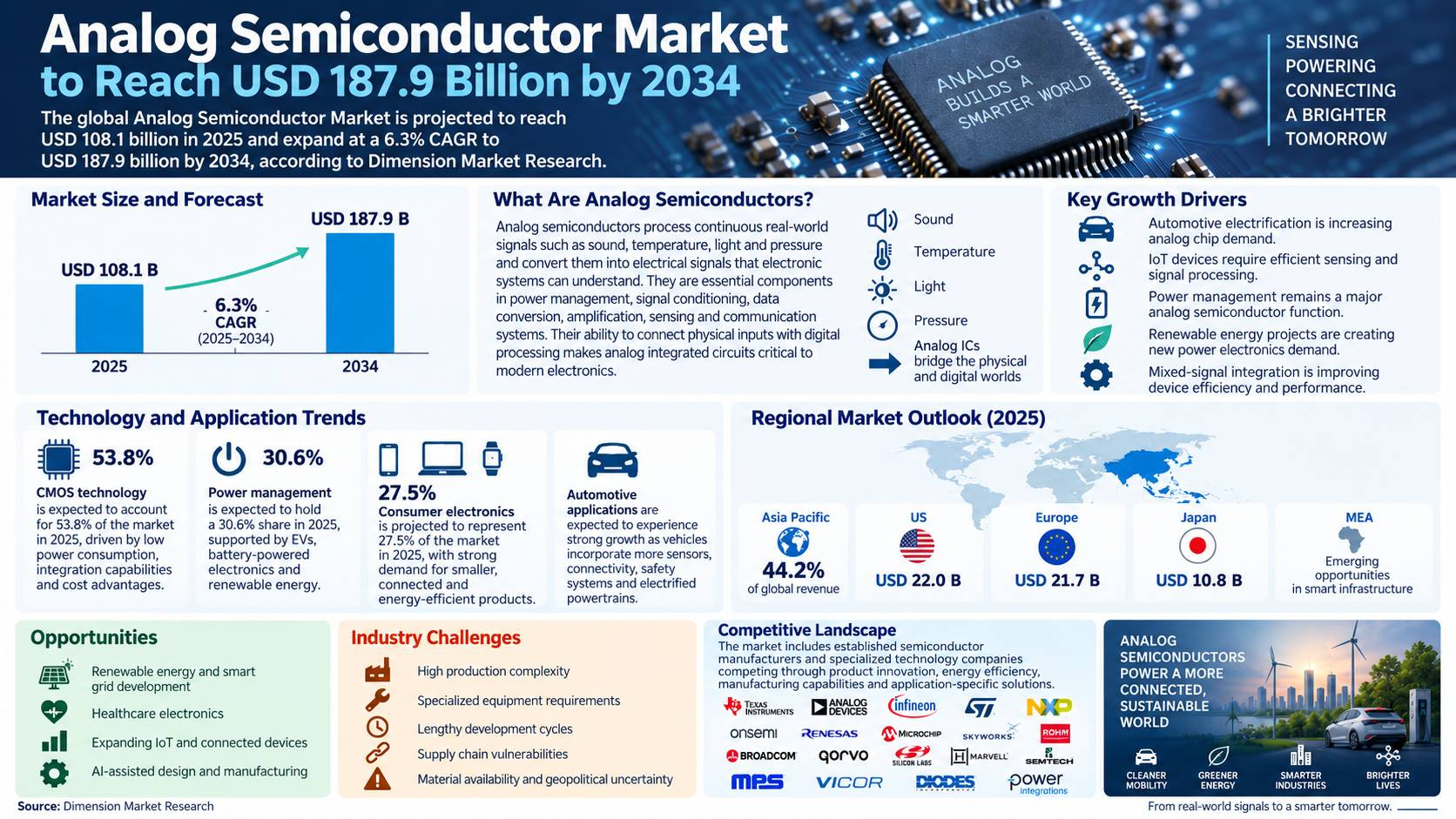
The global Analog Semiconductor Industry is projected to reach USD 108.1 billion in 2025 and expand at a 6.3% CAGR to USD 187.9 billion by 2034, according to Dimension Market Research. Increasing demand for electric vehicles, consumer electronics, industrial automation, connected devices, telecommunications infrastructure and energy-efficient power systems is creating new growth opportunities across the analog semiconductor industry.
Analog semiconductors process continuous real-world signals such as sound, temperature, light and pressure and convert them into electrical signals that electronic systems can understand. They are essential components in power management, signal conditioning, data conversion, amplification, sensing and communication systems. Their ability to connect physical inputs with digital processing makes analog integrated circuits critical to modern electronics.
Analog Semiconductor Industry Growth Drivers
The market is benefiting from the increasing electronic content of vehicles, connected consumer products and industrial systems. Electric and hybrid vehicles require analog semiconductor components for battery monitoring, motor control, power conversion, sensor interfaces and advanced driver assistance systems.
Consumer electronics is another major demand center. Smartphones, laptops, wearables, smart appliances and IoT devices depend on analog chips for audio, display, charging, power management and signal conversion. Growing demand for smaller, connected and energy-efficient products is encouraging semiconductor manufacturers to develop compact and low-power solutions.
- Automotive electrification is increasing analog chip demand.
- IoT devices require efficient sensing and signal processing.
- Power management remains a major analog semiconductor function.
- Renewable energy projects are creating new power electronics demand.
- Mixed-signal integration is improving device efficiency and performance.
Get free sample data of the report - https://dimensionmarketresearch.com/request-sample/analog-semiconductor-market/
Technology and Application Trends
The increasing integration of analog and digital functions is one of the key trends shaping the industry. Mixed-signal semiconductor solutions can reduce component count, size and power consumption while improving system performance. This trend is particularly relevant to consumer electronics, automotive electronics, industrial automation and connected devices.
CMOS technology is expected to maintain a leading position, accounting for 53.8% of the market in 2025. Its low power consumption, integration capabilities and cost advantages make it suitable for increasingly compact electronic systems.
Power management is also expected to remain a significant device function, with a 30.6% share in 2025. Demand is being supported by electric vehicles, battery-powered electronics, renewable energy systems and industrial equipment.
Consumer electronics represents another important application, accounting for 27.5% of the market in 2025. Automotive applications are expected to experience strong growth as vehicles incorporate more sensors, connectivity, safety systems and electrified powertrains.
Regional Analog Semiconductor Industry Outlook
Asia Pacific is the leading regional market, representing 44.2% of global revenue in 2025. Strong semiconductor manufacturing capabilities, consumer electronics production, automotive demand and telecommunications investment support the region's position. China, Japan, South Korea and Taiwan remain important centers for semiconductor production and technology development.
The US Analog Semiconductor Industry is projected to reach USD 22.0 billion in 2025, supported by technology innovation, semiconductor research, advanced manufacturing and strong demand across automotive, industrial and communications applications.
Europe is projected to reach USD 21.7 billion in 2025, with automotive electronics, industrial automation, energy efficiency and renewable energy supporting market development.
Japan is projected to reach USD 10.8 billion in 2025, while its analog semiconductor industry benefits from precision manufacturing, automotive electronics, robotics and advanced consumer devices.
- Asia Pacific leads with a 44.2% revenue share.
- US market value is projected at USD 22.0 billion in 2025.
- Europe is projected to reach USD 21.7 billion in 2025.
- Japan is projected to reach USD 10.8 billion in 2025.
- MEA offers emerging opportunities in smart infrastructure.
Opportunities and Industry Challenges
Renewable energy and smart grid development are opening new opportunities for analog semiconductor manufacturers. Power conversion, voltage regulation, energy monitoring and storage systems all require efficient analog components. Healthcare electronics is another promising area, with medical monitors, diagnostic equipment, imaging systems and wearable devices requiring accurate signal processing.
However, manufacturers face challenges including high production complexity, specialized equipment requirements, lengthy development cycles and supply chain vulnerabilities. Material availability, geopolitical uncertainty and capacity constraints can also affect production costs and delivery schedules.
Artificial intelligence is emerging as another important influence. AI-assisted design can accelerate analog circuit development, while AI-driven manufacturing analytics can help identify defects, improve yields and optimize production processes.
Analog Semiconductor Industry Competitive Landscape
The competitive environment includes established semiconductor manufacturers and specialized technology companies competing through product innovation, energy efficiency, manufacturing capabilities and application-specific solutions. Major companies include Texas Instruments, Analog Devices, Infineon Technologies, STMicroelectronics, NXP Semiconductors, onsemi, Renesas Electronics, Microchip Technology, Skyworks Solutions, ROHM Semiconductor, Broadcom, Qorvo, Silicon Labs, Marvell Technology, Semtech, Monolithic Power Systems, Vicor, Diodes Incorporated and Power Integrations.
The market is also seeing innovation in analog IC design automation and AI-assisted semiconductor development, which could help shorten design cycles and accelerate the introduction of specialized analog solutions.
Report Also Cover
What is the Analog Semiconductor Industry size?
The global Analog Semiconductor Industry is projected to reach USD 108.1 billion in 2025 and USD 187.9 billion by 2034, expanding at a 6.3% CAGR during the forecast period.
What is driving the Analog Semiconductor Industry?
Electric vehicles, consumer electronics, IoT devices, industrial automation, telecommunications, renewable energy and advanced power management are major market growth drivers.
Which region leads the Analog Semiconductor Industry?
Asia Pacific leads the global market, accounting for an estimated 44.2% revenue share in 2025 due to its manufacturing ecosystem and strong electronics demand.
What is the US Analog Semiconductor Industry size?
The US Analog Semiconductor Industry is projected to reach USD 22.0 billion in 2025, supported by semiconductor innovation, advanced manufacturing and technology demand.
Which technology leads the market?
CMOS is expected to lead the technology segment with a 53.8% share in 2025, supported by its power efficiency, integration capabilities and cost advantages.
Which application holds the largest share?
Consumer electronics is projected to hold the largest application share at 27.5% in 2025, supported by demand for smartphones, laptops, wearables and connected devices.
Why are electric vehicles important to analog semiconductors?
Electric vehicles require analog components for battery management, power conversion, motor control, sensor interfaces and safety systems, increasing semiconductor content per vehicle.
What opportunities exist in renewable energy?
Solar, wind, energy storage and smart grid projects require analog components for power conversion, voltage regulation, monitoring and energy management.
Who are the major analog semiconductor companies?
Leading companies include Texas Instruments, Analog Devices, Infineon Technologies, STMicroelectronics, NXP Semiconductors, onsemi, Renesas and Microchip Technology.
What does the Analog Semiconductor Industry report cover?
The report covers market size, forecast, growth drivers, restraints, opportunities, trends, technology, device function, applications, end-user industries, regional markets and competitive analysis.
Similar reports:
About Us
Dimension Market Research (DMR) is a global market intelligence and consulting firm delivering data-driven insights that help organizations make informed strategic decisions. With expertise across 12+ industries and global markets, DMR provides syndicated reports, custom research, competitive analysis, white space analysis, and business strategy consulting.
Our research solutions combine analytical rigor, industry expertise, and forward-looking intelligence to identify opportunities, reduce risks, and support sustainable growth. Trusted by clients across diverse sectors, DMR is committed to delivering accurate, actionable insights that enable businesses to navigate evolving market landscapes with confidence.
Contact Us
Phone USA: +17323699777
Phone India: +919310023843
E-mail: enquiry@dimensionmarketresearch.com
Address USA: 957 Route 33, Suite 12 #308, Hamilton Square, NJ-08690
Address India: D44, Sector 6, Noida 201301, India
Categories
- Artificial Intelligence (AI)
- Technology
- Business
- Education
- Science
- Lifestyle
- Healthcare
- Entertainment
- Politics
- Environment
- Travel
- Finance
- Automobile
- News
- Art
- Causes
- Crafts
- career
- Dance
- Drinks
- Film
- Fitness
- Food
- Games
- Gardening
- Health
- Home
- Literature
- Music
- Networking
- Other
- Party
- Religion
- Shopping
- Sports
- Theater
- Wellness
Read More
Intel Market Research has released a comprehensive analysis of the global Short‑Throw Dual‑Action Polisher Market. The market was valued at USD 758 million in 2025 and is projected to reach USD 1,110 million by 2034, exhibiting a CAGR of 5.7% during the forecast period. A short‑throw dual‑action polisher is an electric polishing tool designed for grinding and polishing automotive paint, metal...

The Foley Catheters Market is expanding steadily as healthcare providers increasingly require reliable urinary drainage solutions for patients undergoing surgery, experiencing urinary disorders, or requiring long-term urinary management. According to Market Research Future, the market was valued at USD 1.79 billion in 2024 and is projected to reach approximately USD 3.17 billion by 2035,...
The United States dominates the 3D Ultrasound Market due to its well established healthcare ecosystem, strong focus on early disease detection, and widespread availability of advanced diagnostic imaging equipment. Rising demand for minimally invasive diagnostic procedures, increasing awareness of maternal and fetal health, and expanding use of 3D ultrasound in cardiology, radiology, and...
Traveling to or from the airport should feel comfortable from the moment you leave home. A professional chauffeur service offers dependable transportation, comfortable vehicles, and a smooth travel experience that removes the stress of driving and parking. Choosing Baltimore Airport Car Service allows travelers to enjoy reliable transportation for business trips, vacations, and special...

The Intranasal Mucosal Atomization Device Market is expanding as healthcare providers increasingly adopt non-invasive drug delivery technologies. Intranasal mucosal atomization devices convert liquid medication into a fine mist that can be administered through the nasal passage, offering a convenient alternative to certain conventional delivery methods. The market is supported by increasing...
