


DOT 3 vs DOT 4 Brake Fluid: Technical Comparison for Manufacturers and Distributors
Brake fluid is one of the essential fluids used in automotive braking systems. It works within a closed hydraulic circuit to transfer pressure from the brake pedal to the braking components. Since braking systems can experience significant temperature changes, the fluid needs to maintain stable performance under demanding conditions.
Among the commonly specified brake-fluid classifications, DOT 3 and DOT 4 are widely used in automotive applications. Both are generally glycol-based fluids, but they have different performance requirements, particularly in relation to boiling temperature. For manufacturers, distributors, workshops, and automotive suppliers, understanding these differences is useful when selecting, producing, or supplying brake fluid.
The correct specification should always be determined according to the vehicle manufacturer's requirements. A higher DOT classification should not automatically be treated as a suitable replacement for another specification.
DOT 3 Specifications
DOT 3 brake fluid is a well-established option for hydraulic braking systems. It is generally formulated from glycol ethers and includes additives that help provide corrosion protection, chemical stability, and compatibility with components used in braking systems.
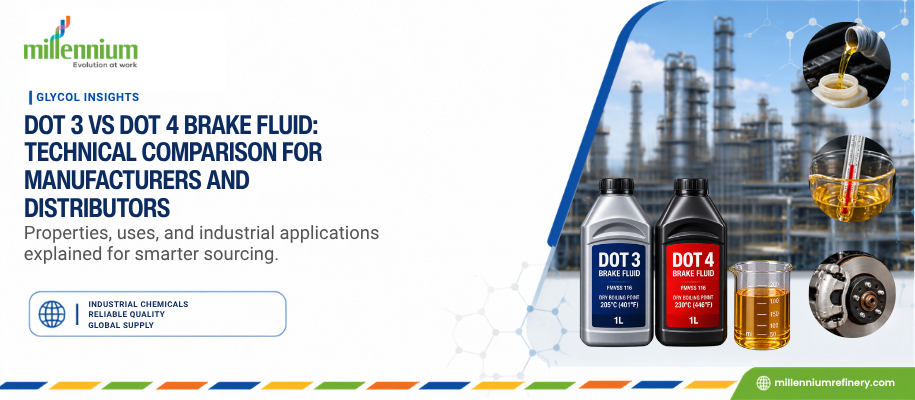
One of the main characteristics considered when evaluating DOT 3 is its boiling-point performance. The applicable specification requires a minimum dry boiling point of approximately 205°C and a minimum wet boiling point of approximately 140°C.
The dry boiling point represents the temperature performance of the fluid in its unused condition, while the wet boiling point considers the effects of moisture absorption. This distinction is important because glycol-based brake fluids are hygroscopic and can absorb water from the atmosphere.
As moisture content increases, the boiling point can decrease. For vehicles operating under normal driving conditions, DOT 3 can provide suitable performance when maintained properly. However, fluid condition should be monitored because prolonged service and moisture exposure can influence performance.
For manufacturers, consistent raw-material quality, additive selection, viscosity control, and corrosion protection are important factors in producing dependable DOT 3 brake fluid.
DOT 4 Specifications
DOT 4 brake fluid is also designed for hydraulic braking systems but has higher minimum boiling-point requirements than DOT 3. This makes it suitable for applications where braking systems may experience greater thermal stress.
The minimum dry boiling point for DOT 4 is approximately 230°C, while the minimum wet boiling point is approximately 155°C under the applicable specification. The increased boiling-point requirement provides additional thermal margin when compared with DOT 3.
A quality dot 4 brake fluid formulation may contain additives that support corrosion resistance, oxidation stability, and compatibility with various braking-system materials. Manufacturers need to carefully control formulation and testing to ensure that the finished product meets the required performance characteristics.
DOT 4 is commonly used in various passenger and commercial vehicles, depending on the specification provided by the vehicle manufacturer. Its higher thermal performance can be beneficial in applications involving frequent braking, heavier loads, or elevated brake-system temperatures.
For distributors, proper packaging is particularly important. Brake fluid should be stored in tightly sealed containers because exposure to atmospheric moisture can gradually affect its properties.
Technical Comparison
The primary difference between DOT 3 and DOT 4 is their required boiling-point performance. DOT 4 has higher minimum dry and wet boiling points, giving it greater resistance to high-temperature conditions.
However, boiling point is not the only factor manufacturers should consider. Viscosity, corrosion resistance, chemical stability, material compatibility, and additive performance are also important when developing or evaluating brake fluids.
Moisture management is another shared consideration. Since both DOT 3 and DOT 4 can absorb moisture, proper storage and handling are necessary throughout the supply chain. Containers should remain closed until the product is ready for use.
The service environment can also influence product selection. A vehicle operating mainly under ordinary conditions may have different requirements from one exposed to repeated heavy braking or high operating temperatures.
It is also important to avoid assuming that DOT 4 can always replace DOT 3. Brake systems are designed with specific fluid requirements, and manufacturers may specify particular fluid standards based on seals, hoses, valves, and other components.
For automotive-fluid distributors, technical documentation can help customers make the correct selection. Product specifications, technical data sheets, safety information, batch details, and storage instructions provide useful information for buyers.
Industrial Applications
Brake fluid is supplied across several sectors of the automotive industry. Manufacturers produce fluids for vehicle manufacturers, aftermarket suppliers, service centers, workshops, fleet operators, and distributors.
DOT 3 can be used in braking systems designed for its specification and performance range. It remains relevant for various conventional automotive applications where the vehicle manufacturer specifically recommends it.
DOT 4 is used across a wider range of applications where its higher boiling-point requirements are specified. These can include passenger vehicles, commercial vehicles, fleet operations, and other automotive systems requiring suitable thermal performance.
For distributors, maintaining different brake-fluid specifications allows them to meet the requirements of a broader customer base. Clear product identification is essential because customers need to distinguish between different specifications before purchasing.
Packaging size can also vary depending on the target market. Smaller containers may be suitable for workshops and aftermarket customers, while larger packaging can be considered for industrial buyers and bulk distributors.
Quality assurance is another important aspect of brake-fluid distribution. Suppliers should maintain consistent manufacturing standards and provide appropriate technical documentation. Proper transportation and storage can help protect the product from contamination and moisture exposure.
Businesses interested in exploring brake-fluid products and related automotive solutions can click here for additional information. Customers can also visit website to learn about product specifications, packaging options, and supply capabilities. For further technical information and application details, read more about the available solutions.
Conclusion
DOT 3 and DOT 4 brake fluids are both important products for hydraulic braking systems, but they are designed around different performance requirements. DOT 3 offers a suitable solution for applications specified for its classification, while DOT 4 provides higher minimum boiling-point performance for systems requiring greater thermal capability.
For manufacturers, reliable formulation, testing, additive selection, corrosion protection, and material compatibility are essential. Distributors should focus on correct labeling, sealed packaging, documentation, storage, and customer guidance.
Rather than selecting a brake fluid based only on its DOT number, buyers should follow the vehicle or equipment manufacturer's recommendations. Understanding the differences between DOT 3 and DOT 4 allows manufacturers and distributors to supply the appropriate product for each application while supporting consistent braking-system performance.
Categories
- Artificial Intelligence (AI)
- Technology
- Business
- Education
- Science
- Lifestyle
- Healthcare
- Entertainment
- Politics
- Environment
- Travel
- Finance
- Automobile
- News
- Art
- Causes
- Crafts
- career
- Dance
- Drinks
- Film
- Fitness
- Food
- Games
- Gardening
- Health
- Home
- Literature
- Music
- Networking
- Other
- Party
- Religion
- Shopping
- Sports
- Theater
- Wellness
Read More
Airport Surveillance Radar Size is influenced by airport modernization, increasing air traffic, safety requirements, and investments in advanced surveillance infrastructure. Industry studies identify primary and secondary surveillance radar as important technology segments, while airport applications include air traffic control, surveillance, and related airport operations. Increasing Air...

Radiofrequency (RF) skin rejuvenation devices are innovative cosmetic technologies that use precisely controlled radiofrequency energy to heat the deeper layers of the skin, stimulating natural collagen and elastin production. This non-surgical treatment helps reduce fine lines and wrinkles, improve skin firmness, tighten loose skin, minimize acne scars, and enhance overall skin texture and...

Erosion Sediment Control Market Overview The Erosion Sediment Control Market Report is a comprehensive and meticulously developed research study designed to provide in-depth insights into the evolving dynamics of the Erosion Sediment Control market. Prepared through extensive primary interviews, secondary research, and detailed data analysis, this report evaluates critical factors...
NOHU: Điểm Đến Giải Trí Số Hiện Đại Với Tiêu Chuẩn Quốc Tế Sự phát triển mạnh mẽ của công nghệ di động và internet đã mở ra một kỷ nguyên mới cho các hình thức giải trí trực tuyến. Giữa bối cảnh thị trường ngày càng phong phú, người dùng không chỉ tìm kiếm một địa chỉ để giải tỏa căng...

According to the latest report published by Data Bridge Market Research, the Powder Coatings Market The global powder coatings market size was valued at USD 16.26 billion in 2025 and is expected to reach USD 25.16 billion by 2033, at a CAGR of 5.61% during the forecast period. This Powder Coatings Market research report is a comprehensive synopsis...

