

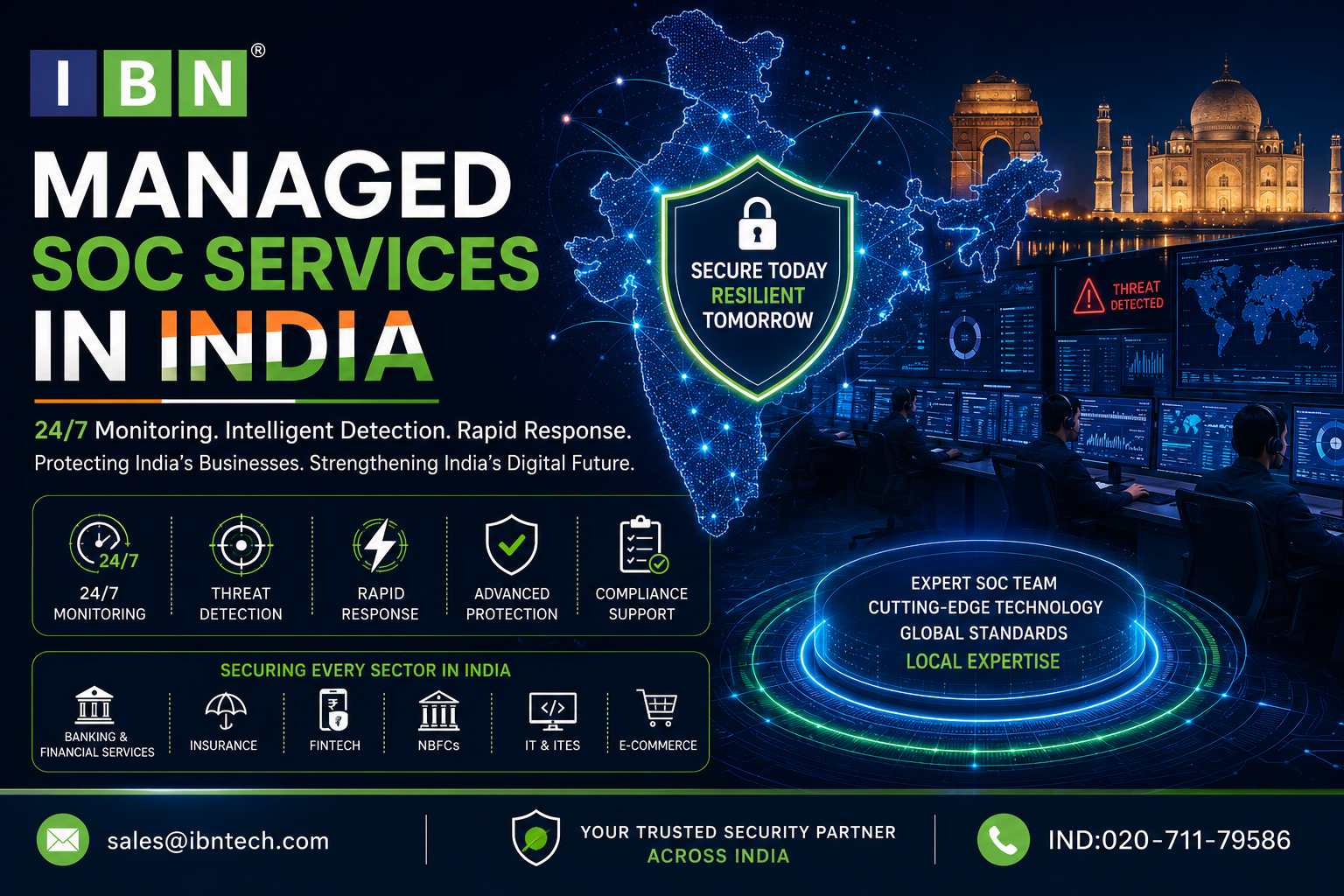

Managed SOC Services in India: How IT Teams Can Strengthen Security Operations
Modern IT environments are no longer limited to traditional office networks and on-premises infrastructure. Applications, cloud workloads, endpoints, identities, business systems, and remote access have created a broader security environment that needs continuous visibility. For many organizations, managed soc services in india provide a way to strengthen security monitoring without requiring every SOC function to be built and operated internally.
The focus is not simply on watching alerts. Effective managed security operations connect monitoring, analysis, escalation, and response processes so that important security events receive appropriate attention.
Why Managed SOC Services in India Matter for IT Businesses
Managed SOC services in India provide outsourced security operations that help organizations monitor security events, identify suspicious activity, investigate alerts, and escalate potential incidents according to defined processes.
For IT businesses, continuous monitoring is increasingly important because security events can occur outside normal working hours. An organization may have strong security tools in place, but those tools still generate events that require analysis and prioritization.
An external SOC model can provide additional operational support while allowing internal IT teams to focus on infrastructure, applications, users, and business technology.
The value becomes clearer when security monitoring is viewed as an ongoing operational responsibility rather than a one-time technology deployment.
How Managed SOC Services Support IT Security Operations
An IT environment can generate a large amount of security-related information. Endpoint activity, authentication events, network traffic, cloud activity, and other sources can contribute to the overall security picture.
A managed SOC helps bring these signals into a structured monitoring process.
Security analysts can review alerts, investigate unusual activity, correlate relevant information, and determine whether an event requires escalation. This creates a layer between raw security data and an organization's response process.
The approach also helps establish consistency. Instead of responding to security events differently depending on who happens to notice them, organizations can define procedures for classification, investigation, escalation, and documentation.
Where Managed SOC Services Fit Into the IT Operating Model
The decision to use managed soc services does not necessarily mean transferring every security responsibility to an external team. IT organizations can structure responsibilities according to their internal capabilities and security requirements.
An external SOC may handle continuous monitoring and initial alert analysis, while internal teams retain responsibility for business systems, infrastructure changes, access decisions, or remediation.
This division can be particularly useful when an IT department has security tools but limited capacity to continuously investigate the resulting alerts.
A clearly defined operating model should explain who monitors, who investigates, who approves response actions, and who communicates during significant incidents.
When these responsibilities are documented in advance, security teams can spend less time determining ownership during an active event.
Why Traditional or DIY Monitoring Can Fall Short
Building an internal security operation requires more than purchasing a SIEM platform or adding security tools. Organizations also need skilled personnel, defined processes, appropriate monitoring coverage, escalation procedures, and continuous maintenance.
One common difficulty is alert fatigue. When monitoring generates numerous events, analysts may struggle to separate routine activity from events that deserve deeper investigation.
Another issue is coverage. Internal teams may have strong visibility during business hours but limited resources for continuous monitoring.
There is also the challenge of maintaining detection logic as the IT environment changes. New applications, cloud services, endpoints, and access patterns can change what normal activity looks like.
A managed SOC model can address some of these operational challenges by providing dedicated security monitoring and established processes.
What IT Businesses Should Evaluate Before Choosing a Service
The quality of a SOC arrangement depends heavily on how well the service fits the organization's environment.
IT leaders should examine the scope of monitoring, available escalation processes, communication methods, reporting practices, and responsibilities between internal and external teams.
The technology layer also matters. The organization should understand what security data can be monitored and how alerts are investigated.
Equally important is operational transparency. Security teams should know how incidents are categorized, what triggers escalation, and what information will be shared with internal stakeholders.
A service should support the organization's security objectives rather than simply increase the number of alerts being monitored.
What Effective Managed SOC Services Should Enable
A practical SOC operating model should help an IT business achieve several outcomes:
- Continuous visibility into relevant security events
- More structured alert prioritization
- Faster identification of potentially significant activity
- Clear escalation between security and IT teams
- Consistent incident investigation processes
- Better documentation of security events
- Regular reporting for security and management teams
- Ongoing improvement of monitoring coverage
These outcomes are more meaningful than measuring the service only by the volume of alerts processed.
A Practical IT Security Use Case
Consider an IT company with employees accessing business applications from multiple locations while workloads operate across different technology environments.
An unusual login may initially appear to be a routine authentication event. However, additional activity could change its significance. For example, related endpoint activity, access attempts, or unusual system behavior may provide useful context.
A structured SOC process can bring these signals together for investigation.
The analyst can then determine whether the event appears routine, requires monitoring, or should be escalated for further action.
This illustrates an important principle: security monitoring is most valuable when individual events are evaluated in context rather than viewed in isolation.
Building Better Monitoring Practices
A sustainable SOC environment requires regular review. IT environments change continuously, and security monitoring must evolve with them.
Organizations should periodically examine whether important systems are being monitored, whether alerts remain relevant, and whether escalation procedures still match operational responsibilities.
Detection rules should also be reviewed to identify unnecessary noise and improve useful coverage.
Internal teams should understand how to interact with the SOC. A technically capable monitoring function can still struggle if IT administrators do not know when or how to respond to escalated events.
Clear communication therefore becomes part of security effectiveness.
Compliance and Governance Considerations in India
Security monitoring also needs to operate within an organization's broader governance framework.
Indian businesses may have contractual, regulatory, data protection, and information-security obligations depending on their operations and the systems they manage. Monitoring practices should therefore be aligned with applicable organizational requirements.
Security logs and incident records can also contribute to accountability by creating a documented record of security activity and response processes.
For IT organizations, governance should not be treated as a separate activity from SOC operations. Monitoring objectives, access controls, incident handling, reporting, and evidence management should work together as part of the broader security framework.
Making Security Operations More Sustainable
The purpose of managed SOC services in India is not simply to add another security layer. The broader objective is to create a sustainable operating model for continuous security monitoring.
For IT businesses, this can be valuable when internal teams need stronger visibility but do not want every monitoring responsibility to sit with already-busy infrastructure or security personnel.
A well-structured service can complement existing technology and internal expertise by providing continuous monitoring, investigation, and escalation capabilities.
As IT environments continue to become more distributed and interconnected, security operations need to remain equally adaptable. Managed SOC services in India can support that objective by connecting security technology with defined processes and human analysis.
IBN Technologies LLC provides SIEM & SOC, VAPT, MDR, vCISO, and Microsoft Security services to help organizations strengthen their cybersecurity and security operations approach.
Contact Us:
IND- 02067680404
IBN Technologies Ltd.
E-mail: - sales@ibntech.com

