

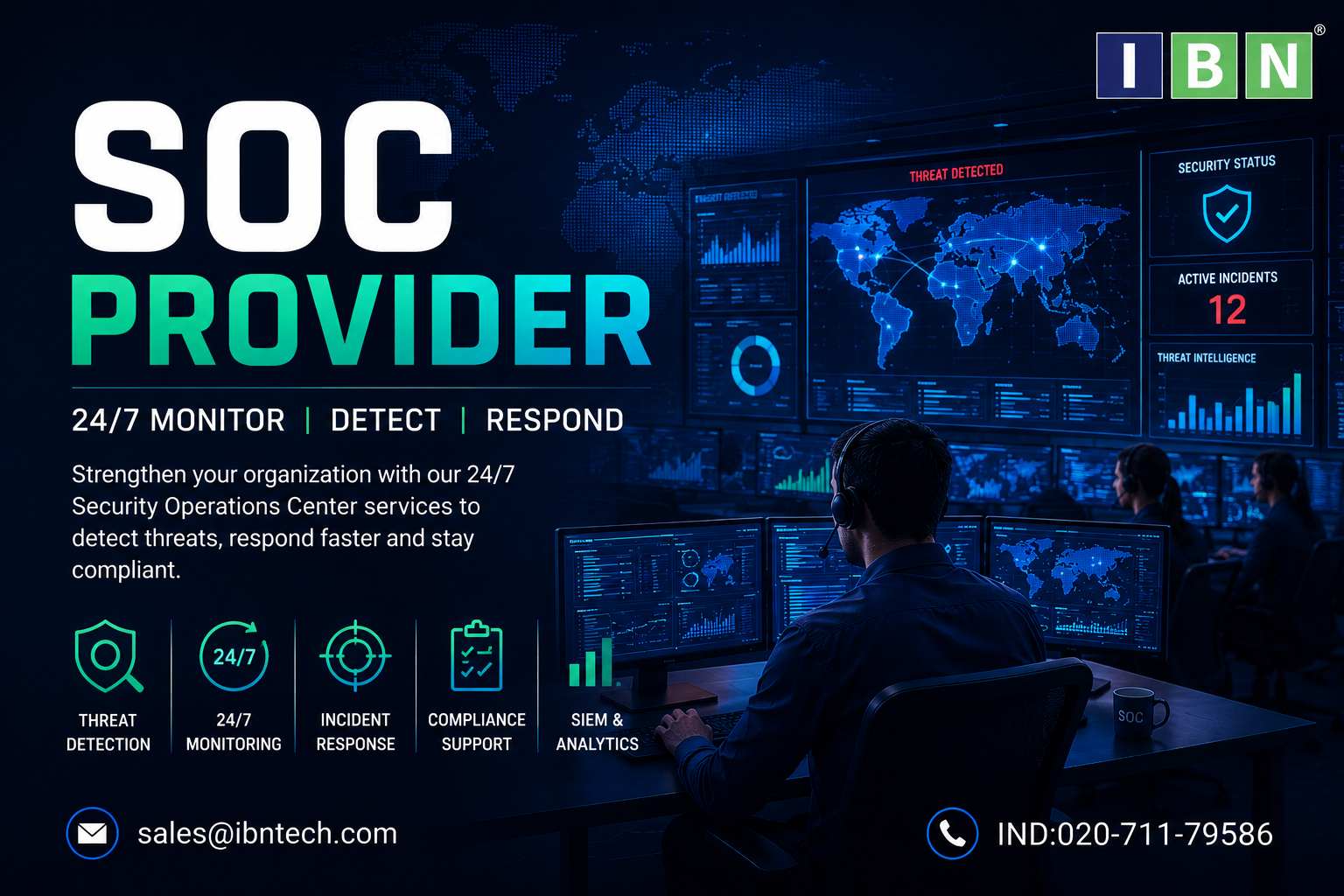

How IT Businesses Can Choose SOC Providers That Fit Their Security Needs
IT businesses operate in environments where applications, cloud platforms, endpoints, networks, databases, and business systems are constantly connected. That connectivity supports productivity and digital services, but it also creates a broad security surface that needs continuous attention.
A suspicious login, unusual endpoint behaviour, unexpected network connection, or abnormal application activity can be difficult to assess when security information is spread across different tools.
This is where soc providers can play an important role. They help organisations establish structured security operations for monitoring, threat detection, event analysis, investigation, reporting, and incident response.
For Indian IT businesses, the challenge is not simply finding a security company that can monitor alerts. The more important task is identifying a provider whose monitoring approach, technology, response processes, and service scope fit the organisation's actual environment.
What SOC Providers Bring to Modern IT Security
SOC providers support security operations by helping organisations continuously monitor relevant technology environments and investigate activity that may indicate a security concern.
In simple terms, a Security Operations Center combines people, processes, and security technology to identify suspicious activity, analyse security events, and coordinate appropriate responses.
For an IT business, this can mean bringing together security information from endpoints, networks, applications, cloud environments, and other relevant systems.
A SOC is not simply another security tool. It is an operating function that helps turn security information into actionable information.
That distinction matters because an organisation can have multiple security products while still lacking a coordinated process for reviewing what those products are reporting.
How SOC as a Service Providers Support IT Businesses
Soc as a service providers can deliver security monitoring and related SOC capabilities through an outsourced service model.
This approach can be useful for IT organisations that have internal technology teams but do not want every security monitoring responsibility to sit with those teams.
An internal IT team may already be responsible for infrastructure, application support, cloud administration, user management, system availability, and technology projects. Adding continuous security monitoring can increase the operational burden.
A SOC as a service model can provide dedicated monitoring capabilities while internal teams continue to manage their core technology responsibilities.
The exact scope can vary according to business requirements. It may include security monitoring, threat detection, SIEM operations, investigation, incident response support, reporting, and threat intelligence.
The important consideration is whether the service is aligned with the organisation's environment and responsibilities.
Why IT Environments Create Security Blind Spots
IT businesses often operate across multiple technology layers.
An organisation might have workloads running in cloud environments while maintaining on-premises infrastructure. Employees may access applications from different locations and devices. Development teams may use separate platforms from corporate IT teams.
Each environment can generate security events.
The problem begins when these events are examined in isolation.
For example, an unusual authentication event might not immediately indicate a serious problem. When combined with suspicious endpoint activity or unexpected access to another system, however, it may become more significant.
Security monitoring needs context.
A SOC can help collect and analyse relevant events so that security teams have a broader view of what is happening across the environment.
This can make investigation more systematic and help teams focus attention on events that require further analysis.
Why DIY Security Monitoring Can Become Difficult
Building an internal SOC can provide an organisation with direct control over its security operations, but it also involves ongoing operational requirements.
The organisation needs suitable security technology, monitoring processes, skilled personnel, alert-handling procedures, escalation workflows, reporting mechanisms, and continuous operational coverage.
The challenge is not limited to implementing the technology.
Security teams also need to maintain the monitoring environment as infrastructure changes.
New applications, cloud resources, endpoints, integrations, and network components can introduce additional security information that needs to be incorporated into the monitoring process.
For growing IT businesses, maintaining this level of operational consistency can become difficult alongside everyday technology responsibilities.
An external SOC service can provide additional operational capacity without requiring the organisation to build every component internally.
What to Evaluate Before Choosing a SOC Provider
IT businesses should start the evaluation process by understanding their own security environment.
The first consideration is monitoring coverage.
Which systems need to be monitored? Are cloud environments included? What about endpoints, applications, network infrastructure, and authentication systems?
The next consideration is alert handling.
A provider should have a clear process for reviewing, prioritising, and investigating security events.
Response responsibilities should also be defined.
If an important security event is detected, the organisation should know who receives the notification, who investigates the incident, what actions the provider can take, and what remains the responsibility of the internal team.
Reporting is another important area.
Technical teams may need detailed incident information, while business leaders may need concise visibility into significant security activity and trends.
Finally, IT businesses should consider how the service will adapt as their technology environment grows.
IT SOC Provider Evaluation Checklist
- Identify all technology environments that require monitoring.
- Determine which applications and systems generate important security events.
- Confirm whether cloud, on-premises, and hybrid environments can be monitored.
- Understand how alerts are prioritised and investigated.
- Review incident escalation procedures.
- Clarify provider and internal team responsibilities.
- Confirm available security reporting.
- Understand how new systems are added to monitoring.
- Review the provider's approach to continuous security monitoring.
- Establish a process for reviewing SOC coverage as the business changes.
SIEM and the SOC Work Together
Security Information and Event Management technology is commonly used within security operations to centralise and analyse security information.
For IT businesses, SIEM can help collect relevant logs and events from different technology sources.
Centralised analysis can make it easier to identify relationships between events.
For example, an authentication event may become more meaningful when it is associated with unusual activity from an endpoint or application. Correlation can help provide the additional context needed for investigation.
However, SIEM alone does not constitute a complete SOC.
The platform provides technology for collecting and analysing security information. The SOC provides the operational processes needed to monitor, investigate, prioritise, escalate, and respond to relevant events.
IT organisations should therefore evaluate both the technology and the operational service supporting it.
Continuous Monitoring Helps Reduce Security Gaps
IT environments do not operate only during traditional office hours.
Applications, cloud platforms, networks, and business systems may remain active continuously. Security events can therefore occur at any time.
Continuous monitoring provides a structured mechanism for reviewing security activity beyond a limited working window.
The purpose is not to guarantee that every threat will be detected.
Instead, it creates an ongoing process for identifying suspicious activity and determining which events require investigation or escalation.
For organisations with limited internal security capacity, this can provide an additional layer of operational support.
Incident Response Needs Clear Ownership
A SOC can identify and investigate a security event, but effective response requires coordination.
Suppose suspicious activity is detected on an employee endpoint. The SOC may investigate the event and escalate it to the organisation's internal team.
The internal team may then need to review the endpoint, account, application, or network environment and decide what action is appropriate.
The exact responsibilities depend on the agreed service model.
What matters is that ownership is established before an incident occurs.
IT businesses should define escalation channels, notification procedures, response responsibilities, and documentation requirements as part of their SOC operating model.
Clear ownership can help prevent delays caused by uncertainty during an actual incident.
Supporting Security Governance in India
Security monitoring is also connected to broader governance and compliance responsibilities.
The requirements applicable to an IT business depend on its services, customers, data, technology environment, contractual obligations, and relevant regulations or standards.
A SOC can contribute by providing security monitoring, event visibility, reporting, and incident-related information.
However, organisations should not assume that implementing a SOC automatically satisfies every compliance requirement.
IT businesses should first identify the requirements relevant to their operations and then determine how SOC monitoring and reporting can support those obligations.
This creates a more practical relationship between security operations and wider governance activities.
SOC Services Should Scale With IT Growth
Technology environments rarely remain unchanged.
An IT business may add new cloud workloads, launch applications, expand its workforce, introduce new endpoints, or integrate additional services.
Each change can affect the organisation's security monitoring requirements.
A new system that is not included in the monitoring environment can create a visibility gap.
This makes scalability an important part of SOC evaluation.
The provider should be able to adapt monitoring coverage as the organisation's technology environment evolves.
Security operations should develop alongside the business rather than remain tied to the infrastructure that existed when the service began.
Building a More Consistent Security Operation
The value of a SOC comes from creating a repeatable process around security monitoring.
For IT businesses, this means having a structured approach to collecting relevant security information, analysing events, identifying suspicious activity, investigating potential incidents, escalating important findings, and supporting response activities.
Soc as a service providers can offer additional operational capacity for organisations that need these capabilities without building every SOC function internally.
The right service model will depend on the organisation's technology environment, internal expertise, security requirements, and operational priorities.
For Indian IT businesses, selecting soc providers should therefore be approached as a security operations decision rather than simply a technology purchase. A well-aligned SOC can help create clearer security visibility, more consistent monitoring, and a defined process for responding to activity that requires attention.
Contact Us:
IND- 02067680404
IBN Technologies Ltd.
E-mail: - sales@ibntech.com

