

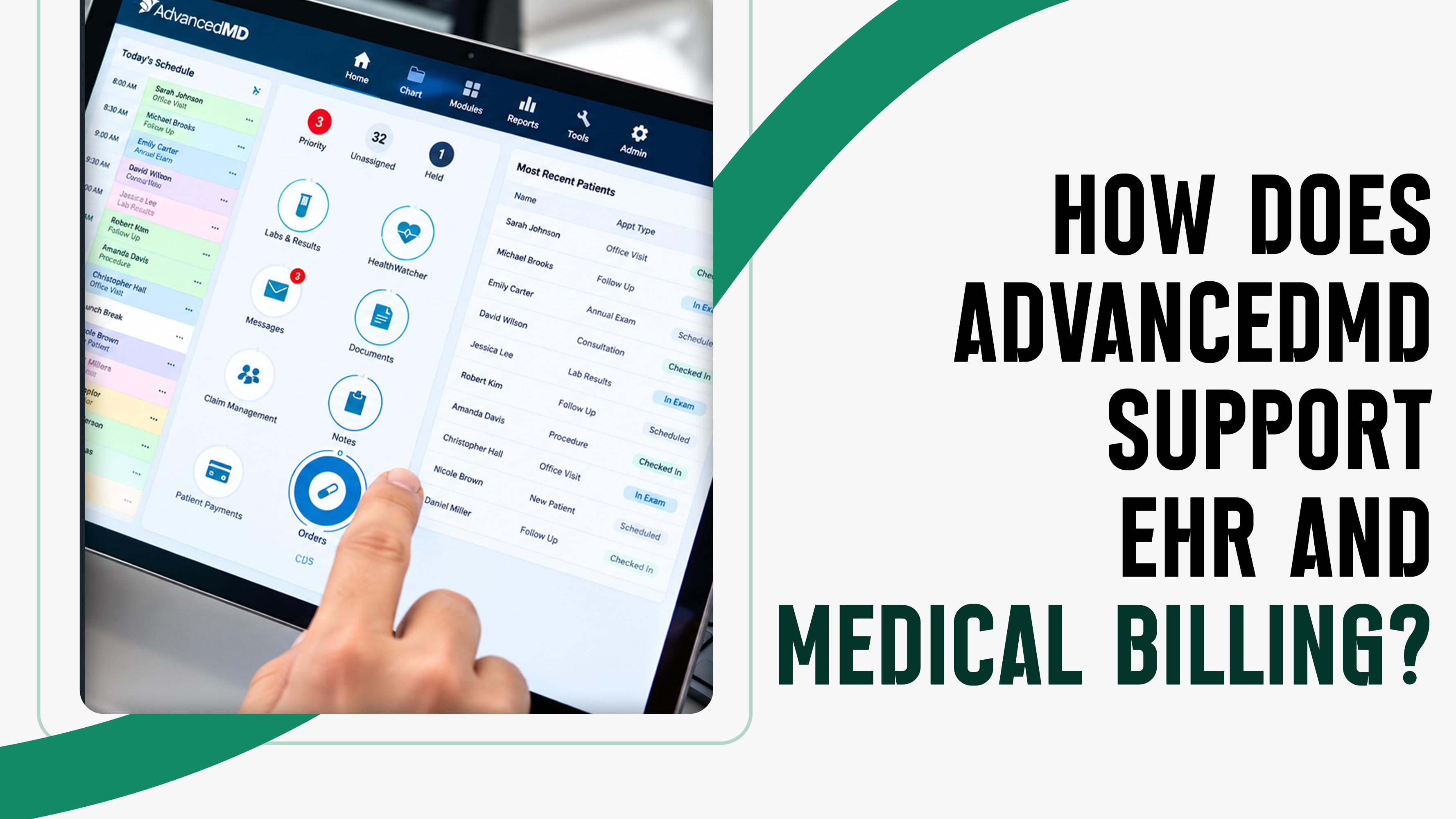

Medical practices need accurate clinical documentation and reliable billing processes to keep daily operations running smoothly. However, EHR and billing are often treated as separate functions. Providers document patient encounters while billing teams later need to collect the right information, assign codes, prepare claims, and follow up on payments.
When information has to move manually between disconnected systems, the process can create duplicate data entry, delays, and opportunities for errors.AdvancedMD takes a different approach by connecting its EHR and billing capabilities within a broader healthcare technology platform. The company describes a workflow in which information can move from scheduling and patient care through coding, claims, reimbursement, and financial reporting.For practices evaluating EMR and EHR software, understanding this connection is important because an EHR should not only document care. It should also support the financial processes that follow a patient encounter.
What Is AdvancedMD?
AdvancedMD is a cloud-based healthcare software platform that combines EHR, practice management, medical billing, patient engagement, revenue cycle management, and reporting capabilities.
Rather than requiring clinical and billing teams to work from completely separate databases, AdvancedMD connects patient, encounter, payer, and financial information across its platform. The company says its billing workflow can access information from the EHR and use it for charge capture and claims processing.
This approach is particularly relevant to independent practices that want to manage clinical and financial processes through a more connected technology environment.
How Does AdvancedMD Connect EHR and Billing?
The connection between EHR and billing begins with the information collected during the patient encounter.
A simplified process looks like this:
Scheduling → Eligibility → Patient Visit → Clinical Documentation → Coding → Charge Capture → Claim → Clearinghouse → Payment → A/R Management
Each stage produces information that can support the next stage.
For example, when a provider completes documentation, billing staff can access the relevant encounter information rather than manually requesting records or entering the same information into another system.
AdvancedMD states that its integrated approach allows charges to move from the EHR into the billing process, helping reduce duplicate data entry.
1. EHR Documentation Creates the Foundation for Billing
The billing process starts with accurate information about the care provided.
The AdvancedMD EHR provides tools for clinical documentation, patient records, prescribing, templates, and other clinical workflows. The information documented during an encounter can then support downstream coding and billing activities.
This connection matters because billing teams need evidence from the clinical record to determine appropriate codes and prepare claims.
AdvancedMD explains that billing and coding teams can access patient chart information, including provider documentation, when working on claims.
Instead of treating the clinical record and billing record as two unrelated datasets, the connected workflow allows billing teams to work from information already captured during care.
2. Charge Capture Can Start Earlier
Charge capture is an important bridge between clinical documentation and billing.
When services are documented, the appropriate charges need to be identified and prepared for the billing process. AdvancedMD states that charges can automatically pass from the EHR and mobile applications into billing, reducing the need for duplicate entry.
This can be particularly useful for practices with high patient volume because manual charge entry can become time-consuming.
The goal is not simply to make billing faster. Accurate charge capture also helps ensure that the services documented during an encounter are properly represented in the financial workflow.
3. Supports Medical Coding
Medical coding transforms clinical information into standardized codes used for claims and reimbursement.
AdvancedMD provides coding tools for CPT and ICD-related workflows. The platform also maintains updated coding information and provides tools that help coding teams find commonly used codes.
Its 2026 Summer Release also introduced computer-assisted coding within the EHR workflow. According to AdvancedMD, the tool can suggest ICD and CPT codes based on clinical documentation, while providers or authorized users retain the ability to review and accept or reject suggestions.
This is an important distinction: automation can assist the coding process, but professional review remains part of the workflow.
4. Insurance Eligibility Verification
Billing problems can begin before a claim is ever submitted.
If insurance information is incomplete or coverage is inactive, the practice may encounter problems later in the revenue cycle.
AdvancedMD provides electronic eligibility verification and has introduced additional functionality for secondary and tertiary insurance verification. Its 2026 Summer Release states that automated verification can help identify coverage before claims are submitted.
For practices, verifying insurance information earlier can help staff identify potential issues before they become billing problems.
This makes eligibility verification an important connection between the front-office process and the eventual billing workflow.
5. Claims Management and Claim Scrubbing
Once coding and charge capture are complete, the next major step is claims submission.
AdvancedMD provides a centralized Claims Center for managing claims-related activities. Its billing technology includes claim-status tracking, worklists, and claim-scrubbing functionality designed to identify potential issues before submission.
Claim scrubbing is important because errors discovered after submission can create additional work for billing staff and delay reimbursement.
By checking claims before they reach the payer, practices can address certain issues earlier in the process.
6. Integrated Clearinghouse
A clearinghouse acts as an important connection between a healthcare provider and insurance payers.
AdvancedMD describes an integrated clearinghouse that supports electronic claim submission and electronic remittance processes. The company states that this reduces the need to manually upload claims and download remittance information.
For billing teams, this can create a more centralized process:
Prepare Claim → Check Claim → Submit Claim → Receive Remittance → Review Payment
Keeping these activities connected can reduce unnecessary manual handling.
7. Helps Manage Denials and Outstanding Claims
Submitting a claim is not the end of the billing process.
Billing teams may need to monitor claim status, investigate rejected claims, work on denials, and follow up on outstanding balances.
AdvancedMD's billing environment includes claim-status tracking and worklists designed to help billing teams organize follow-up activities.
The platform also provides reporting and analytics that can help practices identify financial trends and areas requiring attention.
This is particularly relevant to practices that want their billing process to continue beyond initial claim submission.
8. Supports Accounts Receivable Management
Accounts receivable represents money that has not yet been collected.
An effective billing workflow needs visibility into outstanding balances, claims, payer activity, and collection priorities.
AdvancedMD provides A/R management tools and worklists that can help billing teams identify outstanding financial activity and prioritize tasks. Its technology materials describe A/R control capabilities designed to provide visibility into outstanding claims and collection workflows.
This means the billing process does not stop once a claim is submitted. Staff can continue tracking the financial journey until payment is received or additional action is required.
9. Payment Posting and Reconciliation
After payers process claims, payment information needs to be reviewed and posted accurately.
AdvancedMD provides electronic remittance functionality and payment-related tools within its billing environment. Its current product information also highlights payment and remittance management capabilities.
The 2026 Summer Release added reconciliation-related enhancements, including the ability to view payment reconciliation statuses and carrier notes in relevant reports.
These tools can help financial teams move from simply receiving payments to understanding how those payments relate to claims and payer activity.
10. Financial Reporting Connects Clinical and Business Data
An EHR contains clinical information, while billing systems generate financial data. Bringing these areas together can give practice managers a broader view of operations.
AdvancedMD offers reporting, analytics, and business intelligence tools for reviewing financial and operational information. Its practice management materials highlight reporting and analytics as part of the platform.
This can help managers examine areas such as:
-
Outstanding accounts receivable
-
Claim activity
-
Payment trends
-
Payer performance
-
Coding-related issues
-
Collection activity
-
Practice financial performance
The exact reports available can depend on the configuration and services used by the practice.
How the EHR-to-Billing Workflow Works in Practice
Consider a typical patient visit.
A patient schedules an appointment and provides insurance information. The practice verifies eligibility before the visit. During the appointment, the provider documents the encounter in the EHR.
The information from the encounter can then support coding and charge capture. Billing staff can review the relevant information, prepare the claim, and submit it through the integrated clearinghouse.
After submission, the billing team can monitor claim status, review remittance information, manage outstanding balances, and follow up on issues.
This creates a connected financial journey rather than treating EHR documentation and billing as completely separate tasks.
What Makes This Different From Separate EHR and Billing Systems?
When organizations use disconnected systems, staff may need to transfer information between applications. This can involve manual entry, file transfers, duplicate records, or additional reconciliation work.
An integrated platform can reduce some of these handoffs because clinical and billing functions operate within the same broader ecosystem.
For practices comparing medical practice management software, this integration can be an important evaluation factor. However, practices should still verify the exact workflows, integrations, payer requirements, and billing processes they need.
Considerations Before Using AdvancedMD for EHR and Billing
Integration can provide advantages, but practices should evaluate more than connectivity.
Before selecting AdvancedMD, consider:
-
Your specialty and documentation requirements
-
Billing volume and payer mix
-
In-house versus outsourced billing
-
Existing clearinghouse requirements
-
Coding workflows
-
Required third-party integrations
-
Staff training needs
-
Data migration requirements
-
Reporting requirements
-
Patient payment processes
-
Implementation and ongoing costs
Practices should map their current EHR-to-billing process first. This makes it easier to identify where the platform could replace manual steps and where additional configuration may be necessary.
Final Thoughts
AdvancedMD connects EHR and medical billing by allowing clinical documentation, charge capture, coding, eligibility verification, claims, clearinghouse activity, payments, and financial reporting to work within a broader healthcare software environment.
The most important advantage to evaluate is not the number of individual features but how information moves between them. A well-connected process can reduce repetitive data entry, give billing teams faster access to clinical information, and create better visibility across the revenue cycle.
For practices comparing EMR and EHR software, EHR-to-billing integration should therefore be considered alongside clinical functionality, coding requirements, billing operations, reporting, integrations, and overall practice needs.
FAQ’s
Does AdvancedMD connect EHR and medical billing?
Yes. AdvancedMD describes its platform as integrating EHR, practice management, billing, scheduling, reporting, and analytics, allowing clinical information to flow into billing workflows.
How does AdvancedMD support medical coding?
AdvancedMD provides CPT and ICD-related coding tools and, as part of its 2026 Summer Release, introduced computer-assisted coding that can suggest codes based on clinical documentation for user review.
Does AdvancedMD offer claim scrubbing?
Yes. AdvancedMD provides claim-scrubbing functionality designed to identify potential issues before claims are submitted to payers.
Can AdvancedMD verify insurance eligibility?
Yes. AdvancedMD provides electronic eligibility verification and has added functionality for secondary and tertiary insurance verification.
Does AdvancedMD support accounts receivable management?
Yes. Its billing tools include A/R management capabilities, worklists, claim tracking, and financial reporting designed to support collection workflows.

