Step One: Initial Consultation and Assessment
Every responsible treatment plan begins with assessment. Your provider reviews your medical history, examines your scalp, and discusses your hair loss pattern.
Blood work or trichoscopy may be recommended to rule out underlying conditions. Diagnosis determines whether PRP is appropriate for your situation.
Step Two: Determining Candidacy
Not everyone responds to PRP. Ideal candidates have early to moderate thinning with active follicles.
Patients with certain medical conditions, blood disorders, or active scalp infections may not be suitable. Honest assessment protects you from ineffective treatment.
Step Three: Designing Your Treatment Plan
Your provider designs a protocol based on your pattern of loss. This includes the number of initial sessions and their spacing.
Maintenance frequency is also planned. Customization indicates genuine clinical attention rather than a standardized package.
Step Four: Pre-Treatment Preparation
You will receive instructions on hydration, medications to pause, and scalp care. Anti-inflammatory medications and alcohol are often restricted briefly.
Arrive with a clean scalp on the day of your session. Follow preparation guidance carefully for best results.
Step Five: The Blood Draw
A small blood sample is drawn from your arm, similar to routine lab work. The volume required is modest.
This step takes only a few minutes. Most patients find it unremarkable.
Step Six: Centrifugation and Processing
The blood sample is placed in a centrifuge to separate platelets and growth factors from other components.
Processing time varies but typically takes under fifteen minutes. Proper technique influences the quality of the final plasma.
Step Seven: Preparing the Scalp
Your provider cleans and may apply a topical numbing agent to the treatment area. This reduces discomfort during injections.
The scalp is divided into targeted zones based on your pattern of thinning.
Step Eight: The Injection Phase
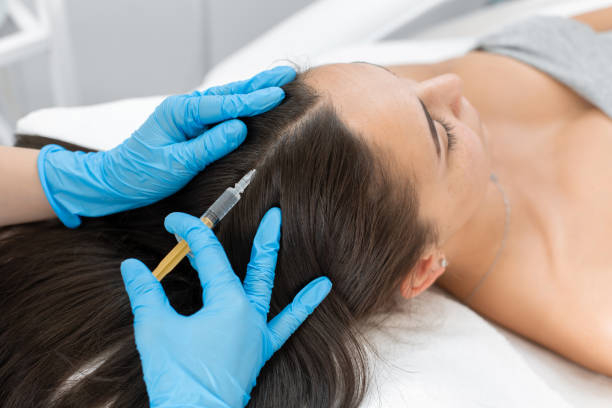
The concentrated plasma is injected into targeted areas using fine needles. Multiple injection points ensure thorough coverage.
Discomfort is minimal—most patients describe brief pinching. The injection phase typically takes fifteen to thirty minutes.
Step Nine: Immediate Post-Treatment Care
Mild redness and tenderness at injection sites are normal. These resolve within a day or two.
Avoid washing your hair for the period your provider specifies. Skip harsh products, heat styling, and vigorous exercise briefly.
Step Ten: The Initial Recovery Period
Most patients return to normal activities immediately. There is no meaningful downtime.
Some experience mild scalp tightness or sensitivity. This is temporary and expected.
Step Eleven: Early Response (Weeks One to Four)
Visible change does not occur immediately. Some patients notice reduced shedding within the first weeks.
This early sign indicates the treatment is affecting follicle activity. Continue following aftercare guidance.
Step Twelve: Mid-Treatment Progress (Months Two to Six)
Density improvements develop gradually during this period. New growth often appears as fine hairs along the hairline or part.
Strand thickness may increase, creating fuller-looking coverage. Photographic tracking reveals subtle progress.
Step Thirteen: Assessing Results (Months Six to Twelve)
Full results typically emerge around twelve months with consistent sessions. Hair caliber and density improvements become more apparent.
This is when patients can fairly evaluate their outcome.
Step Fourteen: Maintenance Sessions
PRP results require maintenance. Follow-up sessions at recommended intervals preserve density and slow further loss.
Stopping treatment entirely often leads to gradual reversal. Long-term planning matters.
Step Fifteen: Ongoing Monitoring and Adjustment
Your provider may reassess your plan periodically. If response is limited, adjustments or additional investigation may be recommended.
Honest evaluation ensures your treatment remains appropriate over time.
For those seeking expert guidance and customized aesthetic care, you can book an appointment consultation at the Enfield Royal Riyadh.
FAQs
How long does a PRP session take?
Most sessions are completed within an hour, including preparation and injections.
Is PRP treatment painful?
Discomfort is minimal; most patients report brief pinching during injections.
How many sessions will I need?
Most protocols begin with three to four sessions, then periodic maintenance.
When will I see results?
Reduced shedding appears within weeks; density improves over three to six months.
Is there downtime after PRP?
No meaningful downtime; most patients resume normal activities immediately.
Final Thoughts
The PRP hair treatment process is straightforward, minimally invasive, and structured around gradual biological improvement. From consultation through maintenance, each step serves a purpose. Understanding what happens at every stage replaces uncertainty with confidence. When you know the process, you can approach treatment calmly—and evaluate your results fairly.