


Understanding Cutting Forces in CNC Machining and How to Reduce Them
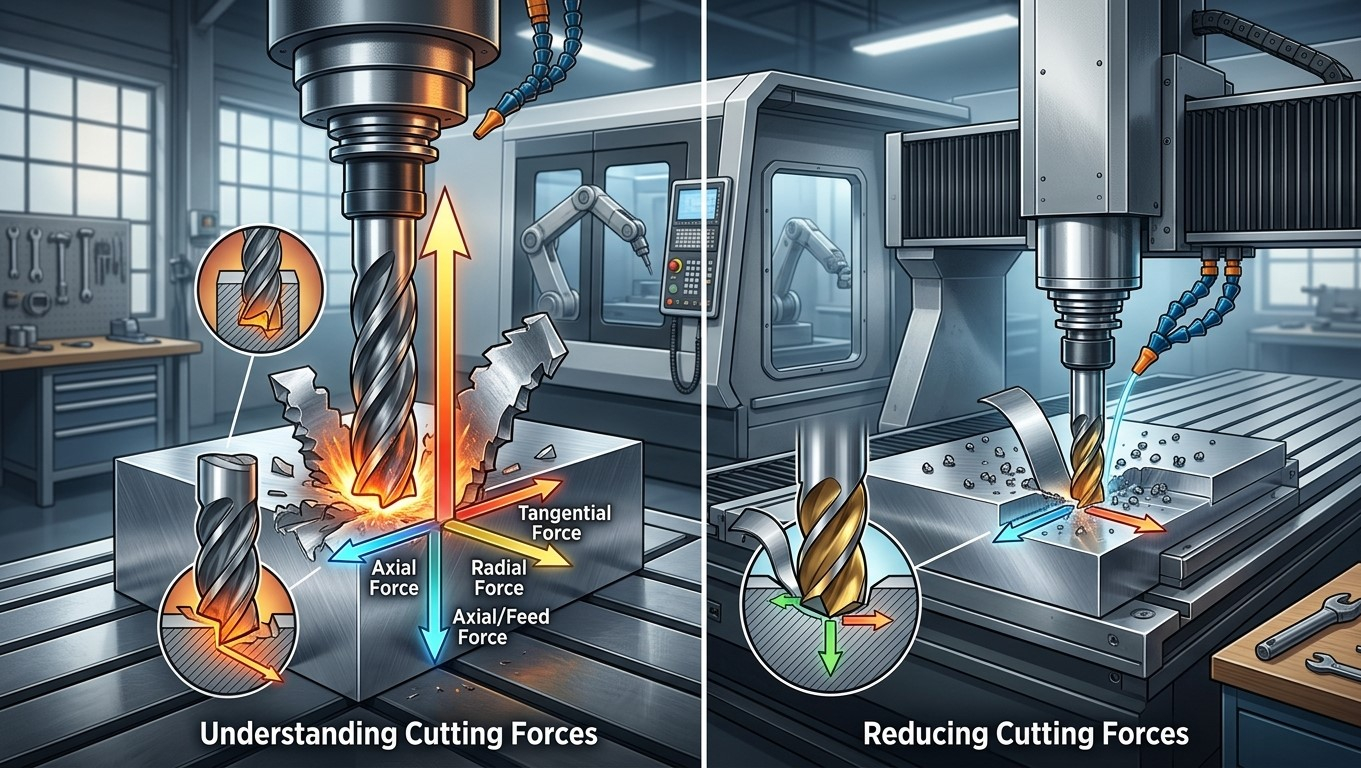
CNC machining depends on a precise interaction between the cutting tool, workpiece, machine, and cutting parameters. One of the most important factors affecting this interaction is cutting force. Excessive cutting forces can lead to tool wear, vibration, poor surface finish, dimensional inaccuracies, spindle load, and even premature tool failure. Understanding how these forces develop and how to control them is therefore essential for efficient machining. For manufacturers looking for reliable tooling solutions, Khokhawala Trading LLC, an experienced Industrial Tools Supplier in Dubai, provides access to industrial cutting tools, carbide cutting tools, CNC machining tools, and machining accessories for demanding applications.
What Are Cutting Forces in CNC Machining?
Cutting forces are the mechanical forces generated when a cutting tool removes material from a workpiece. As the cutting edge enters the material, it must overcome the material's resistance to deformation and separation.
These forces act in different directions depending on the machining operation. In milling, turning, drilling, and other CNC processes, the magnitude and direction of the force can continuously change.
Cutting forces are influenced by several factors, including:
-
Workpiece material and hardness
-
Tool material
-
Cutting-edge geometry
-
Tool diameter
-
Depth of cut
-
Radial engagement
-
Feed rate
-
Cutting speed
-
Tool overhang
-
Tool sharpness
-
Machine and workholding rigidity
-
Coolant and chip evacuation
Controlling these factors helps reduce unnecessary loads on the machine and cutting tool.
Why Cutting Forces Matter in CNC Machining
Cutting forces are not necessarily a problem. A certain amount of force is required to remove material. The objective is to maintain cutting forces within a range that the tool, machine, workholding system, and workpiece can handle effectively.
Excessive cutting forces can create several problems.
1. Increased Tool Wear
High mechanical loads place greater stress on the cutting edge. This can accelerate flank wear, edge chipping, crater wear, or premature tool failure.
2. Poor Surface Finish
When cutting forces cause vibration or tool deflection, the cutting edge may not follow the programmed toolpath accurately. This can produce poor surface finish and visible machining marks.
3. Dimensional Inaccuracy
Tool deflection can cause the actual cutting diameter or position to differ from the programmed value. This is especially important in precision machining operations.
4. Chatter and Vibration
High cutting forces can excite machine or tooling vibrations. Chatter may reduce tool life, damage the workpiece surface, and make stable high-speed machining difficult.
5. Increased Spindle Load
Higher cutting forces require greater machine power. If the load becomes excessive, spindle performance can be affected and machining efficiency can decrease.
Main Factors That Affect Cutting Forces
Understanding the factors that influence cutting forces makes it easier to control them.
Workpiece Material
Different materials require different levels of cutting force. Aluminum generally cuts more easily than hardened steel, while stainless steel and nickel-based alloys can generate high cutting loads because of their strength and work-hardening characteristics.
Tool selection should therefore be matched to the material being machined.
Cutting Tool Geometry
Tool geometry has a major influence on cutting forces.
Important features include:
-
Rake angle
-
Clearance angle
-
Helix angle
-
Cutting-edge angle
-
Nose radius
-
Flute geometry
-
Number of cutting edges
A suitable positive rake angle, for example, can reduce cutting resistance in many applications by allowing the tool to shear material more efficiently.
However, geometry must always be selected according to the application. An extremely sharp edge may reduce cutting resistance but may not provide sufficient strength for heavy-duty machining.
Depth of Cut
Increasing axial or radial depth of cut increases the amount of material being removed and generally increases cutting forces.
For heavy roughing operations, deeper cuts may be desirable for productivity, but the machine, tool, workholding, and workpiece must be sufficiently rigid.
Feed Rate
Feed per tooth in milling and feed per revolution in turning directly influence chip thickness. Increasing feed generally increases cutting forces.
Reducing feed can therefore help lower force, but excessively low feed rates can also cause rubbing, poor productivity, or unwanted heat generation.
Tool Diameter and Overhang
Larger-diameter tools are generally more rigid and can resist deflection better. Long tool overhangs, on the other hand, increase the possibility of bending and vibration.
Keeping the tool as short as practical is one of the simplest ways to improve machining stability.
How to Reduce Cutting Forces in CNC Machining
Reducing unnecessary cutting forces involves optimizing the entire machining system rather than changing only one parameter.
1. Select the Right Cutting Tool
Tool selection should begin with the workpiece material and machining operation.
Carbide cutting tools are widely used for CNC machining because they provide high hardness, wear resistance, and the ability to operate at higher cutting speeds than many conventional tool materials.
The tool should also have geometry appropriate for roughing, finishing, slotting, profiling, drilling, or other specific operations.
Using the wrong tool geometry can increase cutting resistance even when the machine itself has sufficient power.
2. Optimize Cutting Parameters
Cutting speed, feed, depth of cut, and radial engagement should be balanced according to the tool manufacturer's recommendations and actual machine conditions.
A useful approach is to avoid making aggressive changes to multiple parameters at once. Adjust one parameter, observe spindle load, tool wear, chip formation, and surface finish, and then optimize further.
For milling applications, reducing radial engagement can sometimes lower cutting forces while maintaining a productive feed rate. This approach can be particularly useful when machining with modern high-efficiency toolpaths.
3. Use Appropriate Tool Geometry
Geometry should match both the workpiece material and the operation.
For example, a geometry designed for aluminum may prioritize efficient chip evacuation and sharp cutting edges, while tooling for hardened materials may require stronger cutting edges and specialized grades or coatings.
The correct rake, clearance, helix, flute count, and edge preparation can make a significant difference in cutting resistance.
4. Minimize Tool Overhang
Tool deflection increases as tool overhang increases. A long, unsupported tool behaves like a flexible beam and can deflect under cutting loads.
Whenever possible:
-
Keep tool projection short
-
Use rigid CNC tool holders
-
Avoid unnecessary extensions
-
Select an appropriate holder diameter
-
Maintain proper holder-to-tool contact
High-quality CNC tool holders and properly assembled tooling can significantly improve machining stability.
5. Control Tool Runout
Runout causes individual cutting edges to engage the workpiece unevenly. One flute may remove substantially more material than another, creating localized high cutting forces.
Excessive runout can result in:
-
Uneven tool wear
-
Chatter
-
Poor surface finish
-
Reduced tool life
-
Dimensional variation
Tool assemblies should therefore be checked for cleanliness, correct seating, and acceptable runout.
6. Improve Workholding Rigidity
Cutting forces do not act only on the tool. They also transfer through the workpiece and workholding system.
Weak clamping can allow the workpiece to move or vibrate. This can lead to dimensional errors and poor surface quality.
Appropriate chucks, vises, fixtures, and other machining accessories should provide sufficient support for the operation.
Thin or flexible workpieces may require additional support or a different machining strategy.
7. Improve Chip Evacuation
Poor chip evacuation can increase cutting resistance because chips may become trapped between the tool and workpiece.
This is especially important during deep pockets, drilling, slotting, and high-material-removal operations.
Appropriate coolant delivery, air blast, through-tool coolant, or other chip evacuation methods can help keep the cutting zone clear.
8. Use Suitable Tool Coatings
Tool coatings can improve wear resistance, reduce friction, and support higher cutting performance in appropriate applications.
Common coating technologies are selected according to tool material, workpiece material, temperature, and machining conditions.
However, a coating cannot compensate for incorrect tool geometry or unsuitable cutting parameters. Coating selection should therefore be considered as part of the complete tooling strategy.
Cutting Forces and Tool Deflection
One of the most important relationships in CNC machining is the connection between cutting force and tool deflection.
When a cutting force acts on a tool, the tool can bend. Greater tool overhang generally increases this effect.
Tool deflection can cause:
-
Undersized or oversized features
-
Tapered walls
-
Poor corner accuracy
-
Inconsistent surface finish
-
Increased vibration
-
Uneven tool wear
For precision applications, reducing cutting forces through appropriate tool diameter, shorter overhang, suitable geometry, and controlled cutting parameters can significantly improve dimensional stability.
The Role of Precision Measurement
Reducing cutting forces is only part of the machining process. Manufacturers must also verify whether the resulting components meet required specifications.
Precision measuring tools such as calipers, micrometers, dial indicators, bore gauges, and height gauges can be used to inspect critical dimensions.
Measurement helps identify whether changes in tooling or machining parameters are producing the desired results.
For high-precision production, measurement should be integrated into the machining workflow rather than treated as a final inspection step only.
Common Mistakes That Increase Cutting Forces
Several common practices can unintentionally increase cutting loads.
Using the Wrong Tool
A tool designed for a different material or operation may produce excessive resistance.
Excessive Depth of Cut
Taking unnecessarily deep cuts can overload the cutting edge and machine.
Excessive Feed
High feed rates can create large chip thickness and increase cutting forces beyond the tool's practical range.
Long Tool Overhang
Long extensions reduce rigidity and increase deflection.
Poor Workholding
Insufficient clamping can allow vibration and movement.
Ignoring Tool Wear
A worn cutting edge typically requires more energy to cut material effectively. Continuing to use a severely worn tool can increase force, heat, and the risk of tool failure.
Poor Tool Holder Condition
Dirty or damaged tapers, improper clamping, or worn holders can negatively affect tool stability.
Best Practices for Controlling Cutting Forces
A practical CNC machining strategy should include the following:
-
Select tooling according to workpiece material and operation.
-
Use carbide cutting tools where appropriate for the application.
-
Choose suitable tool geometry and edge preparation.
-
Optimize cutting speed and feed using reliable tooling data.
-
Control depth and radial engagement.
-
Minimize tool overhang.
-
Maintain low and consistent tool runout.
-
Use rigid CNC tool holders and workholding systems.
-
Ensure effective chip evacuation.
-
Monitor tool wear and replace tools at appropriate intervals.
-
Use precision measuring tools to verify dimensional accuracy.
-
Record successful cutting conditions for repeat production.
Benefits of Reducing Cutting Forces
Effective cutting-force management can provide several operational benefits:
-
Longer cutting tool life
-
Better surface finish
-
Improved dimensional accuracy
-
Lower vibration
-
Reduced spindle loading
-
More stable machining
-
Improved productivity
-
Lower tooling costs
-
Reduced scrap and rework
-
Better machine and tool reliability
These benefits are particularly valuable in production environments where consistent performance and repeatability are essential.
Conclusion
Understanding cutting forces in CNC machining is essential for achieving stable, accurate, and productive manufacturing. Cutting forces are influenced by workpiece material, tool geometry, cutting parameters, tool diameter, overhang, workholding, runout, and machine rigidity. By selecting appropriate industrial cutting tools, optimizing machining parameters, improving tool holding, and controlling tool wear, manufacturers can reduce unnecessary loads and improve overall machining performance.
Khokhawala Trading LLC supports industrial and engineering requirements with a broad range of CNC machining tools, carbide cutting tools, precision measuring tools, CNC tool holders, and machining accessories. As an experienced Industrial Tools Supplier in Dubai, the company provides tooling solutions suited to demanding manufacturing, CNC, fabrication, and maintenance applications. Choosing the right tooling system and managing cutting forces effectively can help businesses achieve better productivity, longer tool life, and more consistent machining results.
Categories
- Artificial Intelligence (AI)
- Technology
- Business
- Education
- Science
- Lifestyle
- Healthcare
- Entertainment
- Politics
- Environment
- Travel
- Finance
- Automobile
- News
- Art
- Causes
- Crafts
- career
- Dance
- Drinks
- Film
- Fitness
- Food
- Games
- Gardening
- Health
- Home
- Literature
- Music
- Networking
- Other
- Party
- Religion
- Shopping
- Sports
- Theater
- Wellness
Read More
Company OverviewGufic Biosciences Limited is a leading Indian pharmaceutical company specializing in injectable formulations. The company operates one of the world's largest lyophilized injectable plants in Indore. Walk-In Interview DetailsDate: Saturday, 17 January 2026Time: 10:00 AM to 04:00 PMLocation: Gufic Biosciences Limited, Plot No. 48, Smart Industrial Park, Natrip, Pithampur, Dhar...

The agricultural industry is facing a dual challenge: a growing list of chemical-resistant weed strains and tightening global regulations on conventional chemical herbicides. In response to this crisis, autonomous weeding machines equipped with high-powered lasers or micro-cultivators are stepping into the fields to provide a highly sustainable alternative. These rugged ground units utilize...

The robotic lawn mower market is expanding rapidly as manufacturers introduce AI-powered navigation, computer vision, RTK-GPS positioning, advanced obstacle detection, and smartphone-based remote control features to improve efficiency and user experience. Innovations such as boundary-wire-free operation, machine learning algorithms, cloud connectivity, weather adaptation, and IoT integration...

According to the latest report published by Data Bridge Market Research, the Bioactive Milk Compound Market CAGR Value The global bioactive milk compound market size was valued at USD 4.38 billion in 2025 and is expected to reach USD 6.52 billion by 2033, at a CAGR of 5.10% during the forecast period The wide ranging Bioactive Milk Compound...
Polyclonal, Monoclonal, and Recombinant Variants in Experimental Workflows Reagent manufacturers produce BAGE2 antibodies in distinct structural formats to support a wide range of analytical methodologies in cell biology and pathology research. Understanding the mechanical differences among antibody formats allows principal investigators and lab managers to select the appropriate binder for...
