


Commercial Cabling Problems That Quietly Hurt Network Performance
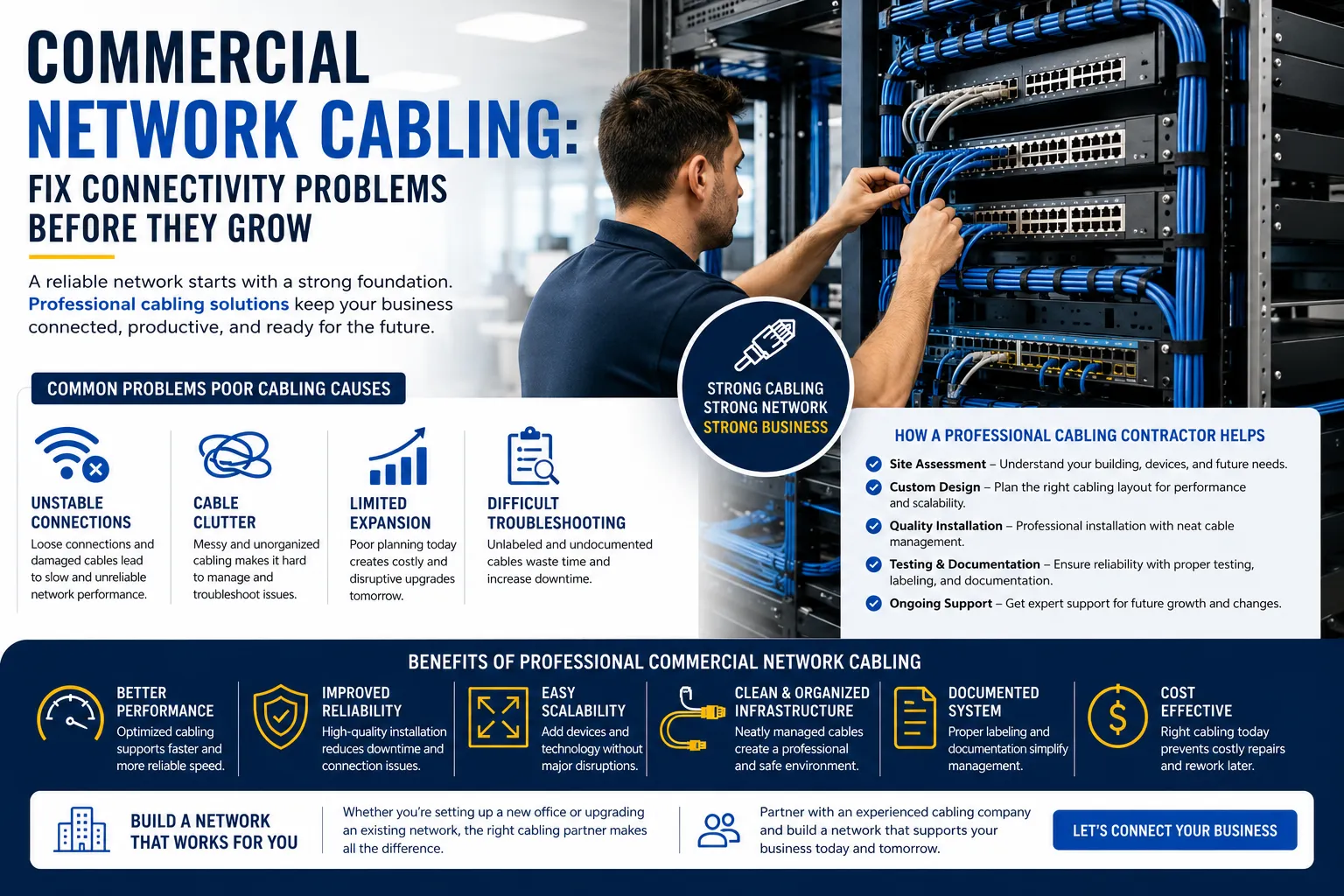
A business network can have modern switches, reliable routers, and a fast internet connection yet still experience connectivity problems. When employees report slow connections, dropped devices, or inconsistent performance, attention often goes toward software or networking equipment.
The physical cabling is sometimes overlooked.
Commercial wiring can remain in place for years while offices expand, equipment moves, and new technologies are added. Over time, temporary connections can become permanent, cables may be damaged, and network rooms can become increasingly difficult to manage.
Professional commercial network cabling provides a structured way to organize the physical infrastructure and reduce many of these avoidable problems.
How Poor Cabling Affects a Business
Cabling is responsible for physically connecting many of the systems businesses rely on every day. When connections are poorly installed or maintained, the effects can appear throughout the workplace.
Common symptoms include:
- Intermittent network connections
- Slow internal data transfers
- Dropped VoIP calls
- Unreliable wireless access points
- Devices that disconnect unexpectedly
- Difficulty identifying cable faults
- Frequent network troubleshooting
- Limited options for adding new devices
- Overcrowded communication rooms
These problems can waste employee time and make IT support more complicated.
A business does not necessarily need to replace its entire network when these symptoms appear. A professional assessment can help determine whether cabling is actually contributing to the problem.
What Is Structured Cabling?
Structured Cabling is an organized approach to designing and installing communication infrastructure throughout a commercial building.
Instead of installing individual cables whenever a new device is added, structured infrastructure creates standardized connection points and pathways.
A typical system can include:
- Horizontal cabling
- Backbone cabling
- Patch panels
- Network outlets
- Patch cords
- Equipment racks
- Telecommunications rooms
- Cable management systems
This organization makes it easier to identify connections, perform maintenance, and expand the network.
It also gives businesses a consistent infrastructure that can support multiple technologies.
Why Structured Cabling Installation Requires Planning
A successful structured cabling installation should begin with an understanding of how the business uses technology.
Installers need to consider where employees work, where equipment is located, how many devices require connections, and how the business may grow.
Cable pathways should be planned before installation begins. Network outlets should be positioned where they are actually useful, while telecommunications rooms should have enough space for equipment and cable management.
Planning these details in advance can reduce the need for disruptive changes later.
Don't Let a Messy Network Room Become a Business Risk
A communication room filled with tangled and unlabeled cables creates several problems.
Technicians may struggle to determine which cable belongs to which workstation. Troubleshooting can take longer, and adding new connections may require moving or disturbing existing cables.
Proper cable management helps create a more predictable environment.
Useful practices include:
- Labeling cables and ports
- Using organized patch panels
- Maintaining appropriate cable pathways
- Keeping equipment racks orderly
- Avoiding unnecessary cable loops
- Documenting important connections
- Leaving reasonable room for future expansion
An organized network room is not simply more attractive. It can make maintenance and troubleshooting much more efficient.
Know When Coax Cable Is Still Useful
Businesses sometimes assume that modern networking means every connection should use Ethernet or fiber. That is not always the case.
Coax cable remains useful for certain commercial applications, including television distribution, broadband services, video systems, and other technologies designed around coaxial connections.
The key is to use the appropriate cable for the intended application.
A commercial building may contain multiple cabling technologies at the same time. Ethernet may serve computers and phones, fiber may provide backbone connections, and coax may support specific video or communication systems.
Good infrastructure planning considers all of these requirements instead of forcing one technology into every application.
Avoid Mixing Temporary Fixes With Permanent Infrastructure
One of the most common causes of cable clutter is the gradual accumulation of temporary solutions.
A business may initially use an extension cable while waiting for a permanent connection. Later, another cable is added because a workstation moves. Eventually, several temporary connections become part of the everyday network.
This makes the infrastructure harder to understand and maintain.
When a business changes its layout or adds equipment, it is better to review the cabling requirements and make permanent improvements where appropriate.
Plan for More Devices Than You Have Today
A commercial network should have some consideration for future growth.
Businesses regularly add employees, security cameras, wireless access points, printers, VoIP phones, conference room technology, and other connected equipment.
If a cabling system is designed with no room for expansion, future changes may require additional cable routes or disruptive installation work.
A scalable design can include additional network outlets, accessible pathways, sufficient rack space, and appropriate backbone infrastructure.
This allows the business to adapt without completely rebuilding its physical network.
Testing Is an Essential Part of Installation
Installing a cable is only one part of a successful cabling project.
Completed connections should be tested to identify problems such as poor terminations, damaged cables, incorrect connections, or performance issues.
Testing can help confirm that the infrastructure is ready before employees begin relying on it.
Documentation is equally important. Businesses should maintain useful information about cable routes, ports, network rooms, and major connections.
Without documentation, even a well-installed system can become difficult to manage several years later.
How to Evaluate a Commercial Cabling Provider
Businesses should consider several factors when selecting a cabling contractor.
Look for a provider that can understand the company's requirements rather than simply installing cables according to a basic diagram.
Useful questions include:
- Can the provider assess the existing infrastructure?
- Does the company understand structured cabling?
- Can it work with copper, fiber, and coaxial infrastructure?
- Are completed connections tested?
- Will cables and ports be labeled?
- Is installation documentation provided?
- Can the design accommodate future growth?
- Does the provider understand commercial environments?
These questions can help businesses compare providers based on the quality and long-term usefulness of the installation.
Build a Cabling System That Is Easier to Manage
Commercial technology depends on physical infrastructure that often receives little attention until something stops working.
Poor cable management, aging connections, temporary wiring, and insufficient capacity can make a network harder to troubleshoot and expand.
A well-designed commercial network cabling system takes a different approach. It organizes connections, supports multiple technologies, improves accessibility, and provides room for future changes.
With properly planned Structured Cabling, appropriate structured cabling installation, suitable use of coax cable, accurate testing, and clear documentation, businesses can create a physical infrastructure that supports reliable connectivity for years to come.
Categories
- Artificial Intelligence (AI)
- Technology
- Business
- Education
- Science
- Lifestyle
- Healthcare
- Entertainment
- Politics
- Environment
- Travel
- Finance
- Automobile
- News
- Art
- Causes
- Crafts
- career
- Dance
- Drinks
- Film
- Fitness
- Food
- Games
- Gardening
- Health
- Home
- Literature
- Music
- Networking
- Other
- Party
- Religion
- Shopping
- Sports
- Theater
- Wellness
Read More
Mumbai is a vibrant city known for its busy lifestyle, luxury hotels, business districts, nightlife, and social events. For adults looking for professional companionship, Mumbai escorts can offer company for occasions such as dinner dates, business gatherings, parties, sightseeing, and other social events. Explore Mumbai Escorts Choosing the right companion is easier when profiles provide clear...

The aircraft cooling system sector plays a significant role in supporting modern aviation by providing environmental control and thermal management technologies that maintain safe operating temperatures for cabins, avionics, and increasingly power-dense electrical systems. Manufacturers are increasingly incorporating lightweight, energy-efficient cooling architectures that improve overall...

The Japan CBCT Dental Imaging Market is expanding as dental professionals increasingly adopt advanced imaging technologies for accurate diagnosis and treatment planning. According to Market Research Future, the market is projected to grow from USD 42.09 million in 2025 to USD 83.58 million by 2035, representing a CAGR of 7.17% during the forecast period. Dental clinics are showing growing...
The heavy construction equipment industry is undergoing substantial modernization globally, supported by increasing investments in smart infrastructure, industrial development, and sustainable construction practices. Equipment manufacturers are integrating advanced digital technologies to improve machine performance, fuel efficiency, and fleet management capabilities. According to Business...
The Homeopathic Medicine Market is expected to experience continued development as healthcare consumers become more interested in complementary and alternative treatment options. The market is supported by several trends, including greater awareness of wellness, demand for natural remedies, and the expansion of online healthcare-related commerce. Market Research Future estimates that the global...
