


Agentic AI Marketing: Building Autonomous Campaign Optimization Workflows With Intelligent AI Agents
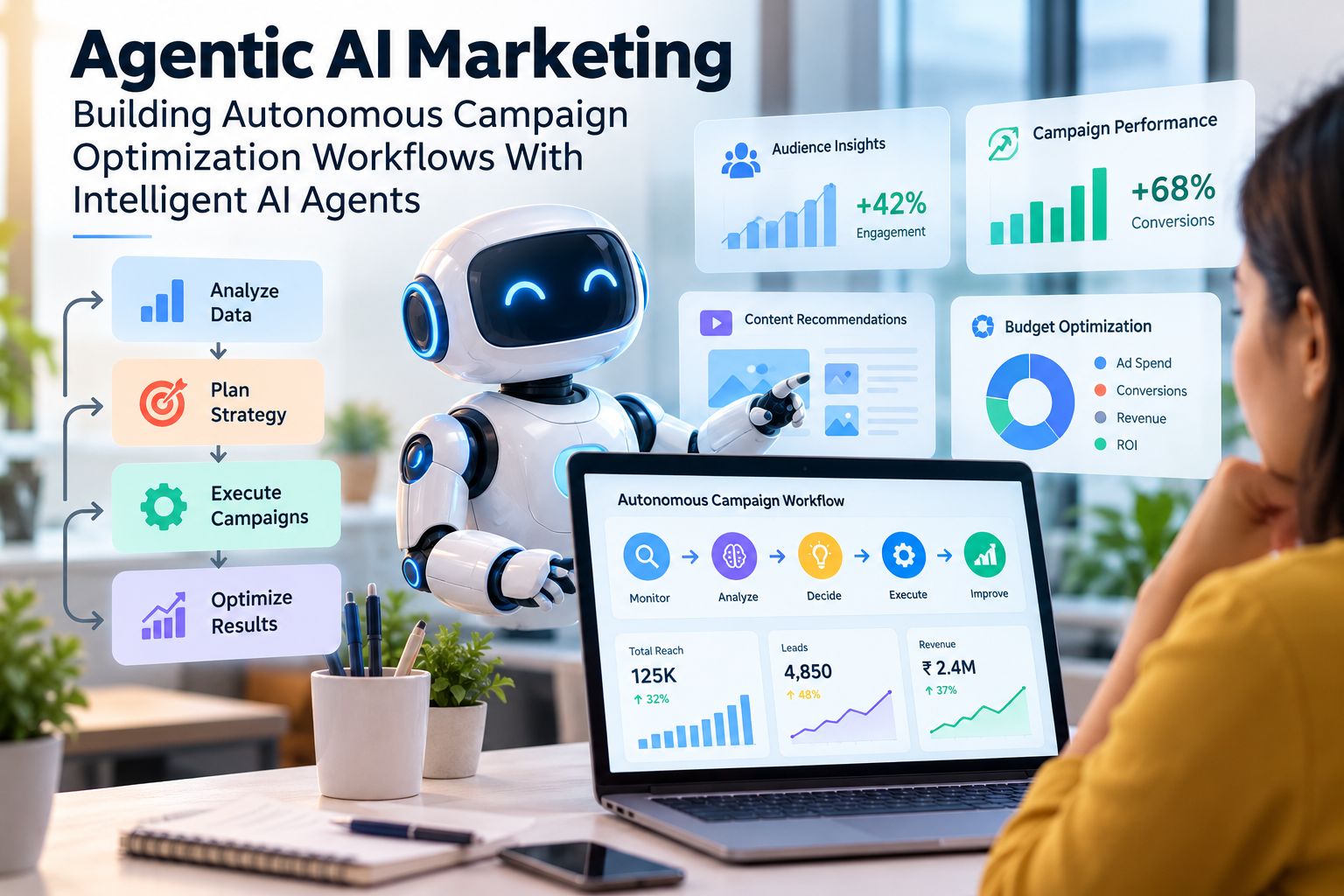
Marketing teams have never had more data at their fingertips. They can see clicks, conversions, customer journeys, engagement rates, search behavior, and campaign performance almost instantly. The harder part is acting on all that information quickly enough. Agentic Marketing changes the equation by using intelligent AI systems that can observe campaign data, make decisions, take action, and adjust strategies with limited human intervention.
Traditional automation follows predefined rules. Agentic systems can work toward a goal, evaluate changing conditions, and decide what action should come next. That difference is becoming important for brands managing multiple channels, audiences, and campaigns at the same time.
What Is Agentic AI Marketing?
Agentic AI marketing combines artificial intelligence with autonomous decision-making workflows. Instead of simply executing a task after receiving an instruction, an AI agent can monitor a situation, interpret information, select an action, and evaluate the result.
For example, consider a paid advertising campaign. A conventional automation may pause an advertisement when its cost per acquisition crosses a predefined threshold. An agentic workflow can look at several factors before acting, including conversion quality, audience behavior, historical performance, creative fatigue, budget allocation, and changes in demand.
The goal is not to remove marketers from the process. It is to give them systems that can handle repetitive decisions while humans remain responsible for strategy, brand direction, and important approvals.
How Autonomous Campaign Optimization Works
A useful agentic workflow usually follows a continuous cycle:
-
Observe: Collect campaign and customer data from relevant sources.
-
Analyze: Identify patterns, changes, opportunities, and potential problems.
-
Decide: Select an action based on defined objectives and constraints.
-
Execute: Make an approved campaign change.
-
Measure: Track the effect of the decision.
-
Learn: Use the latest results to inform the next decision.
This creates a feedback loop rather than a one-time automation.
Suppose an ecommerce brand notices that one product category is receiving strong traffic but weak conversions. An AI agent could investigate landing-page behavior, search terms, audience segments, product availability, and campaign messaging. It might recommend shifting budget, testing different creative, or changing audience targeting.
A human marketer can then approve the action or allow the workflow to operate within predefined limits.
Why AI Agents Matter for Marketing Teams
Modern campaigns generate more decisions than most teams can comfortably handle manually. Marketers may need to review dozens of audiences, creatives, landing pages, keywords, offers, and performance indicators every day.
AI Marketing Automation can reduce the operational burden by allowing agents to monitor these signals continuously.
The biggest benefit is not simply speed. It is consistency.
An agent can repeatedly check performance according to the same criteria without waiting for someone to open a dashboard. It can also connect information that may be spread across advertising platforms, analytics systems, customer relationship management tools, and content platforms.
That can help marketing teams spend more time on positioning, creative thinking, customer research, and strategic planning.
Key Components of an Agentic Campaign Workflow
A strong system needs more than a capable AI model. It needs a reliable operating structure.
Clear Marketing Objectives
Agents need measurable goals. These could include improving qualified leads, increasing repeat purchases, reducing acquisition costs, or improving engagement.
A vague instruction such as "make the campaign better" leaves too much room for inconsistent decisions.
Reliable Data
An agent is only as useful as the information available to it. Data should be accurate, timely, and relevant to the decision being made.
Important inputs can include:
-
Conversion data
-
Customer segments
-
Website behavior
-
Advertising performance
-
Sales information
-
Content engagement
-
Historical campaign results
Decision Rules and Guardrails
Autonomy should have boundaries. Marketers can define spending limits, approval requirements, brand guidelines, audience restrictions, and conditions under which an agent must stop and request human input.
This approach creates controlled autonomy rather than unrestricted decision-making.
Measurement and Feedback
Every action should produce measurable evidence. If an agent changes an audience or creative, the system needs to determine whether that change actually improved the intended outcome.
This prevents automation from becoming activity without accountability.
From Automated Tasks to Intelligent Workflows
There is a major difference between automation and agentic systems.
A basic automated workflow might send an email when a customer abandons a shopping cart. An agentic workflow can examine the customer's previous interactions, purchase history, product category, engagement level, and current campaign context before deciding what type of follow-up is appropriate.
That distinction opens the door to more adaptive Automated Marketing Campaigns.
Instead of creating hundreds of fixed rules, marketers can establish objectives and constraints while agents determine which approved actions are appropriate in changing circumstances.
The Role of Human Oversight
Autonomous does not have to mean unsupervised.
Marketing decisions can affect brand reputation, customer trust, advertising budgets, and regulatory compliance. Human review remains especially important when an action could have significant financial or reputational consequences.
A practical model divides decisions into three levels:
-
Low risk: Agents can act automatically within established limits.
-
Medium risk: Agents can recommend actions for quick approval.
-
High risk: Humans make the final decision.
This structure allows teams to gain efficiency without handing over every important decision to an AI system.
Where Vibe Marketing Fits
A newer approach sometimes described as Vibe Marketing focuses on using AI to rapidly translate a brand's creative direction, audience signals, and campaign context into marketing experiments.
The concept can be useful when treated as a workflow rather than a replacement for strategy. A marketer might establish the brand voice, campaign objective, target audience, and creative boundaries. AI agents can then help generate variations, analyze responses, identify promising patterns, and suggest the next experiment.
The human still defines what the brand should stand for. The AI helps increase the pace of execution and learning.
Building a Responsible Agentic Marketing System
Businesses considering agentic workflows
Categories
- Artificial Intelligence (AI)
- Technology
- Business
- Education
- Science
- Lifestyle
- Healthcare
- Entertainment
- Politics
- Environment
- Travel
- Finance
- Automobile
- News
- Art
- Causes
- Crafts
- career
- Dance
- Drinks
- Film
- Fitness
- Food
- Games
- Gardening
- Health
- Home
- Literature
- Music
- Networking
- Other
- Party
- Religion
- Shopping
- Sports
- Theater
- Wellness
Read More
Not everyone who feels unhappy with the appearance of their ears needs surgery, but certain aesthetic concerns may make ear reshaping worth discussing with a qualified surgeon. Ear Cosmetic Surgery in Riyadh (جراحة تجميل الأذن في الرياض) may be considered by people who want to improve prominent ears, uneven positioning, unusual contours, or proportions that they feel do not complement...

The Isosorbide Mononitrate Glucose Injection Market is expected to experience steady development through the coming years as demand for cardiovascular healthcare products continues to increase. The market's growth is supported by the need for pharmaceutical solutions associated with cardiovascular conditions and hospital-based treatment. WiseGuyReports projects that the market could grow from...

The global tower crane market is witnessing steady growth as infrastructure development, urbanization, and high-rise construction projects continue to increase across developed and emerging economies. According to The Insight Partners, the global tower crane market size is projected to reach US$ 12.21 billion by 2034 from US$ 7.92 billion in 2025. The market...
The Healthcare Revenue Cycle Management Software Market is expected to continue changing as healthcare organizations place greater emphasis on digital financial management. Revenue cycle platforms are designed to support the financial journey associated with healthcare services, from registration and billing through claims processing and payment collection. Future development is likely to be...
According to the latest report published by Data Bridge Market Research, the Heat Stabilizers Market The global heat stabilizers market size was valued at USD 5.64 billion in 2025 and is expected to reach USD 8.09 billion by 2033, at a CAGR of 4.6% during the forecast period. Heat Stabilizers Marketing report makes available state-of-the-art information about the entire market along...
