


How Many Moving Boxes Do You Really Need?
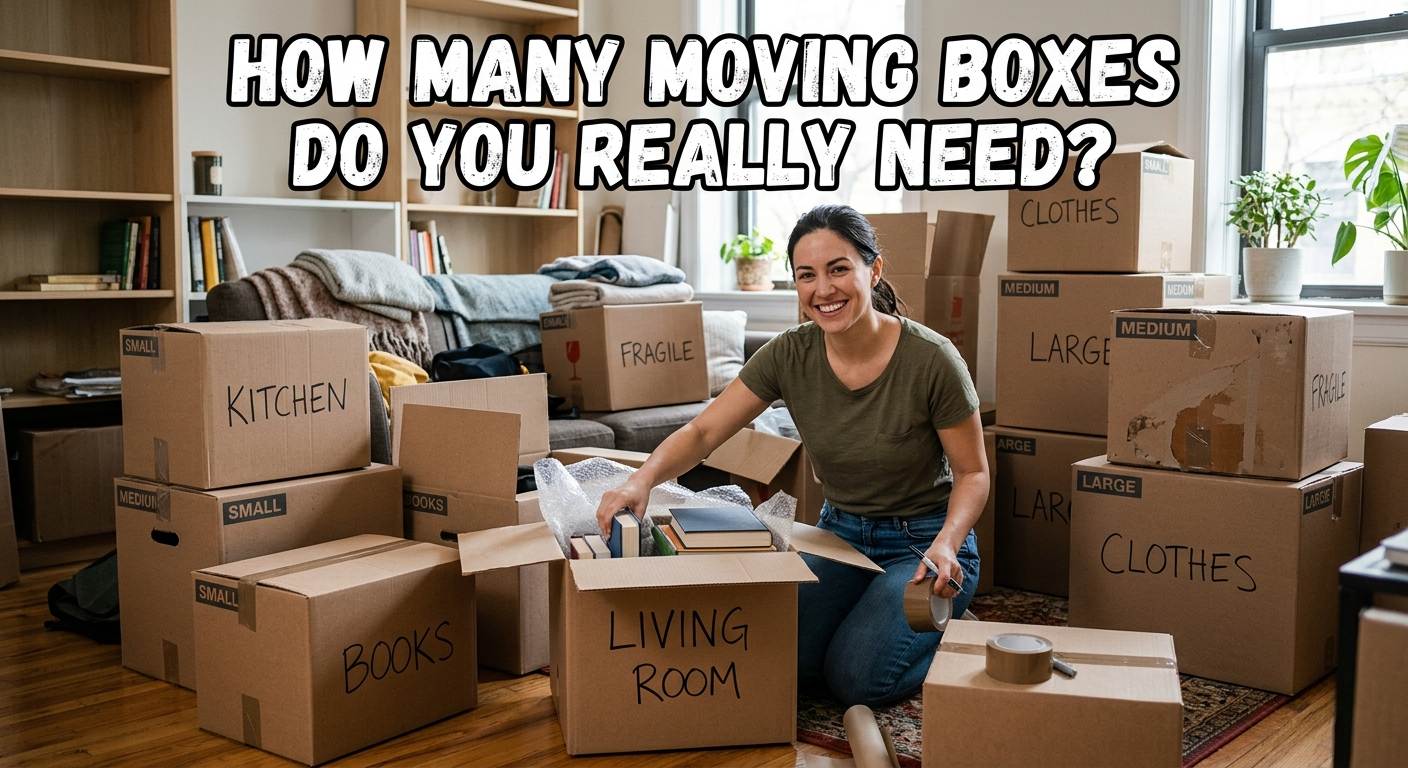
One of the hardest parts of preparing for a move is figuring out how many boxes will actually be needed.
Buying too few can interrupt packing, while buying far too many wastes money and creates unnecessary clutter.
A practical estimate depends on home size, household habits, box sizes, and the types of belongings being packed.
There is no universal number that works for every household. A minimalist living in a two-bedroom apartment may need fewer boxes than someone moving from a heavily furnished one-bedroom home.
The better approach is to estimate boxes based on the household itself rather than relying on square footage alone.
Why Estimating Moving Boxes Is Harder Than It Looks
Two homes with identical floor plans can require completely different amounts of packing material.
One household may have full bookshelves, seasonal decorations, kitchen appliances, collectibles, and years of stored belongings. Another may own only basic furniture and everyday necessities.
This is why professional packing estimates usually consider several factors together:
-
Number of bedrooms
-
Number of people in the household
-
Length of time spent in the home
-
Amount of storage space
-
Number of books and decorative items
-
Kitchen size
-
Clothing volume
-
Garage, attic, or basement storage
-
Whether belongings have been decluttered
The longer a household has occupied a property, the more likely it is to have accumulated items that are easy to overlook during an early box estimate.
Start With the Size of the Home
Home size provides a useful starting point, even though it should not be the only factor considered.
People planning a move can also research packing requirements, moving preparation, and service options through resources such as My Moving Journey, a moving directory and resource website designed to help consumers better understand different stages of the moving process.
A rough starting estimate might look like this:
|
Home Size |
Approximate Number of Boxes |
|
Studio apartment |
15–25 boxes |
|
1-bedroom home |
20–40 boxes |
|
2-bedroom home |
35–60 boxes |
|
3-bedroom home |
50–80 boxes |
|
4-bedroom home |
70–110 boxes |
|
5+ bedroom home |
90–140+ boxes |
These figures should be treated as planning ranges rather than fixed rules. Storage habits can easily move a household toward either end of the range.
Why Bedroom Count Is Only a Starting Point
Bedrooms provide a convenient measurement because they roughly indicate household size. However, they say little about how much is stored elsewhere.
A three-bedroom house with a packed garage, attic, pantry, and home office may require substantially more boxes than a four-bedroom home occupied by a household that regularly declutters.
That is why a room-by-room inventory provides a more dependable estimate.
Estimate Boxes Room by Room
Instead of asking, “How many boxes does a three-bedroom house need?” it can be more useful to ask how many boxes each individual room requires.
This method helps uncover belongings hidden in cabinets, drawers, closets, and storage areas.
Kitchen
The kitchen is often one of the most box-intensive rooms.
Cookware, dishes, glasses, pantry products, small appliances, utensils, food containers, and fragile items all require space. Many kitchen belongings also need additional padding, which reduces the usable capacity of each box.
A typical kitchen may require:
-
2–4 small boxes
-
4–7 medium boxes
-
2–4 large boxes
-
1–3 dish or specialty boxes
A large kitchen with extensive cookware or pantry storage can require considerably more.
Bedroom
An average bedroom may need roughly 8–15 boxes, depending on the amount of clothing and personal belongings.
Wardrobe boxes can reduce the need to fold hanging clothes. Shoes, bedding, books, electronics, and personal items will usually need separate packing space.
Children's bedrooms may also contain toys, school supplies, collections, and bulky items that increase the box count.
Living Room
Living rooms can appear easy to pack because furniture takes up most of the visible space. However, bookshelves, entertainment units, drawers, artwork, lamps, electronics, and decorative items quickly add boxes.
A typical living room may require around 5–12 boxes.
Homes with large book or media collections may need additional small boxes because heavy belongings should not be packed into oversized cartons.
Bathroom
Bathrooms generally require fewer boxes than other rooms.
One or two small or medium boxes may be enough for toiletries, towels, grooming products, cleaning supplies, and bathroom accessories.
Liquids should be sealed carefully and kept upright to reduce the risk of leakage.
Garage, Basement, and Attic
These spaces are where estimates often go wrong.
Tools, seasonal decorations, sports equipment, stored household goods, gardening supplies, and forgotten containers can significantly increase packing needs.
Instead of guessing, each storage area should be inventoried separately before boxes are purchased.
Use the Right Mix of Box Sizes
Estimating the total number of boxes is only half the job. The right combination of sizes matters just as much.
Packing everything into large cartons may seem efficient, but it often creates boxes that are too heavy to lift safely.
Small Boxes
Small boxes work best for dense and heavy belongings, including:
-
Books
-
Canned goods
-
Small appliances
-
Tools
-
Records
-
Heavy decorative objects
Keeping heavy items in smaller cartons makes their final packed weight easier to control.
Medium Boxes
Medium boxes are among the most versatile options and can hold:
-
Toys
-
Kitchen supplies
-
Shoes
-
Small electronics
-
Office supplies
-
Folded clothing
-
Household accessories
For many moves, medium cartons make up a large portion of the total box supply.
Large Boxes
Large boxes are better suited to lightweight, bulky belongings such as:
-
Pillows
-
Comforters
-
Blankets
-
Towels
-
Lightweight clothing
Heavy books or dishes should generally not be loaded into large cartons simply because extra space is available.
Calculate Boxes Based on What the Household Actually Owns
Home-size estimates become much more useful when they are adjusted according to the volume of belongings.
Someone who wants a more structured estimate can use a moving box calculator to estimate packing needs based on household details instead of purchasing boxes entirely by guesswork.
Before settling on a number, each household should consider whether it falls into a light, average, or heavy belongings category.
Light Household
A light household usually owns fewer decorative objects, books, clothes, kitchen items, and stored possessions.
Such households may need 15–25% fewer boxes than a standard home-size estimate.
Average Household
An average household typically has furnished rooms, normal closet storage, kitchenware, electronics, bedding, and some seasonal items.
The standard box ranges based on home size are usually a reasonable starting point in this situation.
Heavily Furnished or Long-Term Household
A household that has occupied the same property for many years may have significantly more belongings.
Garages, attics, closets, storage rooms, and basements can contain dozens of items that are not visible during an initial walkthrough.
These moves may require 20–30% more boxes than the standard estimate.
Decluttering Can Change the Box Count Dramatically
Estimating boxes before decluttering often leads to unnecessary purchases.
Every item that is donated, sold, recycled, or discarded is one less item that needs to be packed, transported, unloaded, and unpacked.
A simple sorting system can divide belongings into four categories:
-
Keep
-
Donate
-
Sell
-
Discard or recycle
The process is particularly useful for clothing, old paperwork, duplicate kitchenware, unused electronics, books, toys, and stored household items.
Decluttering can also affect moving costs. For moves priced partly according to shipment weight, volume, labor, or truck space, reducing unnecessary belongings may lower the amount of work and transportation capacity required.
Do Not Forget Specialty Boxes
Standard cardboard boxes cannot safely handle every household item.
Some belongings benefit from purpose-built cartons or protective packaging.
Wardrobe Boxes
Wardrobe boxes include a hanging bar that allows clothes to remain on hangers.
They can be especially useful for suits, dresses, jackets, formalwear, and other clothing that is difficult to fold.
Dish Boxes
Dish boxes are typically stronger than ordinary cartons and are designed for fragile kitchenware.
Dividers and protective wrapping can provide additional separation for glasses, cups, plates, and other breakable items.
TV and Picture Boxes
Televisions, mirrors, framed artwork, and large pictures may require adjustable specialty boxes.
Original manufacturer packaging can also be useful when it is still available and remains in good condition.
How Many Extra Boxes Should Be Purchased?
Even a careful estimate can miss a closet shelf, kitchen cabinet, garage container, or collection of small belongings.
For that reason, purchasing a modest buffer is usually more practical than buying the exact estimated number.
Around 10% extra boxes can provide flexibility without creating excessive waste.
For example, if a household estimates that it needs 50 boxes, keeping approximately five additional cartons available can help cover unexpected packing needs.
Unused boxes may also be returnable when purchased from retailers that allow returns, provided they remain clean and unused. Return policies should be checked before buying.
Common Box-Planning Mistakes
Box shortages are often caused by planning mistakes rather than unusually large households.
Counting Only Visible Belongings
Items inside cabinets, drawers, closets, storage containers, garages, and attics can represent a significant portion of the move.
A complete walkthrough should include enclosed storage spaces.
Buying Mostly Large Boxes
Large boxes seem convenient until they are filled with heavy belongings.
A balanced mix of small, medium, large, and specialty cartons generally produces safer and more manageable loads.
Packing Without Decluttering
Packing unwanted possessions increases the number of boxes and creates extra work at both ends of the move.
Sorting first makes the estimate more accurate.
Forgetting Packing Materials
Boxes are only one part of the packing supply list.
Most households will also need:
-
Packing tape
-
Labels or markers
-
Packing paper
-
Bubble cushioning where appropriate
-
Stretch wrap
-
Furniture protection
-
Dividers for fragile items
These materials should be estimated alongside the boxes rather than purchased as an afterthought.
A Simple Way to Make the Final Estimate
A practical box estimate can be created in four steps.
First, the household should establish a baseline according to the size of the home.
Second, every room and storage area should be checked to determine whether the household owns fewer or more belongings than average.
Third, unwanted possessions should be removed before the final box order is placed.
Finally, the estimated total can be increased slightly to create a reasonable buffer.
For example, a two-bedroom household might begin with an estimate of 45 boxes. After decluttering, the household may determine that roughly 40 are sufficient. Adding four extra cartons would create a final supply of approximately 44 boxes.
The goal is not to predict the exact number perfectly. It is to get close enough that packing can continue without repeated supply runs or piles of unused cartons.
Final Thoughts
The number of moving boxes a household needs depends less on bedroom count alone and more on how much the household actually owns.
Home size provides a useful baseline, but closets, kitchens, garages, books, clothing, storage habits, and specialty belongings can change the final number substantially.
A room-by-room inventory, followed by decluttering and a small supply buffer, produces a more practical estimate. With the right combination of box sizes and packing materials, the household can prepare efficiently without overspending on supplies that may never be used.
Categories
- Artificial Intelligence (AI)
- Technology
- Business
- Education
- Science
- Lifestyle
- Healthcare
- Entertainment
- Politics
- Environment
- Travel
- Finance
- Automobile
- News
- Art
- Causes
- Crafts
- career
- Dance
- Drinks
- Film
- Fitness
- Food
- Games
- Gardening
- Health
- Home
- Literature
- Music
- Networking
- Other
- Party
- Religion
- Shopping
- Sports
- Theater
- Wellness
Read More
Live betting has transformed the online sports betting experience for millions of sports fans across India. Unlike traditional pre-match betting, live betting allows users to place wagers while a match is actively taking place. This creates a more interactive experience where odds change in real time based on what happens during the game. Whether it is an IPL match, international cricket game,...

Achieving a healthy body weight can be challenging, especially when traditional methods do not deliver the desired results. This is where Weight loss injections in Riyadh (حقن إنقاص الوزن في الرياض) come into focus as a modern, medically supervised solution for effective fat reduction. These injections are designed to assist the body in managing weight by addressing internal factors such...

The Organic Pea Protein Market is witnessing remarkable growth as consumers increasingly seek sustainable, plant-based, and allergen-friendly protein sources. Growing awareness of healthy lifestyles, rising vegan and vegetarian populations, and the expanding demand for clean-label food ingredients are transforming the global protein industry. Organic pea protein has emerged as a...

Dried Eggs Market Shelf-Stable Egg Ingredients Gain Ground in Food Manufacturing The global Dried Eggs Market is transitioning from a specialized shelf-stable ingredient category into an increasingly important component of modern food manufacturing. According to Future Market Insights, the market is projected to increase from USD 2.7 billion in 2026 to USD 6.2 billion by 2036, expanding at a...

The Honeybush Extract Market is gaining momentum as consumers increasingly seek natural, botanical, and wellness-oriented ingredients. The market was valued at USD 300 million in 2024 and is expected to reach USD 500 million by 2035, expanding at a 5.9% CAGR from 2025 to 2035. Rising health consciousness and demand for herbal alternatives are supporting this growth. Food and beverages currently...
