

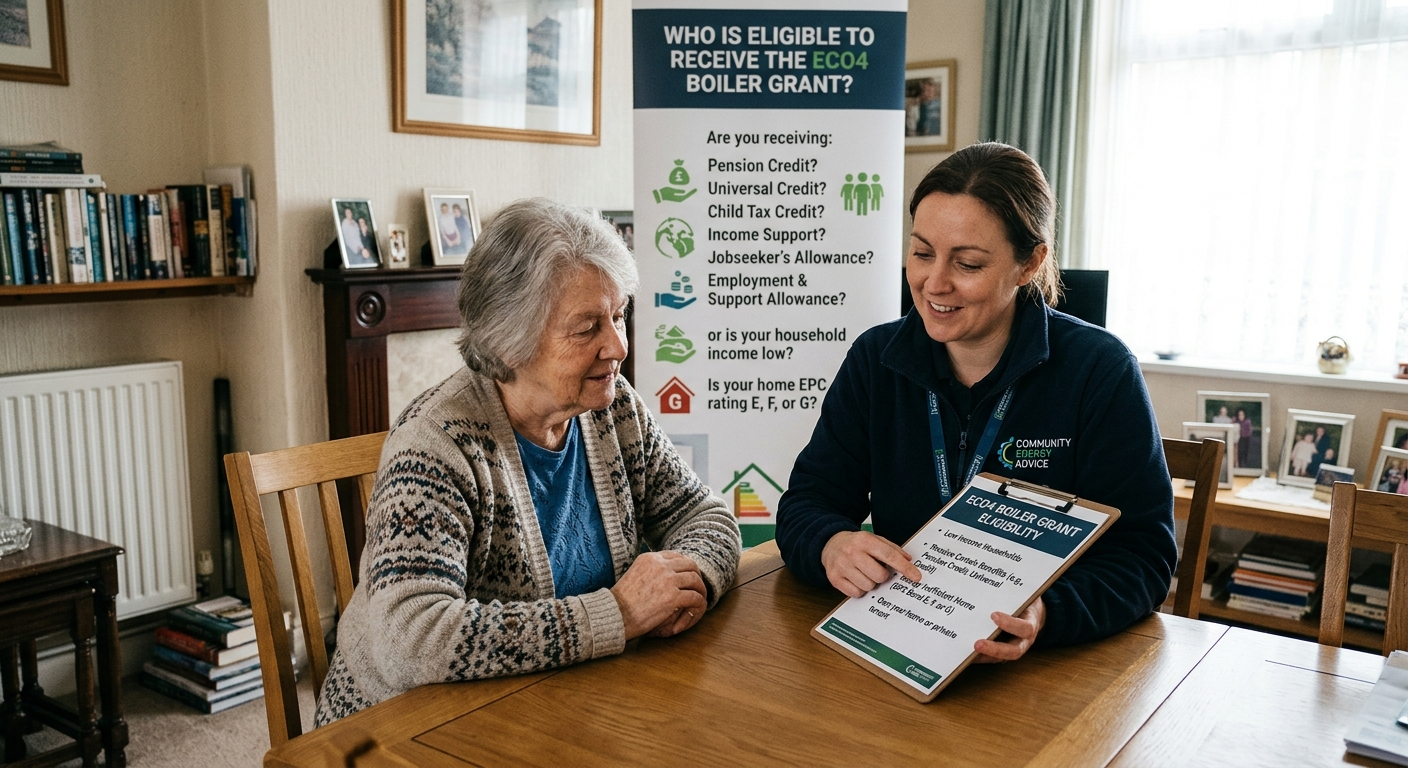

ECO4 can help some households improve their heating and energy efficiency, but being eligible does not automatically mean you will receive a new boiler. The scheme is designed around household circumstances, property condition and the type of heating already installed.
ECO4 is currently scheduled to run until 31 December 2026. It applies across Great Britain and focuses on homes with lower energy efficiency and households that may be at risk of fuel poverty.
It is also worth clearing up one common point. ECO4 is not a standard cash grant that homeowners claim directly. Energy suppliers decide which projects they fund and how much support they provide. You may therefore qualify for ECO4 support without being guaranteed a fully funded boiler replacement.
Who Can Qualify For ECO4?
Several routes can lead to ECO4 support. The most familiar route is through certain means-tested benefits.
Eligible households can include people receiving:
- Universal Credit
- Pension Credit Guarantee Credit
- Pension Credit Savings Credit
- Income Support
- Income-related Employment and Support Allowance
- Income-based Jobseeker's Allowance
- Housing Benefit
- Certain Child Benefit claims, subject to the relevant income limits
The household and property still need to meet the wider ECO4 requirements. Receiving one of these benefits on its own does not guarantee that a boiler replacement will be approved.
You May Qualify Without Receiving Benefits
Not everyone who needs help with heating receives a qualifying benefit. ECO4 Flex provides another route for some households.
Under ECO4 Flex, local authorities and devolved administrations can identify households that are on a low income, vulnerable to the cold or otherwise likely to benefit from energy efficiency improvements. One published route uses a combined gross household income below £31,000, while other routes consider factors such as health conditions and vulnerability to cold.
This can make the free boiler scheme relevant to people who would not qualify through the usual benefits route. The exact criteria can vary because local authorities have their own processes for identifying eligible households.
A referral also does not guarantee an installation. The supplier must still decide whether to take the project forward and which measures are suitable for the property.
Does Your Boiler Have To Be Old?
Age alone is not enough to qualify for an ECO4 boiler replacement.
The condition and efficiency of the existing heating system are more important. ECO4 can cover certain boiler repairs, replacements and upgrades, but each measure has its own requirements.
For example, a broken efficient boiler that cannot be repaired economically may qualify for replacement, subject to the scheme's replacement limits. An inefficient, non-condensing boiler may also qualify for an upgrade where the ECO4 rules are met.
This is why simply saying that a boiler is 10, 15 or 20 years old does not establish eligibility.
Is There A Boiler Replacement Scheme For Over 60s?
Being over 60 does not, by itself, create an automatic entitlement to a free boiler under ECO4.
Older people can form part of vulnerability criteria used by ECO4 Flex, particularly where age is combined with other circumstances such as low income or vulnerability to cold. Some local authority criteria specifically recognise older households when assessing vulnerability.
So, someone searching for a boiler replacement scheme over 60s should look at their full circumstances rather than relying on age alone.
Your income, benefits, health, property and existing heating system may all affect the assessment.
What Type Of Home Can Receive ECO4 Support?
ECO4 mainly targets homes with lower energy efficiency ratings. Private domestic properties in EPC bands D to G can be considered under the relevant eligibility routes. Social housing can also qualify under specific ECO4 rules.
Tenants are not automatically excluded. A private tenant may be able to receive ECO4 measures if the household and property meet the requirements, but landlord consent is needed before work takes place.
The property therefore matters just as much as the person living in it.
What Happens After You Apply?
An eligibility check normally looks at both the household and the property. You may need to provide information about your income or benefits, the property and the current heating system.
If the project proceeds, an assessment can determine which improvements are suitable. A boiler replacement is not the only possible ECO4 measure. Depending on the property, support can include insulation, heating upgrades, renewable heating and other energy-efficiency measures.
The important point is that ECO4 works as a property improvement programme rather than a simple replacement-boiler voucher.
Check The Full Eligibility Picture
You may have a route into ECO4 if you receive a qualifying benefit, meet an ECO4 Flex criterion, live in a suitable property and have a heating system that meets the rules for the proposed measure.
But these conditions work together. Meeting one requirement does not guarantee funding or a new boiler.
Before agreeing to any work, ask for a clear explanation of your eligibility, the proposed measure, the amount of funding available and any contribution you would need to make. Ofgem advises consumers to receive a contract before agreeing to ECO measures because suppliers can offer different levels and types of support.

