


Mining Excavator Buying Guide: Choosing the Right Machine for Quarry and Mining Work
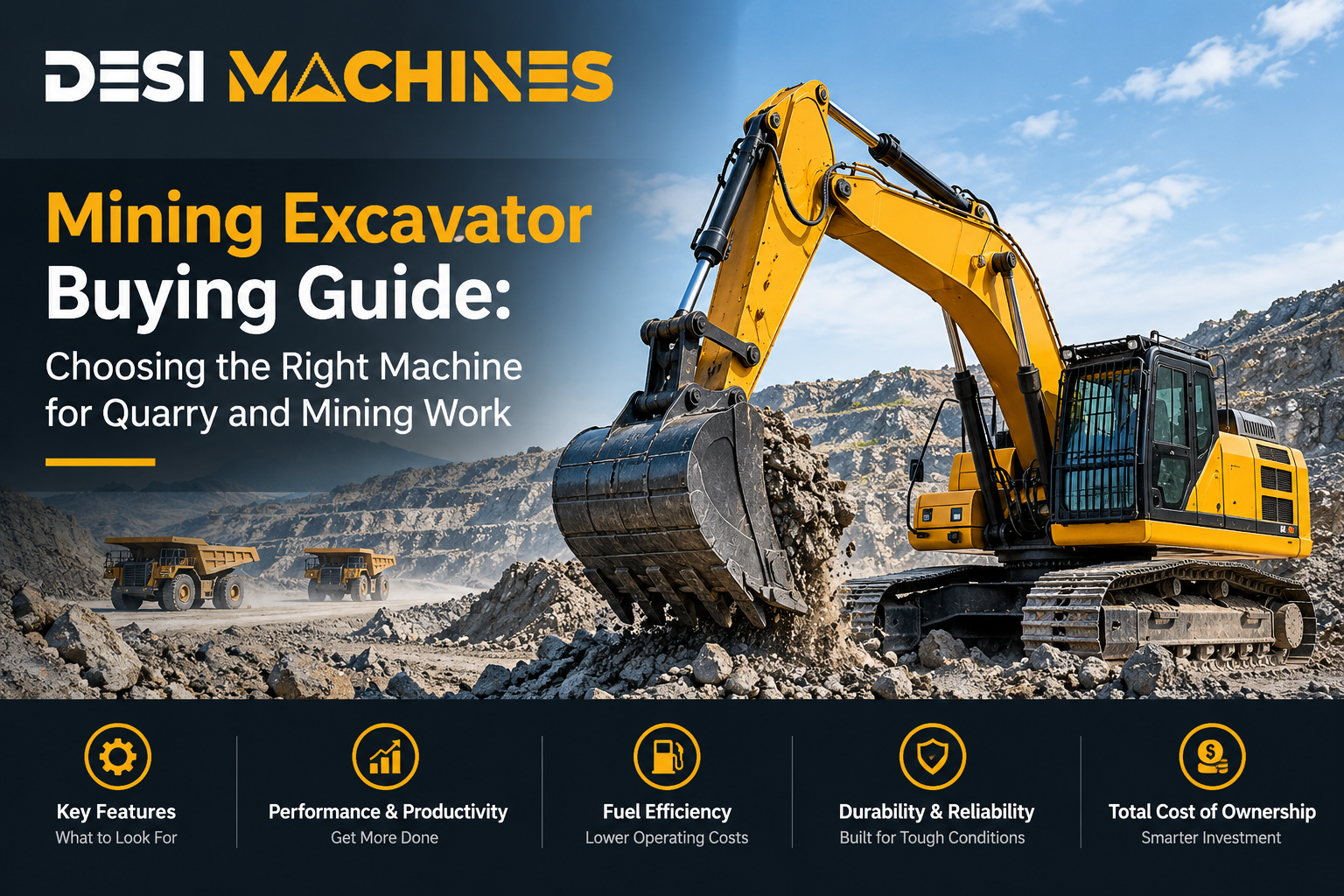
Mining and quarry projects place demanding conditions on excavators. Machines must dig hard material, load large quantities, and work for long hours without frequent interruptions.
Choosing the right mining excavator requires more than checking horsepower or machine price. Buyers should study operating weight, bucket capacity, digging depth, hydraulic performance, fuel use, and application requirements before making a decision. A suitable mining excavator can improve output while keeping operating costs under control.
Start With the Mining Application
Every mine has different working conditions. Coal, iron ore, limestone, and aggregate operations may require different machine capacities.
A mining excavator commonly handles overburden removal, ore loading, bench excavation, and quarry operations. Large machines are also used to load material into heavy dump trucks during open-pit mining.
Begin by identifying the material being excavated. Then consider its hardness, volume, and typical digging depth. These factors help determine the required machine size and bucket configuration.
Match Machine Size With Production Needs
Machine size directly affects the amount of material handled during each cycle. A small mining excavator may suit limited quarry work, while large mines often require machines above 50 tonnes.
Mining excavators listed by Indian equipment platforms range from around 50-tonne machines to models exceeding 100 tonnes. Some models in the category include the Tata Hitachi ZAXIS 470H, SANY SY500C-10HD, Volvo EC550E, and larger machines from Komatsu and BEML.
Do not select the biggest machine available. Oversizing can increase fuel use, transportation difficulty, and operating expenses. Select the capacity that matches the planned production volume.
Check Engine Power and Hydraulic Performance
Engine power is an important specification, but it should not stand alone. Hydraulic power also determines how effectively the excavator can dig, lift, and load difficult material.
The Tata Hitachi ZAXIS 470H, for example, has an operating weight of about 47,100 kg and uses a 315 HP diesel engine. Its bucket range is listed at around 1.9 to 3.1 cubic metres.
When comparing a mining excavator, examine engine output together with digging force, hydraulic flow, and bucket capacity. These specifications give a better picture of actual working capability.
Choose the Right Bucket Capacity
Bucket size affects material moved during every digging cycle. A larger bucket can increase productivity when the material and machine are properly matched.
However, bigger is not always better. The bucket must suit the excavator's hydraulic system and the type of material being handled.
A mining excavator working in hard rock may require a different bucket setup than one handling loose overburden. Buyers should also consider the payload of the dump trucks used on site. Balanced equipment reduces waiting time and improves loading efficiency.
Consider Digging Depth and Working Range
Mining pits can become deeper as extraction progresses. The excavator therefore needs enough reach and digging depth for the planned bench height.
The Tata Hitachi ZAXIS 470H is listed with a standard maximum digging depth of about 5,920 mm. Long-arm configurations can provide additional reach for deeper excavation requirements.
Before choosing a mining excavator, compare boom length, arm configuration, maximum digging depth, and reach. These details become especially important in deep-pit and quarry applications.
Calculate the Mining Excavator Price in India
The mining excavator price in India changes according to machine size, configuration, bucket capacity, technology, and brand. Current listings show considerable differences across the segment.
For example, the Kobelco SK850LC is listed around ₹3.80 to ₹4.20 crore, while some larger models have no published price and require a project-specific quotation.
Therefore, buyers should treat listed figures as reference points. The final amount can change with GST, transportation, insurance, attachments, configuration, and location.
Study Fuel Use and Maintenance
Mining machines often work for long operating periods. Desi Machines notes that mining excavators can operate for thousands of hours annually in demanding applications.
Fuel consumption can therefore have a major effect on total ownership cost. Buyers should also check service intervals, spare-part availability, undercarriage durability, and dealer support.
A machine with a higher initial price may still prove economical when it delivers better output and lower operating cost per tonne.
Compare Models Before Deciding
A proper mining excavator selection process should compare several models with similar operating capacities. Equipment research portals such as Infra Junction, 91 Infra, IndiaMART, and Desi Machines allow users to review machine specifications, categories, and model comparisons.
The final decision should reflect the mine's production target, material type, working conditions, truck fleet, and operating hours.
The right mining excavator is not simply the largest or most powerful machine. It is the machine that matches the job, works efficiently, and delivers consistent output throughout the project.
Categories
- Artificial Intelligence (AI)
- Technology
- Business
- Education
- Science
- Lifestyle
- Healthcare
- Entertainment
- Politics
- Environment
- Travel
- Finance
- Automobile
- News
- Art
- Causes
- Crafts
- career
- Dance
- Drinks
- Film
- Fitness
- Food
- Games
- Gardening
- Health
- Home
- Literature
- Music
- Networking
- Other
- Party
- Religion
- Shopping
- Sports
- Theater
- Wellness
Read More
Market Size Overview The Advanced Biometric Market Size is influenced by increasing demand for secure authentication, identity management, fraud prevention, and access control. Organizations across banking, healthcare, government, transportation, retail, and enterprise sectors are adopting biometric technologies to strengthen digital and physical security. What factors influence market size?...

The Organic Pea Protein Market is witnessing remarkable growth as consumers increasingly seek sustainable, plant-based, and allergen-friendly protein sources. Growing awareness of healthy lifestyles, rising vegan and vegetarian populations, and the expanding demand for clean-label food ingredients are transforming the global protein industry. Organic pea protein has emerged as a...

The AI In Digital Pathology Market is expanding as healthcare providers increasingly adopt artificial intelligence to improve diagnostic accuracy, laboratory efficiency, and pathology workflow management. Digital pathology has transformed traditional slide-based analysis by converting tissue samples into digital images that can be viewed, stored, and analyzed electronically. The addition of...
The global Polymer Waveguide Market was valued at 14.8 million in 2024 and is projected to reach US$ 28.5 million by 2031, at a CAGR of 9.3% during the forecast period. Download Sample Report Polymer Waveguide Market Size The global Polymer Waveguide Market is gaining momentum as industries increasingly adopt high-speed optical communication technologies, compact photonic components, and...
Green Wall Market Summary As per MRFR analysis, the Green Wall Market Size was projected to reach USD 70.56 Billion by 2035, growing at a CAGR of 10.56% from 2025 to 2035. This growth will provide significant opportunities for the market during the forecast period, driven by increasing demand, technological advancements, and...
