


Why Do Test Automation Challenges Impact Release Cycles?
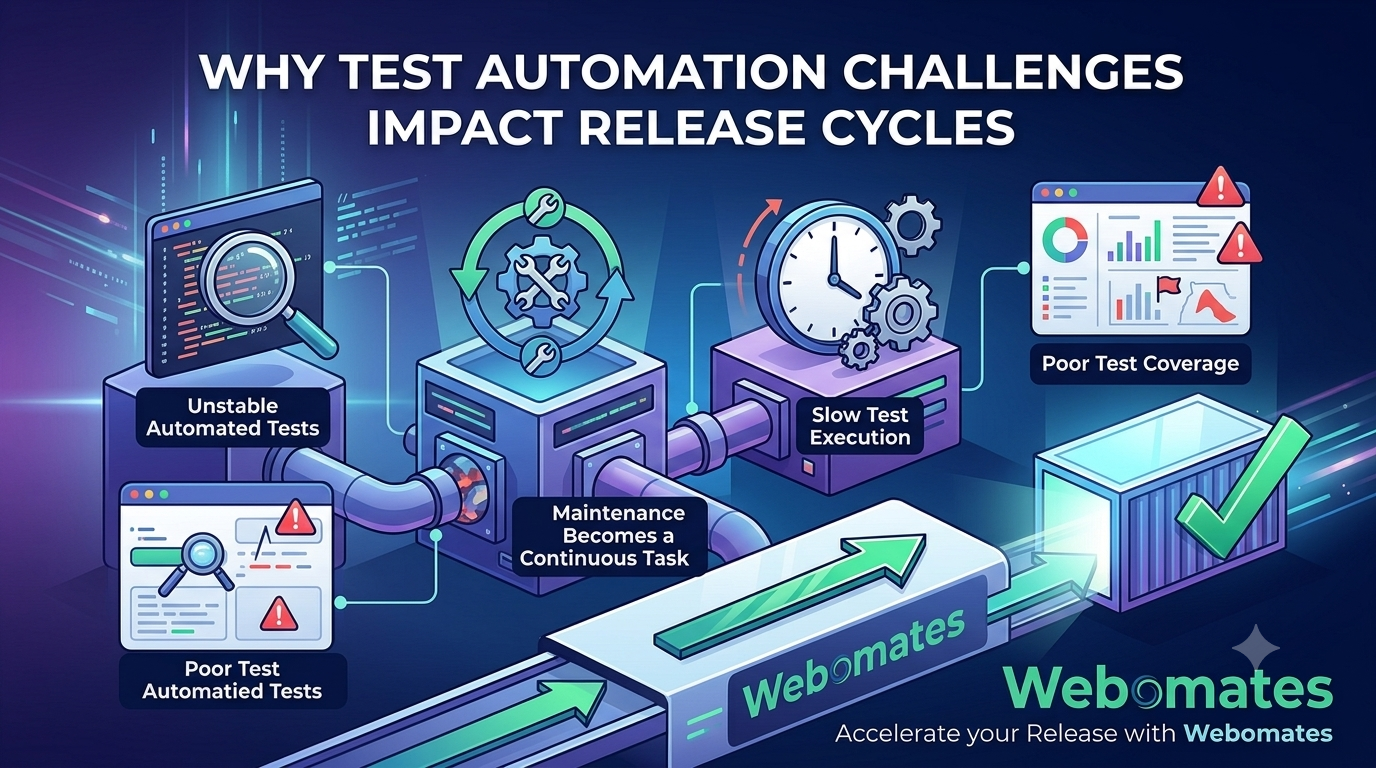
Modern software teams are expected to release features quickly without compromising quality. Automation helps QA teams execute repetitive checks, validate critical workflows, and support faster delivery. However, when automation is difficult to build, maintain, or scale, it can create delays instead of removing them. This is why automation issues can have a direct effect on release cycles. Understanding these problems helps organizations improve testing efficiency and keep development schedules predictable.
Unstable Automated Tests Create Delays
One of the biggest Test automation challenges is test instability. Automated tests may fail because of timing issues, changing environments, unreliable test data, or minor interface updates rather than genuine product defects. When teams cannot quickly determine whether a failure is valid, QA engineers spend valuable time investigating false positives. These repeated investigations slow regression testing and make release decisions harder. A stable automation suite should provide dependable results so teams can act with confidence.
Maintenance Becomes a Continuous Task
Software changes constantly. New features, redesigned screens, updated APIs, and modified business rules can make existing scripts outdated. Test automation challenges become more visible when maintenance takes too much time. If scripts are tightly connected to application details, even small changes may require extensive updates. Developers and testers may then postpone maintenance, causing the suite to become less reliable over time. A well-designed framework should make updates easier and reduce the effort required to keep tests aligned with the application.
Slow Test Execution Can Extend Release Windows
Speed is one of the primary reasons organizations adopt automation. Yet another common Test automation challenges issue is slow execution. Large regression suites can contain thousands of tests, and running them sequentially may take many hours. This becomes especially problematic when testing is performed late in the development cycle. Teams may have to wait for results before approving a release, increasing idle time between testing and deployment. Parallel execution, risk-based prioritization, and optimized test suites can help reduce these delays.
Poor Test Coverage Increases Rework
Automation does not automatically guarantee complete coverage. Teams may automate easy or repetitive cases while missing critical business scenarios, integrations, edge cases, and negative conditions. Incomplete coverage is one of the Test automation challenges that can indirectly lengthen release cycles. When important defects escape automated checks, they may be discovered during manual testing, staging, or even after deployment. Fixing these issues late in the cycle often requires additional testing and validation, creating unplanned rework.
Automation Tool Complexity Can Slow Teams
Selecting and managing the right tools also matters. Some automation platforms require significant coding knowledge, complicated configurations, or multiple integrations. These automation issues can make onboarding slower and create dependency on a small group of specialists. If only a few people understand the framework, testing can become a bottleneck when those individuals are unavailable. Simpler workflows, reusable components, clear documentation, and accessible reporting can make automation easier for the entire QA team to manage.
Environment and Data Problems Affect Reliability
Automated tests depend on stable environments and accurate test data. Differences between development, testing, staging, and production-like systems can cause inconsistent results. Test automation challenges often become harder to diagnose when failures are actually caused by environment configuration, unavailable services, expired credentials, or incorrect data. Teams may spend hours troubleshooting infrastructure instead of validating software quality. Standardized environments, dependable data management, and strong monitoring can reduce these interruptions and improve test reliability.
Communication Gaps Delay Defect Resolution
Automation results are most valuable when developers, testers, and product teams can understand them quickly. Unclear reports or incomplete failure details can create another layer of Test automation challenges. A failed test without useful logs, screenshots, or execution context may require back-and-forth communication before anyone can identify the root cause. This slows defect triage and can push fixes closer to the release deadline. Clear dashboards, actionable reports, and automatic notifications help teams collaborate faster.
Scaling Automation Requires Better Strategy
As applications grow, automation must grow with them. Simply adding more scripts can increase execution time, maintenance work, and infrastructure requirements. Test automation challenges become more significant when teams lack a strategy for deciding what to automate, what to prioritize, and what to retire. A scalable approach focuses on high-value tests, reusable assets, parallel execution, and regular suite optimization. This keeps automation focused on business-critical coverage rather than creating an oversized collection of fragile tests.
How Teams Can Protect Release Cycles
Reducing automation-related delays requires a proactive approach. Teams should regularly review flaky tests, remove obsolete scripts, improve test data, monitor execution time, and prioritize scenarios based on risk. Integrating automated testing earlier in the development process also helps identify problems before the final release stage. Most importantly, QA teams should treat automation as an evolving engineering practice rather than a one-time project. By addressing root causes instead of repeatedly working around failures, organizations can create faster, more predictable release cycles.
Conclusion
Test automation challenges can affect release cycles through unstable tests, slow execution, maintenance demands, weak coverage, environment issues, and poor collaboration. The goal is not simply to automate more tests, but to build a reliable testing process that provides fast and trustworthy feedback. By improving test design, reporting, scalability, and maintenance practices, organizations can reduce release bottlenecks and improve software quality. Solutions such as Webomates can help teams strengthen their automation strategy and support more efficient, confident software releases.
Categories
- Artificial Intelligence (AI)
- Technology
- Business
- Education
- Science
- Lifestyle
- Healthcare
- Entertainment
- Politics
- Environment
- Travel
- Finance
- Automobile
- News
- Art
- Causes
- Crafts
- career
- Dance
- Drinks
- Film
- Fitness
- Food
- Games
- Gardening
- Health
- Home
- Literature
- Music
- Networking
- Other
- Party
- Religion
- Shopping
- Sports
- Theater
- Wellness
Read More
Contactless Overhead Scanning System Market Insights According to a new report from Intel Market Research, the global Contactless Overhead Scanning System market was valued at USD 127 million in 2025 and is projected to reach USD 195 million by 2034, growing at a robust CAGR of 6.5% during the forecast period (2025–2034). This expansion is driven by accelerating digitization...

The GCC Aesthetics Market is expanding as consumers across the Gulf region show growing interest in aesthetic procedures, personalized beauty services, and advanced treatment technologies. According to Market Research Future, the market was valued at USD 62.05 million in 2024 and is projected to reach USD 150 million by 2035, growing at a CAGR of 8.36% during 2025–2035. Non-invasive...
Ultrasonic Devices Market Growth is being shaped by rising demand for non-invasive diagnostic solutions and continuous advancements in medical imaging technologies. Healthcare systems across developed and emerging economies are increasingly adopting ultrasound-based solutions for faster and safer clinical decision-making. Expanding use in cardiology, gynecology, and radiology is further...
The global telecommunications landscape is undergoing its most significant structural shift since the transition from dial-up to broadband. As the world becomes increasingly reliant on low-latency, high-bandwidth connectivity for everything from remote surgery to the metaverse, the physical infrastructure of the internet is being rebuilt from the ground up. At the core of this connectivity...
The Microelectronic Medical Implants Market is witnessing strong growth as healthcare systems increasingly adopt advanced implantable technologies for diagnosis, treatment, monitoring, and patient care. According to Market Research Future, the global market was valued at USD 39.20 billion in 2025 and is projected to reach USD 78.50 billion by 2035, expanding at a CAGR of 8.05% during the...
