


How Does Equipment Positioning Influence Air Distribution In A Modular OT With Laminar Airflow?
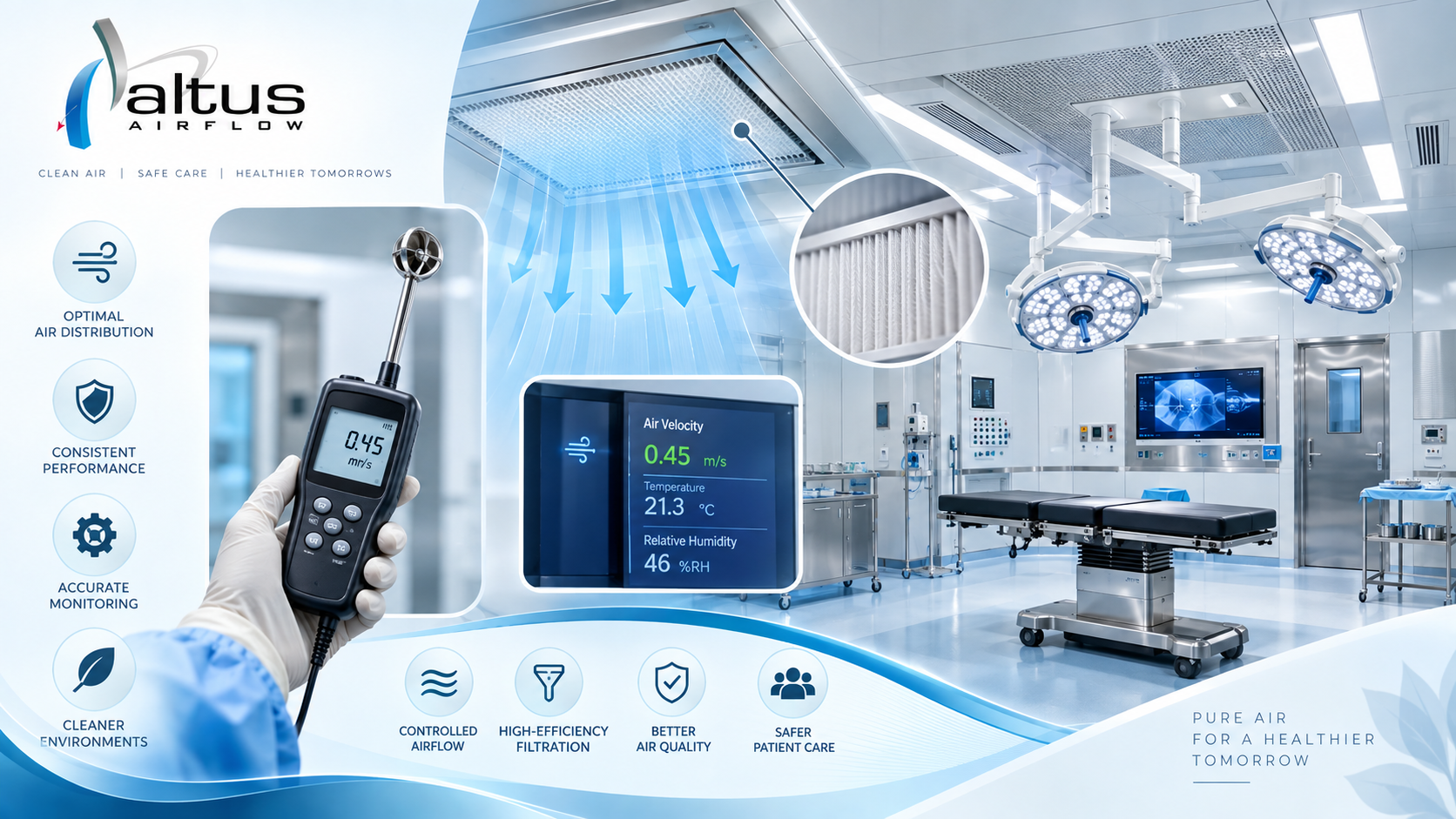
Introduction
Equipment positioning plays an important role in the performance of an operating theatre because surgical lights, medical pendants, equipment booms, monitors, surgical tables, and other fixtures can influence the movement and distribution of air. In a controlled theatre, airflow should be planned together with the room layout so that essential equipment does not unnecessarily interfere with the intended air pattern.
A Modular OT With Laminar Airflow combines controlled airflow distribution, HEPA filtration, HVAC systems, and modular construction to support a controlled surgical environment. Proper equipment positioning allows these components to work together more effectively and helps maintain the intended airflow around the critical surgical zone.
Why Equipment Positioning Matters
Laminar airflow systems are designed to provide a controlled and relatively uniform flow of filtered air over a designated area. However, physical objects installed within or near this airflow path can affect the movement of air.
Equipment can create obstructions, changes in direction, or areas of turbulence. The effect depends on the size, location, shape, and orientation of the equipment as well as the airflow configuration.
Therefore, equipment planning should be included during the early stages of OT design rather than being considered only after the HVAC system has been finalized.
Position of the Operating Table
The operating table is one of the most important reference points for airflow planning. The laminar airflow zone should be designed with consideration for the position of the table and the critical surgical area.
If the table is positioned outside the intended airflow zone, the benefits of the designed distribution may not be achieved as intended.
The table position should therefore be coordinated with the supply ceiling, laminar airflow unit, surgical lights, medical pendants, and other ceiling-mounted services.
Influence of Surgical Lights
Surgical lights are essential equipment but can also influence airflow because they are typically positioned above the operating table.
Their size, shape, mounting arrangement, and location can affect the movement of air from the laminar airflow supply toward the surgical area.
During the design stage, the position of surgical lights should be evaluated in relation to the airflow path. Proper coordination can help minimize unnecessary disruption to the intended airflow pattern.
Medical Pendants and Equipment Booms
Medical pendants and equipment booms provide convenient access to medical gases, electrical connections, and other services. However, their placement within the airflow zone needs careful consideration.
Large pendant structures can become physical obstructions to downward or directional airflow. Their location should therefore be coordinated with the laminar airflow ceiling and operating table.
Three-dimensional planning can help identify potential conflicts between these systems before installation begins.
Placement of Monitors and Other Equipment
Monitors, anesthesia equipment, surgical equipment, instrument stands, and other devices may also influence local air movement.
Although individual pieces of equipment may appear relatively small, multiple objects positioned around the operating area can collectively affect airflow.
The layout should therefore consider not only permanent equipment but also frequently used mobile equipment that may be positioned near the surgical zone during procedures.
Coordination With the HVAC System
Equipment positioning should be coordinated with the complete HVAC design. The air-handling unit, ductwork, supply terminals, filtration system, return air arrangement, and pressure strategy all contribute to the final airflow pattern.
Altus Airflow describes its modular OT systems as integrating laminar airflow and HEPA filtration with positive-pressure ventilation and other OT infrastructure. (altusairflow.com)
Because these systems operate together, changing the position of major equipment can require a review of the airflow arrangement.
Maintaining the Critical Airflow Zone
The critical airflow zone is the area where controlled air delivery is particularly important. Equipment should be positioned so that the intended airflow coverage is maintained over this zone.
The design team should consider the operating table, surgical lights, medical pendants, staff positions, and frequently used equipment when establishing the airflow zone.
This approach helps create a more coordinated relationship between clinical workflow and environmental control.
Effect of Ceiling-Mounted Services
The OT ceiling often contains several important systems, including laminar airflow modules, surgical lights, medical pendants, lighting fixtures, sensors, and other services.
If these components are installed without proper coordination, the ceiling can become crowded and airflow paths may be affected.
A coordinated reflected ceiling plan can help determine suitable locations for each component while considering the required airflow distribution.
Room Layout and Staff Movement
Airflow is also influenced by people moving around the surgical area. Staff members can act as temporary obstructions and may change local airflow behavior.
Equipment placement should therefore support the clinical workflow while avoiding unnecessary congestion around the critical surgical zone.
An effective OT layout balances accessibility, equipment requirements, staff movement, and airflow considerations.
Using 3D Design for Coordination
Three-dimensional design can be useful when planning equipment and airflow together. It allows designers to visualize the position of the operating table, surgical lights, pendants, equipment, ceiling systems, walls, and other components.
Potential clashes can be identified before installation, reducing the possibility of making significant changes during the construction phase.
3D coordination is particularly useful for complex operating theatres with multiple ceiling-mounted systems.
Airflow Testing After Installation
Equipment positioning should ultimately be evaluated through appropriate testing and commissioning. Airflow measurements and visualization can help determine whether the installed arrangement produces the intended airflow behavior.
Depending on the project requirements, testing may include airflow volume, velocity, uniformity, differential pressure, airflow visualization, HEPA filter integrity, and other environmental measurements.
If unexpected airflow patterns are identified, equipment positions or system settings may need to be reviewed.
Future Equipment Changes
Hospitals may add, replace, or reposition equipment over the life of an operating theatre. Such changes can affect the airflow environment, particularly when large equipment is introduced near the critical zone.
Before significant changes are made, the impact on airflow should be considered. Where necessary, airflow testing can be repeated after modifications.
This helps maintain alignment between the room configuration and the original airflow design.
Maintenance and Operational Considerations
Equipment positioning should also allow sufficient access for cleaning, maintenance, filter inspection, and servicing of HVAC components.
An overcrowded ceiling or restricted access area can make routine maintenance more difficult. Proper planning should therefore consider both airflow performance and long-term serviceability.
A well-designed modular OT should provide a practical balance between clinical equipment, airflow, maintenance access, and room functionality.
Conclusion
Equipment positioning has a direct relationship with airflow distribution in a Modular OT With Laminar Airflow. Operating tables, surgical lights, medical pendants, equipment booms, monitors, and other fixtures can influence the intended airflow pattern and should be considered during the design stage.
The best approach is to coordinate clinical layout, HVAC, filtration, ceiling services, and equipment placement as one integrated design. Proper planning, 3D coordination, commissioning, and periodic review can help maintain the intended airflow environment while supporting efficient surgical workflows.
FAQs
1. Why does equipment positioning affect laminar airflow?
Equipment can obstruct or redirect air movement. Its size, location, and orientation may influence the airflow pattern around the surgical area.
2. Can surgical lights affect airflow in a modular OT?
Yes. Surgical lights are typically positioned above the operating table and can influence airflow distribution. Their mounting position should therefore be coordinated with the laminar airflow system.
3. How should medical pendants be positioned in a laminar airflow OT?
Medical pendants should be positioned according to the approved room layout and airflow strategy while considering their size, movement, service requirements, and relationship with the critical airflow zone.
4. Can mobile equipment influence airflow?
Yes. Mobile equipment placed near the surgical area can temporarily alter local airflow patterns. Its position should be considered during workflow and airflow planning.
5. Should airflow be tested after equipment changes?
Yes. Significant changes to equipment layout, particularly around the critical airflow zone, may justify reviewing or re-testing airflow performance according to the project requirements.
Read Our Previous Blog --------->How Is Filter Performance Monitored In A Hepa Filter in Laminar Air Flow System?
Categories
- Artificial Intelligence (AI)
- Technology
- Business
- Education
- Science
- Lifestyle
- Healthcare
- Entertainment
- Politics
- Environment
- Travel
- Finance
- Automobile
- News
- Art
- Causes
- Crafts
- career
- Dance
- Drinks
- Film
- Fitness
- Food
- Games
- Gardening
- Health
- Home
- Literature
- Music
- Networking
- Other
- Party
- Religion
- Shopping
- Sports
- Theater
- Wellness
Read More
The Roofing Chemicals Market is covered by Business Market Insights with 2025 as the base year and 2026–2033 as the forecast period. The retrieved public source material for this batch did not expose all three headline values required for a verified numerical opening, so no market-size figure or CAGR is inferred. Market growth is best understood as the interaction between customer demand,...

Understanding the evolving landscape of the digital phase shifter market is crucial for stakeholders aiming to harness its potential. Currently, this market is on track to achieve a remarkable size of $15.64 billion by 2035, showcasing a promising CAGR of 5.54%. This growth reflects significant advancements in technology, particularly as 5G deployment accelerates globally. The increasing...

The global cold pain therapy market is gaining traction as healthcare providers and consumers increasingly shift toward non-invasive and drug-free pain management solutions. Also known as cryotherapy, cold pain therapy involves the application of low temperatures to reduce inflammation, swelling, and discomfort associated with injuries and chronic conditions. With rising cases of...

The Wireless Display Market was valued at US$ 6.02 Billion in 2025 and is projected to reach US$ 15.64 Billion by 2033, registering a CAGR of 12.68% during 2026–2033. The outlook is supported by smart-device proliferation, demand for cable-free content sharing, and higher-resolution video consumption. However, latency, security, and compatibility concerns and fragmented device ecosystems...
The marine search and rescue equipment market is becoming increasingly important as maritime organizations seek faster, safer, and more technology-driven ways to respond to emergencies at sea. Commercial shipping, fishing, offshore energy, naval operations, cruise transportation, and coastal security all depend on effective emergency response capabilities. Maritime accidents can occur far from...
