Rolfe Reflective Model Example: What? So What? Now What? Explained with a Sample
Reflective writing sounds simple until you're staring at a blank page with a 1,500-word reflection due on Friday. Most students know they should "think about what happened", but turning that into structured, mark-worthy writing is a different challenge. If you're after a clear Rolfe reflective model example you can learn from, this guide breaks the framework down step by step, explains each question properly, and finishes with a full sample reflection you can use as a pattern for your own work.
What Is the Rolfe Reflective Model?
The Rolfe reflective model is a three-stage framework that helps you examine an experience, understand its significance, and plan what to do differently. It rests on three questions: What? So what? Now what? Short, memorable and flexible, it works for almost any subject.
Where the Model Comes From
Gary Rolfe, Dawn Freshwater and Melanie Jasper published the framework in their 2001 book on reflective practice in nursing and the helping professions. It builds on an earlier developmental model by Terry Borton, who used the same three questions to guide learning from experience. Rolfe and colleagues expanded each question with prompts that push you beyond description and into genuine analysis. That expansion is why the model feels natural: it mirrors how people already think when they mull over a tricky situation, just with more structure and more honesty.
Why UK Universities Use It So Often
Lecturers across nursing, education, business, social work and healthcare programmes like Rolfe's model because it is easy to follow and hard to hide behind. You can't just narrate what happened; the "so what" and "now what" stages force you to analyse and commit to action. Many learners also turn to student academic support UK services when they first meet reflective assignments, because the shift from descriptive to critical writing feels unfamiliar. The good news is that once you understand the three questions, the structure does most of the heavy lifting, and your reflections become sharper with every attempt.
The Three Questions at a Glance
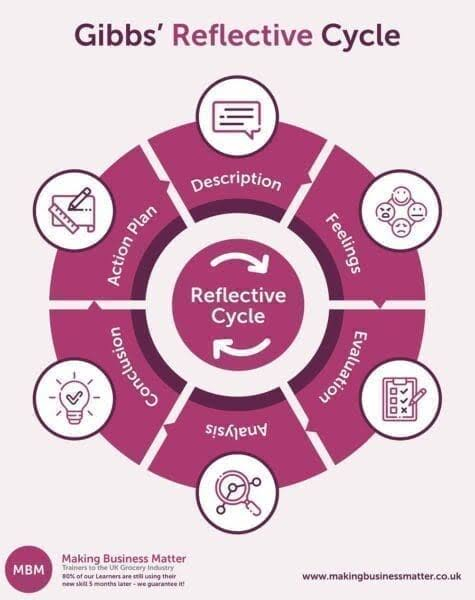
Think of the model as a simple journey. "What?" describes the situation. "So what?" explores why it mattered and what you learned. "Now what?" sets out the actions you will take next. Each stage should build on the one before, so your reflection reads as a connected story of learning rather than three separate lists.
Breaking Down Each Stage of the Model
Stage 1: What?
This is your descriptive stage. Explain what happened, who was involved, where it took place, and what your role was. Include what you were thinking and feeling at the time and what you and others did. Stay factual and concise. A common mistake is spending half the word count here. As a rule of thumb, keep it to roughly 25 percent of your reflection. Useful prompts include: What was the situation? What was I trying to achieve? What was my response? What was good and bad about the experience? Keep confidential details anonymous, especially in clinical or workplace settings.
Stage 2: So What?
This is the analytical heart of the model, and it should take up the biggest share of your word count. Here you ask why the situation mattered, what it taught you, and how it connects to theory, policy or professional standards. Did your actions match best practice? What assumptions were you making? How did your feelings shape your decisions? Bring in academic sources here to support your thinking, such as relevant studies, guidelines or professional codes. Strong "so what" sections compare what you did against what the literature recommends, then honestly assess the gap. This is where marks are usually won or lost.
Stage 3: Now What?
The final stage turns reflection into action. Based on your analysis, what will you do differently next time? What do you need to learn or practise? What are the possible consequences of changing your approach? Be specific and realistic. Instead of writing "I will communicate better", write "I will use a structured handover tool and confirm understanding by asking colleagues to repeat key information back to me. " Where possible, add a timeline or a way to measure progress, such as discussing the issue in supervision or completing a short training module.
A Sample Reflection Using Rolfe's Model
Below is a short sample based on a nursing student's placement experience. Use it as a pattern, not something to copy.
What?
During my second placement on a medical ward, I was assisting with a morning medication round when a patient became anxious and asked me several questions about a new tablet. My mentor had stepped away to answer a phone call. I felt nervous because I wasn't fully sure of the tablet's purpose, but I didn't want to appear uninformed. I gave a brief, general answer and told the patient the nurse would explain more. The patient appeared reassured, but I later realised I had not checked the medication details beforehand. When my mentor returned, I explained what had happened, and she reviewed the information with both of us.
So what?
Looking back, my main concern was protecting my confidence rather than meeting the patient's needs. This highlights a gap between my actions and the NMC Code (2018), which expects nurses to communicate clearly and work within their competence. Although I did not give incorrect information, my general answer risked leaving the patient less informed. Research on patient-centred care suggests that clear explanations about medication improve adherence and reduce anxiety. I also recognise that my hesitation came from a fear of judgement, a common experience among student nurses. However, I handled one thing well: I was honest about my limits and involved my mentor quickly, which protected patient safety. The experience showed me that asking for help is part of safe practice, not a sign of weakness.
Now what?
In the future, I will review each patient's medication list and the purpose of each drug before a round begins. I will also keep a pocket reference to look up unfamiliar medicines, and I will say, "Let me find the right person to answer that properly" instead of giving vague answers. Over the next month, I will discuss medication communication with my mentor during supervision and practise explaining common drugs in plain language. I will review my progress at the end of the placement.
Practical Tips for Writing Your Own Rolfe Reflection
- Balance your word count. Aim for around 25 percent on "what," 50 percent on "so what," and 25 percent on "now what."
- Write in the first person. Reflective writing is personal, so use "I" confidently.
- Link to theory. Cite academic sources, professional codes or course material in your "so what" section.
- Be honest. Markers value genuine insight over a flawless story. Discussing mistakes shows maturity.
- Make actions specific. Vague goals weaken your final section, so include steps, deadlines and measurable outcomes.
- Check your referencing. Use the style your university requires, such as Harvard or APA, consistently throughout.
Common Mistakes to Avoid
The most frequent problem is writing too much description. If your "what" section runs for several paragraphs, you're probably telling a story instead of analysing it. Another issue is skipping theory entirely, which leaves your reflection feeling like a diary entry. Some students also write generic action points that could apply to anyone, such as "I will work harder." Finally, don't ignore your emotions. Feelings are valid evidence in reflective writing, and exploring how they influenced your behaviour often produces your strongest analysis.
Final Thoughts
Rolfe's What? So what? Now what? The model is popular for a reason: it is simple enough to remember under pressure yet powerful enough to produce thoughtful, critical reflection. Start by describing the experience concisely, spend most of your effort analysing why it mattered using credible sources, and finish with clear, realistic actions. Follow the sample above, keep your structure tight, and your next reflective assignment will feel far less daunting.
Categories
- Artificial Intelligence (AI)
- Technology
- Business
- Education
- Science
- Lifestyle
- Healthcare
- Entertainment
- Politics
- Environment
- Travel
- Finance
- Automobile
- News
- Art
- Causes
- Crafts
- career
- Dance
- Drinks
- Film
- Fitness
- Food
- Games
- Gardening
- Health
- Home
- Literature
- Music
- Networking
- Other
- Party
- Religion
- Shopping
- Sports
- Theater
- Wellness
Read More
Satellite Internet Market According to the latest report published by Data Bridge Market Research, the Satellite Internet Market The Satellite Internet Market was valued at USD 13.16 billion in 2025 and is projected to reach USD 45.58 billion by 2033, growing at a CAGR of 16.80% from 2026 to 2033. The market is experiencing strong growth driven by increasing global...

The Data Center UPS Market is experiencing strong growth as data centers increasingly require reliable and uninterrupted power to support cloud computing, artificial intelligence (AI), Internet of Things (IoT), edge computing, and digital services. Uninterruptible Power Supply (UPS) systems protect critical IT infrastructure from power interruptions, voltage fluctuations, surges,...
Mange norske spillere begynner med en rask søkefrase, og lander på sider som lover mer enn de holder. Nettopp derfor bør du lese nettkasino anmeldelser med et våkent blikk. En skikkelig anmeldelse sier ikke bare om et casino ser pent ut, den viser hvordan det faktisk håndterer lisens, betalinger, vilkår og kundestøtte. Som et nyttig eksempel på...

According to a new report from Intel Market Research, the global Ammonia Energy Storage market was valued at USD 1.5 billion in 2022 and is projected to grow from USD 1.7 billion in 2023 to USD 6.4 billion by 2032, exhibiting a robust CAGR of approximately 14.8% during the forecast period. This expansion is driven by strengthening policy frameworks, rapid cost reductions in green ammonia...

If you've recently been advised to take a blood sugar test, you may have questions about why it's needed, what it measures, and how to understand the results. Fortunately, learning the basics is easier than you might think. A blood sugar test is a simple medical examination that measures the amount of glucose circulating in your bloodstream. Because glucose is your body's primary energy source,...