

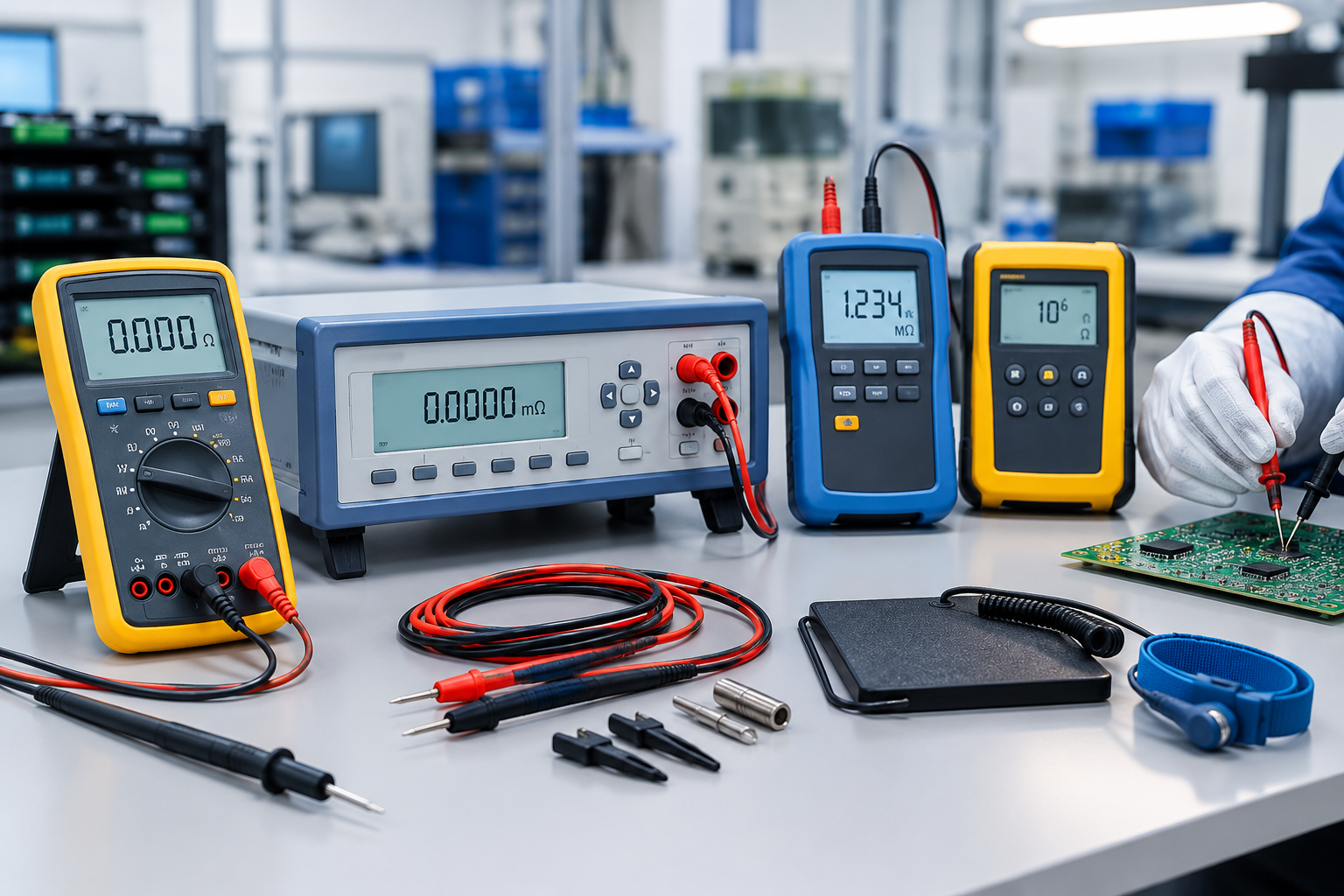
Building a Reliable Resistance Testing Routine for Electronics Manufacturing

In an electronics manufacturing environment, testing should not begin only after a problem appears. A loose connection, abnormal insulation condition, defective joint, or change in an ESD surface can develop gradually. By the time the problem becomes visible, it may already have affected production or equipment reliability.
A structured resistance testing routine gives maintenance and quality teams measurable information they can use to identify changes earlier.
This is where selecting suitable Resistance Meters Manufacturers becomes important. The instrument should match the application, resistance range, measurement method, and working environment. A general-purpose meter may be perfectly suitable for one task but inappropriate for another.
Reliable Spares & Consumables offers resistance measurement solutions for electrical testing, electronics production, maintenance, safety inspections, laboratories, and ESD-related applications. Its current product range includes resistance meters and a Digital Surface Resistivity Meter for ESD surfaces. Resistance Meters product range
Why a Planned Resistance Testing Routine Matters
Many organizations perform electrical testing reactively. A machine stops working, a technician investigates the circuit, and resistance measurements are taken to locate the fault.
That approach has value, but it has a limitation: testing begins after the abnormal condition has already affected the operation.
A planned testing routine is different. Measurements are performed at defined intervals or at specific stages of production and maintenance. Results can then be compared over time.
This approach can help teams identify:
-
Changes in electrical connections
-
Potentially defective joints
-
Abnormal grounding conditions
-
Insulation-related concerns
-
Changes in ESD-control surfaces
-
Unusual resistance readings during troubleshooting
Reliable's product information highlights routine testing, preventive maintenance, electrical safety checks, and early identification of loose connections, defective joints, insulation, and grounding problems as important applications of resistance meters.
Step 1: Define What You Actually Need to Measure
Before purchasing an instrument, identify the measurement requirement.
This sounds obvious, but it is one of the most important purchasing decisions.
A technician checking continuity on a circuit board has a different requirement from an engineer measuring a transformer winding. Likewise, checking an ESD workstation surface is different from measuring insulation resistance.
Common categories include:
General Resistance Measurement
Standard ohmmeters or digital multimeters are suitable for many basic resistance and continuity checks. These are commonly used by electronics technicians and maintenance personnel.
Low-Resistance Measurement
Micro-ohm meters are designed for very small resistance values. Applications can include transformer windings, busbar joints, motor connections, and circuit-breaker contacts.
For these applications, measurement technique becomes especially important because lead and contact resistance can influence the result.
High-Resistance Measurement
Insulation resistance testers are designed for high resistance values and are used for applications involving cables, motors, generators, transformers, and other electrical equipment.
Ground Resistance Measurement
Ground or earth resistance testers are designed to assess grounding systems and are used where electrical safety and effective earthing are important.
Surface Resistivity Measurement
ESD-controlled environments require another category of measurement. Surface resistivity meters can be used to evaluate suitable ESD mats, floors, workstations, clothing, and packaging materials.
The Reliable product page specifically lists these different resistance-meter categories and explains that the appropriate type depends on the intended application.
Step 2: Establish a Repeatable Test Procedure
Buying a good instrument does not automatically create a good testing process.
The operator should know exactly how the measurement is to be performed.
A basic procedure may define:
-
Equipment or material to be tested
-
Test location
-
Instrument or meter type
-
Probe or electrode arrangement
-
Measurement conditions
-
Acceptable range
-
Frequency of testing
-
Required documentation
-
Corrective action for abnormal readings
This becomes especially important when several technicians perform the same testing activity.
If one technician tests a surface in one location and another uses a different position or method, their readings may not be directly comparable.
Consistency is therefore part of measurement quality.
Step 3: Pay Attention to Contact Quality
The contact between the test instrument and the item being measured can affect the result.
Dirty surfaces, oxidation, loose probes, inconsistent pressure, and poor connections may introduce measurement variation.
For low-resistance applications, the problem becomes even more important. When the resistance under test is extremely small, resistance from the test leads and contacts can become significant.
This is one reason specialized low-resistance instruments may use four-terminal Kelvin measurement. The method separates the current path from the voltage-sensing path, helping reduce the influence of lead resistance.
Most buyers focus heavily on the meter specification and less on the test connection. In practice, both matter.
Step 4: Create Baseline Measurements
A baseline provides a useful reference point.
For example, when a new machine, workstation, or ESD surface is installed, the organization can record initial measurements according to its applicable testing procedure. Future readings can then be compared with that baseline.
A trend may be more informative than a single number.
If repeated measurements remain consistent, the test result provides confidence that the measured property has remained stable. If measurements gradually change, the maintenance or quality team has a reason to investigate.
Data logging can make this process easier. The Reliable page identifies data logging as a useful feature of modern resistance meters because readings can be stored for later review and record-keeping.
Resistance Testing in ESD-Controlled Work Areas
ESD protection is particularly relevant to electronics manufacturers because static-control materials need to perform as intended.
A workstation may look perfectly normal while its electrical characteristics have changed because of contamination, wear, aging, cleaning practices, or other factors.
A suitable surface resistivity meter provides measurable information about the surface rather than relying on visual inspection alone.
Reliable's Digital Surface Resistivity Meter is described for point-to-point resistance testing of ESD surfaces, including workstations, floors, mats, clothing, and packaging materials.
However, the instrument should be used according to the applicable test procedure and acceptance criteria. A resistance reading by itself does not represent the complete effectiveness of an ESD control program.
How Procurement Teams Should Evaluate Suppliers
When comparing Resistance Meters Suppliers, procurement teams should provide the supplier with the actual application instead of simply asking for the cheapest meter.
Useful information includes:
-
Required resistance range
-
Type of equipment or material
-
Expected measurement accuracy
-
Frequency of testing
-
Laboratory or production-floor environment
-
Required probes and accessories
-
Data-recording requirements
-
Calibration or verification needs
-
Quantity required
-
Technical support expectations
A supplier who understands these requirements can recommend a more appropriate instrument.
This is particularly important for companies purchasing multiple meters for different departments. The instrument used by a maintenance technician may not be the same type required by an ESD or quality-control team.
What to Check When Comparing Resistance Meters Dealers in India
For organizations searching for Resistance Meters Dealers in India, price is only one purchasing factor.
A practical comparison should include:
Application suitability: Does the meter perform the required type of resistance measurement?
Measurement capability: Does the range and accuracy meet the testing requirement?
Usability: Can technicians operate the instrument consistently?
Accessories: Are appropriate probes, leads, electrodes, or other accessories available?
Support: Can the supplier provide application guidance when required?
Long-term availability: Can replacement accessories and service support be obtained when needed?
This approach helps avoid a common procurement mistake: buying an instrument that appears suitable on paper but does not fit the actual testing procedure.
Why Choose Reliable Spares & Consumables?
Reliable Spares & Consumables has 19 years of industry experience in ESD protection products and industrial electronics manufacturing tools and consumables.
Its resistance meter range is positioned for electrical testing, electronics manufacturing, maintenance, laboratories, industrial environments, and ESD surface testing. The company also provides application-based guidance for selecting different types of resistance measurement equipment.
For manufacturers, EMS companies, PCB assembly facilities, OEM electronics manufacturers, maintenance teams, laboratories, and procurement professionals, this application-focused approach can make equipment selection more practical.
Explore the available models and technical information on the Resistance Meters page.
Final Takeaway
A reliable resistance testing program is built around three things: the correct instrument, a consistent testing method, and meaningful records.
The meter should match the application, whether the requirement involves general resistance, low-resistance measurement, insulation, grounding, or ESD surface testing. The procedure should be repeatable so different operators can obtain comparable results. Finally, recorded measurements can help quality and maintenance teams identify changes over time.
For companies evaluating Resistance Meters Manufacturers, Resistance Meters Suppliers, or Resistance Meters Dealers in India, the best purchasing decision is therefore not simply about obtaining a meter at a competitive price.
It is about selecting measurement equipment that fits the real testing requirement and supports dependable decisions throughout the equipment's working life.

