

Recycled Polypropylene Market Opportunities in Packaging and Automotive Applications

Market Overview
According to Market Research Future® (MRFR), the Recycled Polypropylene Market is positioned for continued development as industries look for practical ways to recover plastic waste and incorporate recycled materials into production. Polypropylene is used in a wide range of products, including packaging, automotive components, construction materials, and textiles. Recycling this polymer can help retain material value and reduce reliance on virgin plastic, provided recovered feedstock meets the technical and commercial requirements of end users.
The market's evolution is closely linked to the development of circular-economy practices. Instead of treating used plastic solely as waste, manufacturers and recyclers are working to establish systems that collect, sort, process, and return suitable material to productive use. The success of these systems depends on collaboration among waste-management companies, recyclers, resin suppliers, converters, and product manufacturers.
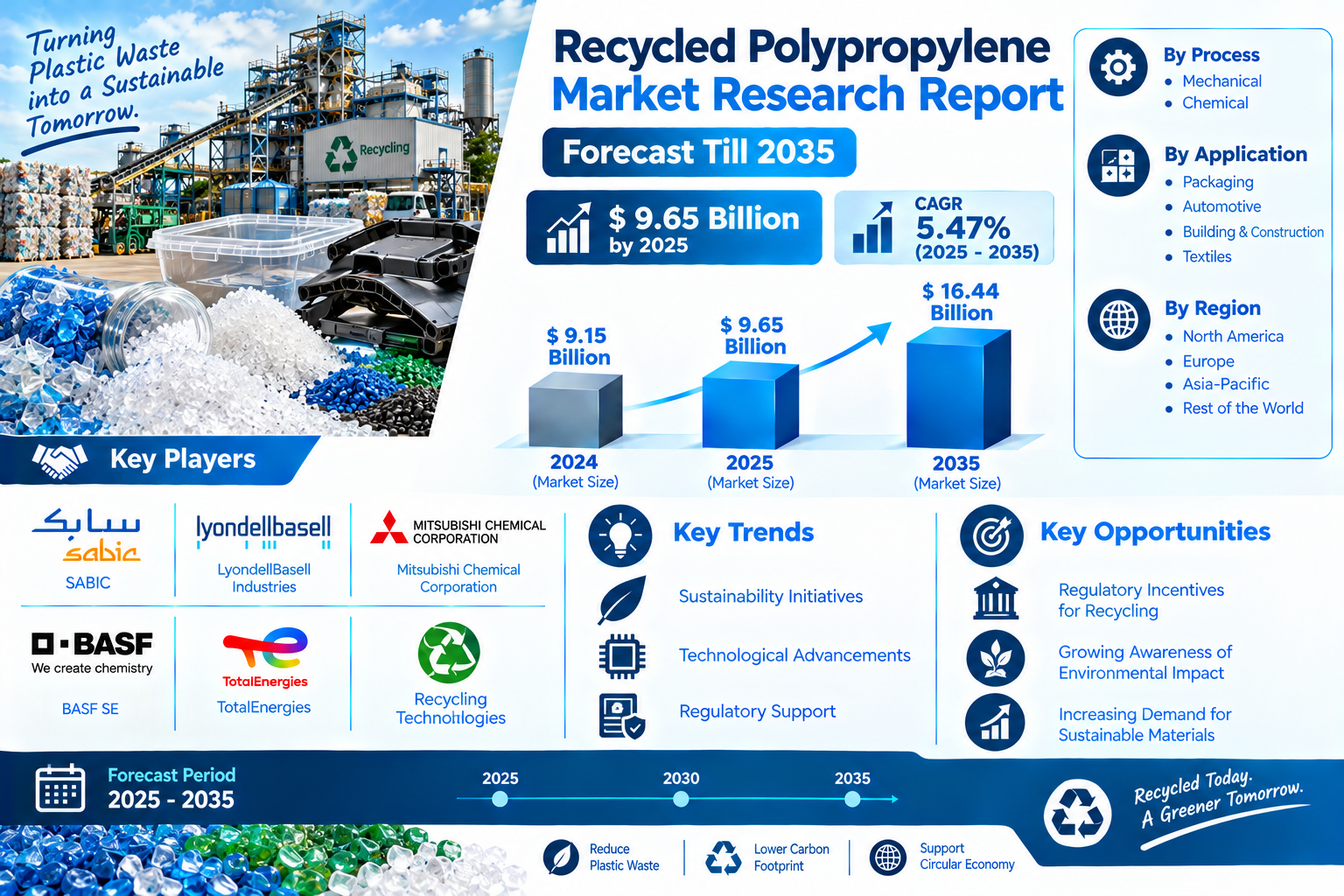
The industry is divided into mechanical and chemical recycling processes. Its major applications are packaging, automotive, building and construction, and textiles. North America, Europe, Asia-Pacific, and the Rest of the World represent the key regional markets. Each segment has distinct opportunities and constraints, shaped by waste collection, industrial demand, local regulations, infrastructure, and the performance standards expected of recycled materials.
Market Size and Forecast Outlook
The Recycled Polypropylene Market was valued at USD 9.15 billion in 2024 and is projected to grow from USD 9.65 billion in 2025 to USD 16.44 billion by 2035. The market is expected to register a CAGR of 5.47% during the 2025–2035 forecast period. This outlook indicates increasing commercial interest in recovering polypropylene and using it as a resource for new products.
Market expansion will depend on whether the industry can establish consistent supplies of appropriately sorted plastic waste. Polypropylene products may contain pigments, fillers, additives, labels, and other materials that complicate recycling. Differences in waste quality can influence processing efficiency and the properties of the recovered polymer. Investments in sorting, washing, contamination removal, and quality control can help address these challenges.
Demand will also depend on manufacturers' ability to incorporate recycled polypropylene without compromising product performance. Buyers need materials that meet their requirements for strength, flexibility, durability, appearance, and processing behaviour. Suppliers that deliver consistent grades and dependable volumes may be better positioned to establish long-term customer relationships.
Growth Opportunities
Regulatory incentives for recycling offer an opportunity to strengthen the market. Governments and regulatory authorities can influence material recovery through waste-management requirements, recycling targets, producer-responsibility frameworks, and incentives for recycling infrastructure. Where such measures encourage higher collection rates and better sorting, they can increase the supply of recyclable polypropylene. The resulting impact depends on the details of each policy and the availability of implementation resources.
Growing awareness of environmental impact is another source of opportunity. Businesses are increasingly examining the material choices behind packaging and manufactured products, while consumers are exposed to more discussion about plastic waste and resource efficiency. These considerations can encourage companies to explore recycled polymers as part of their product and procurement strategies. Clear evidence of recycled content and credible environmental claims can help strengthen buyer confidence.
Increasing demand for sustainable materials may create opportunities in packaging, automotive manufacturing, construction, and textiles. Packaging converters can assess recycled polypropylene for suitable products, while automotive suppliers may consider it for selected components where performance requirements permit. Construction manufacturers can investigate its use in appropriate products, and textile-related applications may offer opportunities where the recycled material meets relevant specifications.
The most promising opportunities are likely to emerge where environmental objectives align with practical economics. Recyclers need efficient operations and adequate feedstock, while manufacturers need reliable materials at competitive prices. Partnerships across the value chain can help coordinate these requirements and improve the commercial viability of recycled polypropylene.
Regional Analysis
North America represents a market in which recycling infrastructure, corporate sustainability programmes, and demand from established manufacturing industries can influence adoption. Packaging and automotive applications provide potential outlets for recycled polypropylene, although regional progress depends on collection efficiency, sorting capabilities, material specifications, and the economics of recycling compared with virgin resin.
Europe's market development is influenced by sustainability priorities and regulatory attention to plastic waste and resource efficiency. Manufacturers seeking to improve material circularity may evaluate recycled polypropylene for suitable applications. The region's prospects depend on effective collection systems, the quality of recovered plastics, consistent standards, and the ability of recyclers to supply material that meets industrial requirements.
Asia-Pacific offers opportunities linked to its manufacturing base and demand for packaging, consumer products, construction materials, and automotive components. Growth in recycling capacity and improvements in waste collection could support greater use of recovered polypropylene. However, conditions differ considerably between countries, and market development depends on infrastructure investment, regulatory frameworks, sorting practices, and demand for recycled materials.
The Rest of the World includes markets with varied levels of recycling infrastructure and industrial development. Opportunities may arise as waste-management systems improve and manufacturers explore more resource-efficient materials. Regional expansion will depend on investment, technology access, logistics, local policy conditions, and the availability of suitable end markets.
Recent Industry Developments
The main industry themes relevant to this market include sustainability initiatives, technological advancements, and regulatory support. These broad developments indicate the areas in which businesses are focusing their attention as they seek to improve material recovery and expand the use of recycled plastics. No specific dated company announcements were provided in the supplied market information, so individual projects or transactions cannot be confirmed here.
Across the recycling value chain, continued process improvement remains important. Mechanical recycling can benefit from better separation, cleaning, and quality control, while chemical recycling development focuses on processing suitable waste streams through different conversion methods. The commercial relevance of each technology depends on feedstock characteristics, energy and operating costs, environmental performance, and the quality of the output.
Market Challenges
Despite its growth potential, the market faces challenges associated with feedstock quality, collection infrastructure, and processing costs. Plastic waste can vary significantly in composition, and contamination can reduce the efficiency of recycling or limit the applications for which the recovered material is suitable. Improving collection and sorting systems is therefore essential to building dependable supply.
Price competition with virgin polypropylene also affects adoption. If virgin resin becomes less expensive, buyers may have fewer immediate financial incentives to switch to recycled alternatives. Recyclers must manage costs while maintaining material quality and reliable delivery. Regulatory uncertainty and differences in recycling standards across markets can further complicate investment and cross-border trade.
Competitive Landscape
Key companies identified in the market include SABIC, LyondellBasell Industries, Mitsubishi Chemical Corporation, BASF SE, TotalEnergies, and Recycling Technologies. Competitive positioning across the wider industry may be shaped by recycling expertise, processing technology, supply-chain partnerships, material quality, and the ability to meet customer requirements at scale.
Over the forecast period, the industry's progress will depend on turning recycling objectives into dependable commercial supply chains. Companies that can secure suitable feedstock, improve process efficiency, and deliver consistent recycled polypropylene may be well positioned to serve manufacturers seeking more sustainable material options.

