

Industrial Hydraulic Filters Market Opportunities in Construction, Manufacturing and Mining

Market Overview
According to Market Research Future® (MRFR), the Industrial Hydraulic Filters Market is projected to expand steadily over the 2025–2035 forecast period as industries continue to rely on hydraulic equipment for power transmission and controlled mechanical operations. Hydraulic filters help preserve fluid quality by capturing contaminants that could otherwise impair pumps, valves, actuators, and other system components. Their performance is closely connected to equipment reliability, maintenance requirements, and the cost of operating industrial machinery.
The market serves a wide range of applications, including fluid power systems, construction machinery, agricultural equipment, marine applications, and metal processing. Each setting presents different demands in terms of pressure, flow, contamination exposure, operating temperature, and maintenance frequency. Consequently, filter selection depends on the system design and the conditions under which the equipment operates.
As industrial customers focus on limiting avoidable downtime and improving asset utilization, filtration remains a practical component of preventive maintenance. The market's outlook is supported by recurring replacement needs as well as demand associated with the deployment and servicing of hydraulic equipment.
Market Size and Forecast Outlook
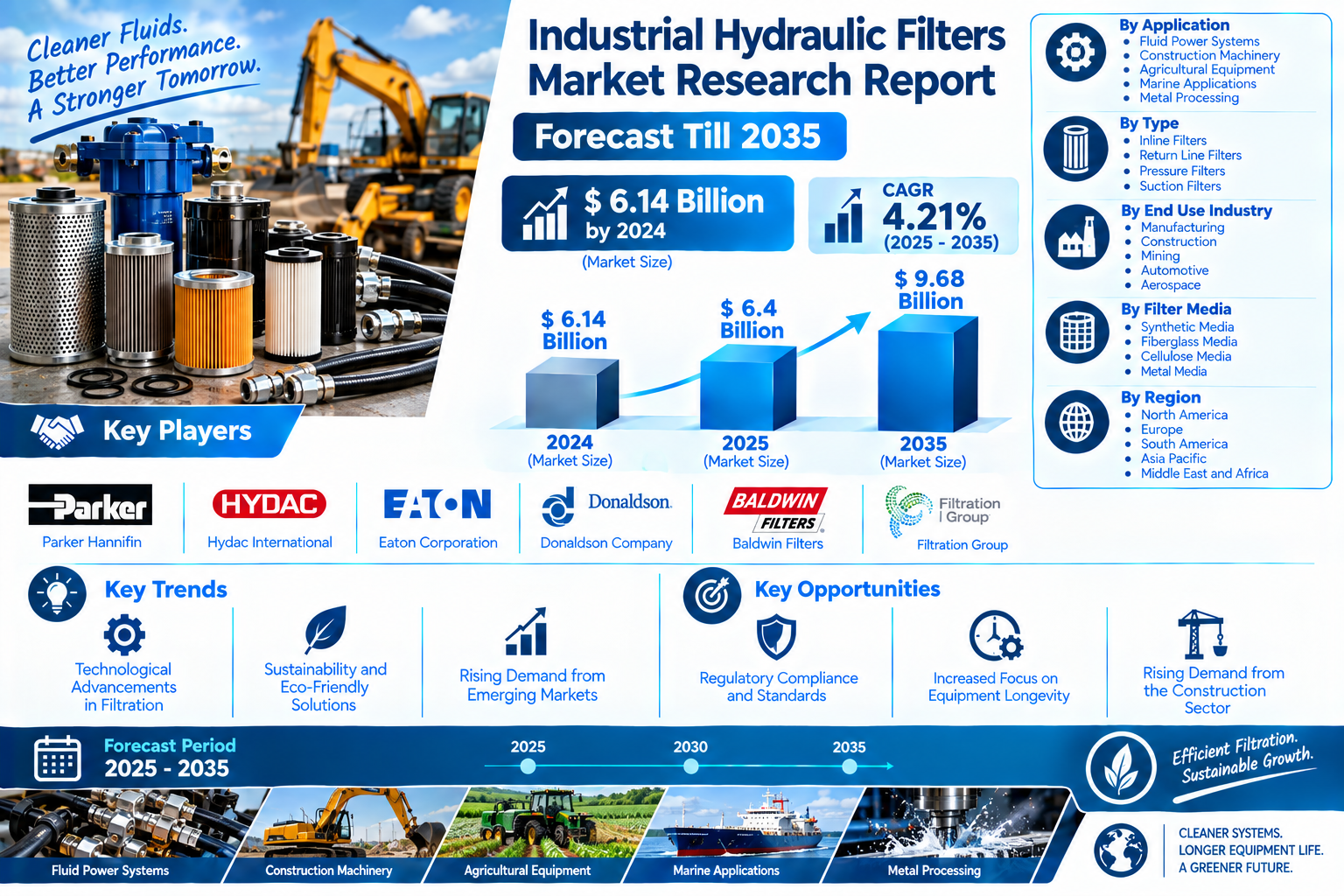
The Industrial Hydraulic Filters Market reached USD 6.14 billion in 2024 and is estimated at USD 6.4 billion in 2025. By 2035, its value is forecast to rise to USD 9.68 billion, representing a compound annual growth rate (CAGR) of 4.21% over the 2025–2035 forecast period.
This outlook reflects the long-term role of hydraulic systems in industrial productivity. Manufacturing plants use hydraulic equipment in production processes and machinery, while construction and mining operations rely on hydraulic power for heavy-duty equipment. Agricultural machinery and marine systems also require filtration to maintain dependable operation under varying workloads and environmental conditions.
Growth is expected to come from several sources. The first is the need to service existing equipment, where filters are replaced as part of routine maintenance. The second is demand from new and upgraded machinery, which creates requirements for compatible filtration components. The third is the pursuit of better equipment protection, as operators look for ways to control wear, improve uptime, and manage maintenance spending.
The market's expansion will not be uniform across every application. Purchasing decisions are influenced by industrial investment, equipment utilization, maintenance practices, and the cost of replacement products. Nevertheless, filtration remains relevant wherever hydraulic-fluid cleanliness is essential to system performance.
Growth Opportunities
Regulatory compliance and industry standards create opportunities for filtration suppliers. Industrial operators must consider the operating requirements applicable to their equipment and the maintenance practices needed to keep systems functioning reliably. Filters that meet appropriate technical specifications can help users maintain fluid cleanliness and support consistent equipment performance. Suppliers that offer clear product information and application guidance may be better positioned to serve customers with specific operating requirements.
A second opportunity lies in the increasing focus on equipment longevity. Replacing major hydraulic components can be costly, and unexpected failures can interrupt production or project schedules. Effective filtration helps limit contamination-related damage, making it relevant to businesses seeking to extend machinery service life. Demand may benefit from maintenance strategies that emphasize regular inspections, suitable filter selection, and timely replacement.
Construction represents another potential source of growth. Construction machinery frequently operates in dusty environments and under heavy loads, conditions that increase the importance of fluid protection and maintenance. Infrastructure development and equipment utilization can support demand for filters used in excavators, loaders, and other hydraulic machinery. The scale of this opportunity will depend on regional construction activity and investment conditions.
Further opportunities may emerge from improved filtration designs and maintenance practices. Products that balance contaminant removal, flow requirements, durability, and operating costs can address the priorities of industrial users. Suppliers may also support customers through technical advice and product ranges suited to different hydraulic configurations.
Regional Analysis
The market is divided into North America, Europe, South America, Asia Pacific, and the Middle East and Africa. These regions encompass a diverse mix of manufacturing operations, infrastructure projects, agricultural activity, marine applications, and heavy-equipment markets. Their respective demand patterns are shaped by industrial development, investment levels, equipment fleets, and maintenance practices.
North America has a broad industrial base and established markets for construction, manufacturing, and machinery maintenance. Demand for hydraulic filters is connected to the operation and servicing of equipment across these sectors. Product performance, availability, and compatibility with existing machinery are important considerations for industrial buyers.
Europe's industrial and manufacturing activities provide a continuing need for dependable hydraulic systems and filtration components. Equipment maintenance, operational efficiency, and environmental considerations can influence purchasing decisions. Suppliers must address a range of machinery requirements and customer expectations across industrial applications.
Asia Pacific offers potential for market development through manufacturing activity, infrastructure investment, agricultural mechanization, and the use of industrial equipment. The pace of demand will vary across countries according to economic conditions and investment priorities. South America and the Middle East and Africa also present opportunities associated with construction, mining, agriculture, and other equipment-intensive industries, although growth will depend on local industrial activity and capital spending.
Recent Industry Developments
Key industry themes include technological advancements in filtration, sustainability initiatives, and rising demand from emerging markets. These themes indicate areas of ongoing industry focus rather than specific announcements by individual companies. No dated company-specific product launches, acquisitions, or other confirmed developments were provided in the supplied market information.
Filtration technology continues to be an important area for product development because hydraulic systems differ in pressure, flow, contamination exposure, and operating conditions. Improvements in product design and media selection can help suppliers address these differences. At the same time, maintenance planning and contamination monitoring remain important considerations for equipment owners seeking to reduce avoidable failures.
Sustainability is also influencing industrial decision-making. Better equipment protection can support longer machinery life and reduce the need for premature component replacement. Emerging markets are another focus because expanding industrial capacity and equipment deployment can generate demand for filtration products and replacement components.
Market Challenges
Despite the market's positive outlook, suppliers face several challenges. Industrial customers must weigh filtration performance against acquisition costs, replacement frequency, and overall maintenance budgets. In cost-sensitive settings, buyers may prioritize immediate expenditure even when a higher-performing product could offer benefits over a longer operating period.
Product compatibility is another concern. Filters must suit the hydraulic system's pressure, flow, fluid, and contamination requirements. An unsuitable product can compromise system performance, making correct specification and technical guidance important. Industrial equipment also operates in varied environments, so a solution appropriate for one application may not meet the requirements of another.
Market performance is additionally influenced by changes in industrial investment and equipment demand. When customers delay capital spending or reduce machinery utilization, purchases associated with new installations may weaken. Suppliers must therefore balance new-equipment demand with recurring replacement requirements.
Competitive Landscape
Parker Hannifin, Hydac International, Eaton Corporation, Donaldson Company, Baldwin Filters, and Filtration Group are identified among the key participants in the Industrial Hydraulic Filters Market. Competition centers on filtration performance, product reliability, application coverage, availability, and customer support.
The market includes inline filters, return-line filters, pressure filters, and suction filters. Filter media options include synthetic media, fiberglass media, cellulose media, and metal media. These categories serve different hydraulic configurations and operating conditions, creating a need for suppliers to offer suitable product choices rather than relying on a single filtration approach.
As the market advances toward 2035, demand is expected to remain connected to equipment reliability, industrial activity, regulatory considerations, and preventive maintenance. Companies that help customers protect hydraulic systems while balancing performance and operating costs may be well placed to compete in this steadily expanding market.

