


How Can Commercial Bug Sweeps Services Help Protect Your Business?
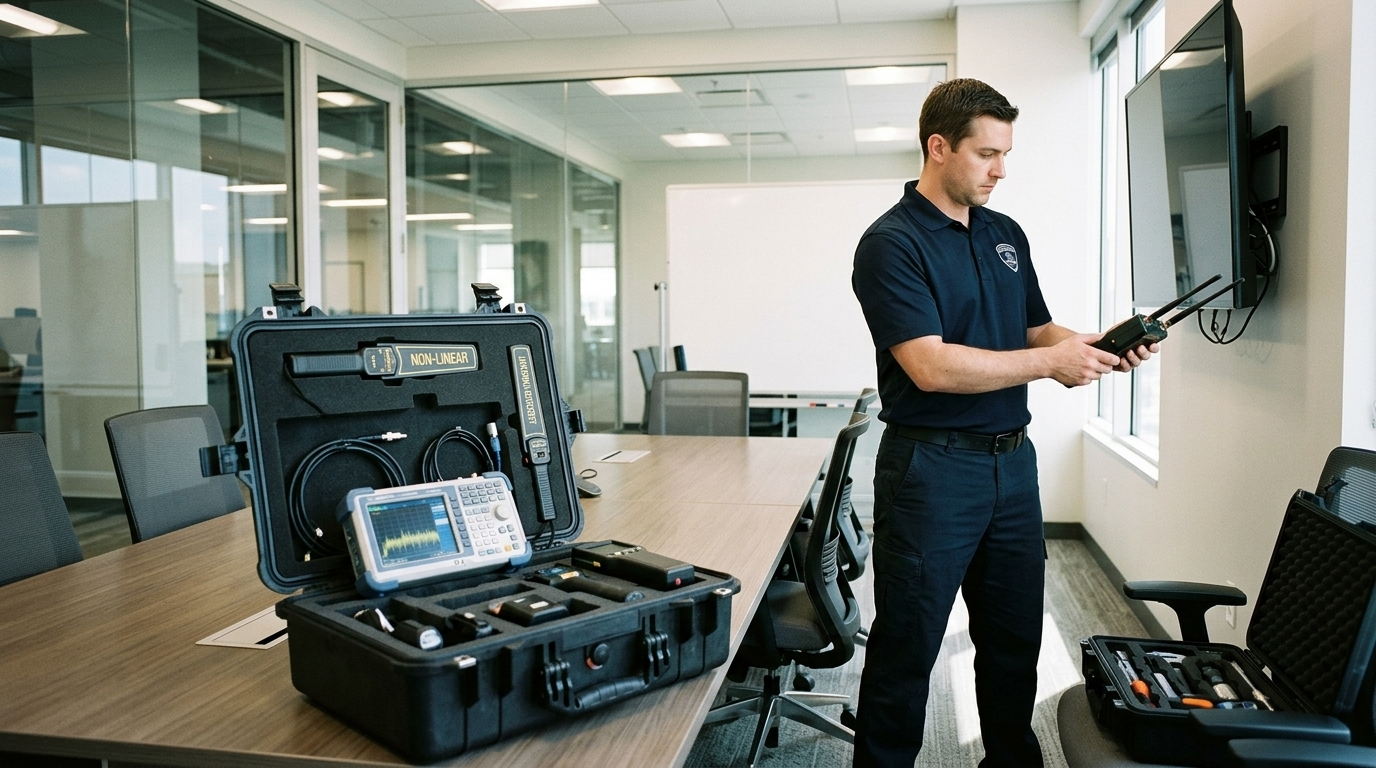
Confidential business discussions, financial negotiations, intellectual property, and strategic decisions can become vulnerable when unauthorized surveillance devices are introduced into a workplace. For organizations that handle sensitive information, protecting conversations is an important part of corporate security. Commercial bug sweeps services help businesses assess potential electronic surveillance risks by examining offices, conference rooms, executive suites, and other sensitive locations for signs of unauthorized monitoring equipment.
Modern surveillance threats are not always easy to identify through a visual inspection. Certain devices may be concealed inside everyday objects, connected to existing infrastructure, or designed to transmit information without attracting attention. A business may therefore have limited visibility into its physical privacy risks without a structured security assessment.
Technical Surveillance Countermeasures (TSCM), commonly known as professional bug sweeping, focuses on identifying and assessing potential technical surveillance threats. Depending on the scope of an engagement, qualified specialists may use radio frequency analysis, physical inspections, equipment testing, and other appropriate methods to investigate suspicious findings.
For companies, law firms, financial institutions, government contractors, and executive offices, a properly scoped TSCM assessment can support a broader strategy for protecting sensitive communications. Understanding how these services work helps decision-makers determine when an inspection is appropriate and what to expect from a professional provider.
What Are Commercial Bug Sweeps Services?
Commercial bug sweeps services are specialized security inspections designed to identify potential unauthorized surveillance devices and technical vulnerabilities within business premises. These services are typically delivered by professionals with experience in Technical Surveillance Countermeasures.
Unlike ordinary security checks, a TSCM inspection considers the possibility that confidential information could be collected through covert audio, video, or electronic monitoring equipment.
Depending on the assignment, an inspection may focus on:
-
Potentially concealed microphones or audio monitoring devices.
-
Unauthorized cameras in sensitive business areas.
-
Suspicious radio frequency transmissions.
-
Unapproved electronic equipment connected to office infrastructure.
-
Physical signs of tampering with fixtures, furnishings, or equipment.
-
Certain telephone, data, or electrical infrastructure concerns within the agreed inspection scope.
Not every inspection includes every category. The equipment, techniques, and coverage depend on the premises, the suspected threat, and the specialist's assessment.
It is also important to distinguish professional TSCM from ordinary wireless network testing or a basic visual search. A comprehensive assessment may require several complementary methods because some surveillance devices do not transmit continuously, while others may use wired connections or store recorded information locally.
The objective is to identify relevant evidence, assess potential risks, and provide recommendations that help the organization make informed security decisions.
Why Do Businesses Need Commercial Bug Sweeps Services?
Businesses routinely exchange information that could create financial, legal, competitive, or reputational risks if disclosed without authorization. Protecting this information requires more than passwords and cybersecurity software.
Digital security measures are essential, but they do not automatically address every risk associated with physical spaces and in-person conversations.
1. Protecting Confidential Business Meetings
Board meetings, mergers and acquisitions discussions, contract negotiations, and executive planning sessions may involve commercially sensitive information.
If unauthorized monitoring equipment is present in a meeting room, confidential conversations could potentially be captured without participants' knowledge.
A professional TSCM inspection can help assess whether the room presents identifiable technical surveillance concerns. Findings can then be used to determine whether additional investigation, equipment removal by authorized personnel, or improved access controls are necessary.
2. Protecting Trade Secrets and Intellectual Property
Companies invest considerable resources in product development, proprietary processes, research, and business strategy. Unauthorized disclosure can weaken their competitive position.
Organizations working in technology, manufacturing, research, engineering, and other innovation-driven sectors may benefit from assessing the security of spaces where sensitive information is discussed.
Commercial bug sweeps services can form one component of a wider intellectual property protection strategy, alongside access restrictions, employee security awareness, document controls, and cybersecurity procedures.
3. Supporting Executive Privacy
Executives may discuss financial performance, personnel decisions, business acquisitions, and strategic plans in private offices or dedicated meeting rooms.
These spaces may warrant additional attention when a company has a credible reason to suspect unauthorized monitoring or when its security policy requires periodic technical assessments.
An appropriately scoped inspection can help investigate concerns and establish a clearer understanding of potential surveillance risks.
4. Reducing Corporate Espionage Risks
Corporate espionage can involve attempts to obtain confidential business information through unauthorized access, insider activity, or covert surveillance.
TSCM inspections are relevant when an organization needs to investigate potential technical surveillance threats. However, an inspection alone cannot establish who may be responsible for a suspected device or whether information has already been collected.
Findings should be evaluated alongside access records, incident reports, and other relevant evidence where appropriate.
What Types of Threats Can a Professional TSCM Sweep Investigate?
The capabilities of a commercial bug sweep depend on the inspection methodology and the equipment available to the provider. Different surveillance technologies leave different indicators, so no single detection method can reliably identify every possible device.
Hidden Audio Surveillance Devices
Covert audio devices may be designed to capture conversations in offices, conference rooms, or other private areas.
Depending on the technology, such devices may transmit audio wirelessly, use a wired connection, or store recordings for later retrieval.
A TSCM specialist may examine relevant areas for suspicious equipment, investigate applicable radio signals, and assess physical or electronic indicators associated with the suspected threat.
The detection approach should reflect the device types and risks under consideration.
Unauthorized Cameras
Hidden cameras can create privacy concerns in sensitive commercial environments, including executive offices, private meeting rooms, and restricted workspaces.
An inspection may involve a visual examination of relevant objects and fixtures, an assessment of suspicious installations, and suitable optical or electronic detection techniques.
However, reflective surfaces, unusual objects, or unexplained electronic components do not automatically prove that a hidden camera is present. Potential findings must be verified before conclusions are drawn.
Radio Frequency Surveillance Devices
Some electronic surveillance equipment communicates using radio frequency signals. Professional specialists may use spectrum analysis and other suitable instruments to investigate suspicious emissions.
The process involves distinguishing potentially relevant signals from legitimate activity generated by ordinary office technology.
Wi-Fi equipment, mobile devices, Bluetooth accessories, and other wireless systems can produce signals that are entirely normal. A signal detection result should therefore be interpreted in context rather than treated as proof of surveillance.
Wired Surveillance and Infrastructure Concerns
Not every potential surveillance threat uses a wireless transmitter. Depending on the engagement, specialists may examine accessible wiring, communications infrastructure, telephone equipment, or other relevant systems for signs of unauthorized modification.
The scope of these checks should be established in advance. Certain infrastructure investigations require specialist technical knowledge, appropriate authorization, and coordination with the organization's IT or facilities team.
Suspicious Equipment and Physical Tampering
Unexpected electronic components, unexplained changes to fixtures, or signs that equipment has been altered may justify further investigation.
A physical inspection can help identify items that do not appear consistent with the approved configuration of a room or its equipment.
Suspicious findings should be documented and assessed carefully. Ordinary equipment should not be removed or dismantled without an appropriate reason and authorization.
How Does a Commercial TSCM Bug Sweep Work?
A professional inspection generally follows a structured process intended to establish the scope, investigate relevant threats, document findings, and recommend suitable corrective action.
The exact procedures differ between providers and should be adapted to the security requirements of the organization.
Step 1: Initial Security Consultation
The engagement usually begins with a discussion about the premises, the type of information being protected, and any specific concerns.
The client may identify recent security incidents, unexplained access to confidential information, unusual equipment discoveries, or rooms that require additional protection.
This information helps the specialist establish inspection priorities without assuming that surveillance is necessarily taking place.
Step 2: Defining the Inspection Scope
The provider and client agree on the areas to be inspected and the categories of potential threats to be assessed.
These may include executive offices, boardrooms, conference facilities, private offices, or selected communications infrastructure.
Access arrangements, confidentiality requirements, safety restrictions, and coordination with internal security personnel should also be established.
Step 3: Physical and Technical Examination
The specialist conducts the agreed inspection using suitable equipment and procedures.
Depending on the engagement, this may include visual examination, physical checks of accessible areas, radio frequency analysis, and appropriate testing of relevant electronic systems.
Each method has limitations. A device that is inactive, disconnected, locally recording, or outside the inspection scope may not be identified by a particular technique.
For this reason, the assessment should be based on multiple relevant sources of evidence where appropriate.
Step 4: Investigation of Suspicious Findings
Potentially relevant findings are examined to determine whether they can be explained by legitimate equipment or require additional investigation.
Normal wireless activity should be differentiated from signals or installations that present a credible concern.
Where evidence remains inconclusive, the provider should explain the uncertainty and recommend suitable next steps rather than claiming that a threat has been confirmed.
Step 5: Reporting and Recommendations
The results should be documented in a report that describes the areas examined, the methods used, significant findings, and any limitations.
If a suspected unauthorized device is identified, the recommended response may include preserving evidence, restricting access to the affected area, or involving appropriate security, legal, or law enforcement professionals.
The response should be determined according to the circumstances and the organization's policies.
Step 6: Follow-Up and Preventive Measures
After the assessment, the business may implement recommended security improvements and arrange further inspections where justified.
Follow-up may be appropriate after office renovations, significant changes to sensitive meeting spaces, credible security incidents, or other events that alter the threat assessment.
A professional inspection provides a view of the premises at a particular time. It should not be represented as a permanent guarantee that no surveillance threat exists.
Which Businesses Should Consider Commercial Bug Sweeps Services?
TSCM services may be useful for organizations that handle confidential information or have specific reasons to investigate potential surveillance risks.
Corporate Offices and Executive Suites
Senior management teams regularly discuss decisions that could affect company finances, staffing, acquisitions, and competitive strategy.
Executive offices and meeting rooms may be included in a risk-based inspection schedule, especially when sensitive information is discussed there.
Law Firms and Legal Practices
Law firms may handle privileged communications, litigation strategies, settlement discussions, and confidential client records.
A technical surveillance assessment can support broader measures designed to protect confidential conversations and sensitive physical spaces.
Any inspection should be coordinated with relevant confidentiality and evidence-handling requirements.
Financial Institutions and Investment Firms
Banks, investment companies, and financial advisory businesses may discuss transactions, investment strategies, and other commercially sensitive matters.
Where justified by the organization's risk assessment, TSCM inspections can complement physical access controls, cybersecurity policies, and secure meeting procedures.
Government Contractors and Research Organizations
Organizations working with sensitive projects, proprietary research, or restricted information may have specific facility security requirements.
Their inspection needs should be aligned with applicable contractual obligations, legal requirements, and the organization's established security framework.
Businesses Involved in Mergers and Acquisitions
Acquisition discussions, valuation meetings, and transaction negotiations may involve information that could materially affect commercial outcomes if disclosed prematurely.
Organizations involved in these activities may consider additional security measures for rooms used during confidential negotiations.
The decision should be based on a realistic assessment of the information involved, the potential impact of disclosure, and the available security controls.
How Should You Choose a Commercial Bug Sweeps Provider?
Selecting a qualified provider is important because TSCM findings can influence security decisions, internal investigations, and business operations.
Businesses should evaluate the provider's expertise, methods, reporting practices, and ability to explain the limitations of an inspection.
Consider the following factors before engaging a service:
-
Relevant technical experience: Look for experience with commercial TSCM assessments and the types of environments your organization needs to protect.
-
Suitable detection equipment: Ask which methods are used and how they address the threats relevant to your premises.
-
Clearly defined scope: Confirm the rooms, systems, and potential surveillance technologies included in the assessment.
-
Confidentiality procedures: Discuss how sensitive business information, inspection findings, and client records will be protected.
-
Evidence-based reporting: Findings should be explained clearly, with distinctions between confirmed observations, potential concerns, and unresolved issues.
-
Professional standards: Verify relevant qualifications, professional references, and any applicable legal or contractual requirements.
-
Follow-up support: Establish whether further assessment, incident response guidance, or preventive security recommendations are available.
Be cautious of providers who promise absolute detection or claim that one tool can identify every type of surveillance device. Technical capabilities depend on the equipment, the environment, the inspection scope, and the nature of the threat.
A credible provider should explain both what was examined and what could not be conclusively assessed.
How Often Should a Business Arrange a TSCM Inspection?
There is no universal inspection schedule suitable for every commercial property. The appropriate frequency depends on the organization's threat assessment, the sensitivity of its information, the likelihood of unauthorized access, and any relevant security requirements.
Some organizations may arrange periodic assessments of selected high-security areas. Others may commission an inspection following a specific incident or before an important confidential meeting.
Situations that may justify considering an assessment include:
-
A credible report of possible unauthorized surveillance.
-
Unexplained changes to equipment in a sensitive room.
-
Office renovations or significant changes to room infrastructure.
-
Relocation into a new executive office or high-security facility.
-
A major transaction involving highly confidential information.
-
A review of security controls following a relevant incident.
An inspection should not be scheduled solely on the assumption that every business is being monitored. Decisions are more useful when they are based on documented risks and proportionate security measures.
How Can Businesses Strengthen Security After a Bug Sweep?
TSCM is most effective when it forms part of a broader corporate security program. Detecting a potential surveillance threat is only one step. Businesses should also consider how access, information handling, and incident response are managed.
Practical measures include:
-
Restricting access to sensitive offices and meeting rooms.
-
Maintaining records of authorized equipment installed in secure areas.
-
Reviewing visitor access and contractor procedures.
-
Establishing a process for reporting suspicious equipment or physical changes.
-
Coordinating physical security with IT and facilities management.
-
Protecting confidential meeting materials and digital records.
-
Documenting incidents and assigning responsibility for corrective action.
-
Reviewing security policies as the business and its threat environment change.
Where a suspicious device is found, it should not be handled casually. The organization should follow an appropriate incident response process, preserve potentially relevant evidence, and seek qualified guidance before taking action that could compromise an investigation.
These measures help businesses move from a one-time inspection toward a more consistent approach to privacy and information protection.
Final Thought
Protecting confidential business information requires attention to both digital and physical security. Commercial bug sweeps services provide a specialized way to assess potential electronic surveillance threats in offices, boardrooms, executive suites, and other sensitive commercial environments. Through appropriate inspection methods, careful evaluation of evidence, and clear reporting, qualified TSCM professionals can help organizations understand their exposure and make informed security decisions. Although no inspection can guarantee the permanent absence of surveillance threats, combining professional assessments with access controls, employee awareness, and a documented incident response process can strengthen corporate privacy and help safeguard sensitive communications.
Categories
- Artificial Intelligence (AI)
- Technology
- Business
- Education
- Science
- Lifestyle
- Healthcare
- Entertainment
- Politics
- Environment
- Travel
- Finance
- Automobile
- News
- Art
- Causes
- Crafts
- career
- Dance
- Drinks
- Film
- Fitness
- Food
- Games
- Gardening
- Health
- Home
- Literature
- Music
- Networking
- Other
- Party
- Religion
- Shopping
- Sports
- Theater
- Wellness
Read More
According to a new release from Intel Market Research, the global student housing market was valued at USD 84 billion in 2025 and is projected to grow to USD 146 billion by 2034, representing a robust compound annual growth rate of **6.3 %** during the forecast period (2025–2034). This upward trajectory is driven by sustained student enrollment trends, the continued shift towards...

The Aerospace Tapes Market is expanding as the aviation industry increasingly adopts specialized adhesive tapes for insulation, surface protection, bonding, sealing, masking, and assembly applications. Rising aircraft production, maintenance activities, and demand for lightweight materials are supporting steady market development. The Aerospace Tapes Market size is expected to reach US$ 3.65...
The Kidney Dialysis Equipment Market is expected to continue developing as healthcare providers seek improved solutions for patients requiring long-term dialysis treatment. Market growth is being influenced by the prevalence of kidney diseases, demographic changes, technological innovation, and rising healthcare investment. Market Research Future projects that the industry will grow from around...
The landscape of the Laxatives Market is evolving, with share dynamics reflecting a shift toward natural and health-oriented products. By 2035, the industry is anticipated to achieve a market share that underlines the growing consumer demand for effective digestive health solutions. This significant rise, fueled by innovative product offerings and changing consumer habits, is indicative of a...
When you first dive into the world of online betting IDs in India, it’s easy to get overwhelmed by the sheer number of buttons and blinking lights. But once the initial excitement settles, you start looking for the actual meat of the platform—what does it actually do for the player? It’s not just about having a place to put your money; it’s about the features that make...

