

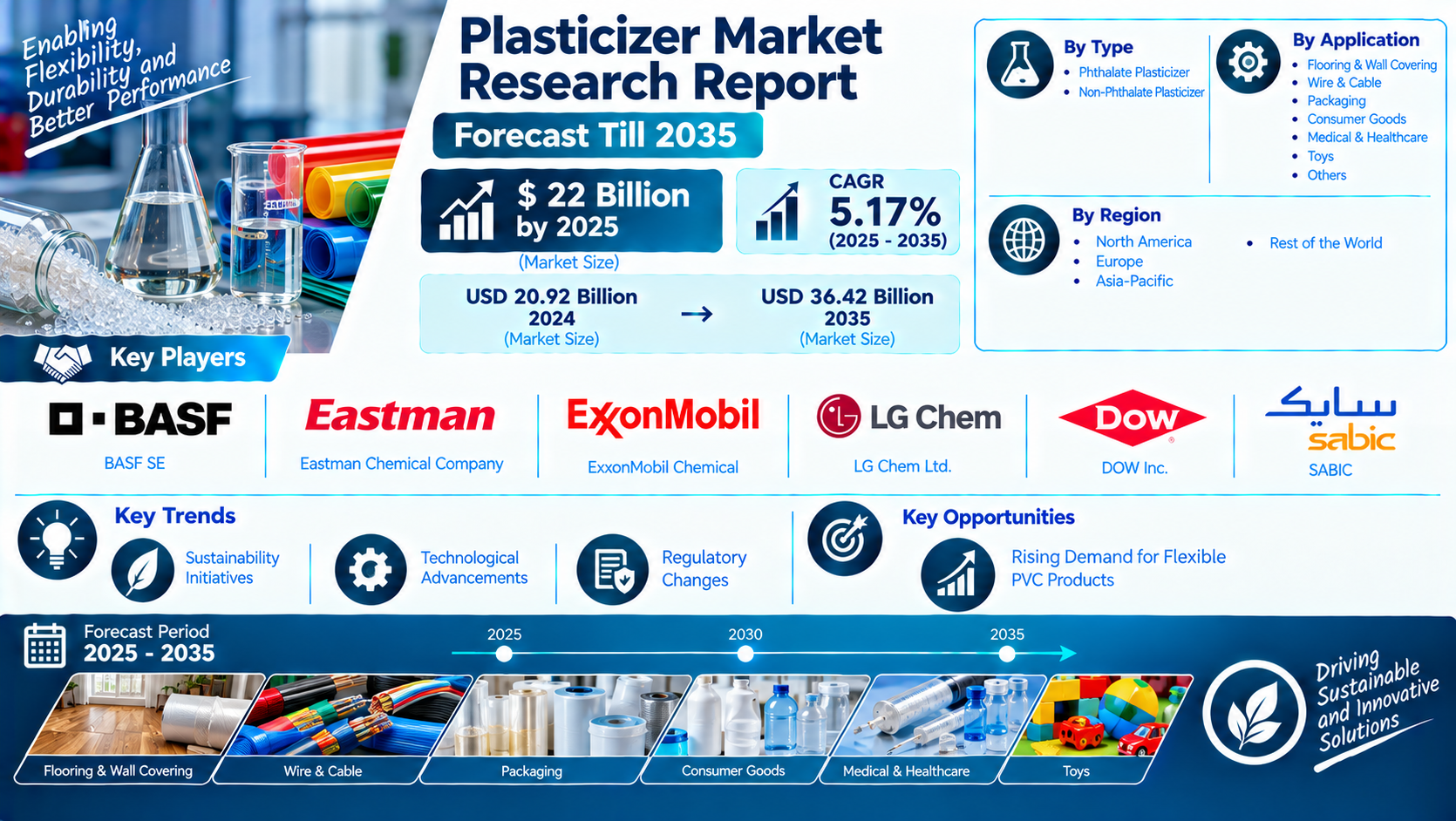

According to Market Research Future® (MRFR), the Plasticizers Market is positioned for continued growth as manufacturers seek materials that improve flexibility, processability, and performance across a wide range of plastic products. The market was valued at USD 20.92 billion in 2024 and is estimated at USD 22 billion in 2025. It is projected to reach USD 36.42 billion by 2035, expanding at a compound annual growth rate (CAGR) of 5.17% during the 2025–2035 forecast period. Demand for flexible polyvinyl chloride (PVC), alongside sustainability initiatives, technological development, and changing regulations, is expected to shape market opportunities.
Market Overview and Growth Outlook
Plasticizers are additives incorporated into certain polymers to improve flexibility, workability, and other material characteristics. They are particularly important in flexible PVC formulations used in products that need to bend, conform to different shapes, or withstand regular handling. Depending on the formulation, plasticizers can influence softness, durability, processing behaviour, and the performance of the finished product.
Their role across multiple applications supports demand from manufacturers of flooring, wall coverings, wire and cable products, packaging, consumer goods, toys, and selected medical and healthcare products. These end uses have different performance requirements, so manufacturers must select additives that are compatible with the polymer, intended service conditions, and relevant product standards.
The projected increase from USD 22 billion in 2025 to USD 36.42 billion by 2035 indicates a substantial expansion in market value over the forecast period. The reported CAGR of 5.17% reflects an outlook in which established applications continue to provide a demand base while manufacturers respond to changing formulation and regulatory requirements. Actual growth will depend on industrial production, raw-material costs, product substitution, and the adoption of plasticizers suited to particular applications.
Flexible PVC and Application Demand
Demand for flexible PVC products is a key opportunity identified in the report. PVC can be formulated for different levels of flexibility, making it useful in applications where durability, shape retention, and ease of processing matter. Plasticizers help manufacturers achieve the material characteristics required for specific products.
In flooring and wall coverings, plasticized materials may be selected for their flexibility and ability to meet design and installation requirements. The wire and cable sector uses polymer compounds that must satisfy application-specific needs relating to flexibility, insulation, durability, and operating conditions. Plasticizer selection must therefore consider the electrical, mechanical, and environmental performance required of the finished product.
Packaging and consumer goods provide other areas of demand. Flexible materials can support packaging designs that need to conform around products or withstand repeated handling. In consumer goods and toys, formulation choices are influenced by durability, product design, and applicable safety requirements. Medical and healthcare applications can involve particularly demanding specifications, including compatibility, quality control, and regulatory considerations. Not every plasticizer is appropriate for every end use, making application-specific evaluation essential.
Product Types: Phthalate and Non-Phthalate Plasticizers
The report divides the market into phthalate plasticizers and non-phthalate plasticizers. These categories reflect different chemical approaches to modifying polymer properties and are subject to varying performance requirements and regulatory considerations.
Phthalate plasticizers have historically served a range of flexible PVC applications. Their use depends on the specific compound, application, and applicable rules governing the finished product. Regulatory requirements may restrict certain substances in particular uses, encouraging manufacturers to review formulations and verify compliance with relevant standards.
Non-phthalate plasticizers provide alternatives for applications where manufacturers seek different regulatory profiles or material characteristics. Their suitability depends on factors such as compatibility with the polymer, processing performance, durability, cost, and required product properties. Substitution is not necessarily straightforward: changing the additive may require formulation adjustments and testing to confirm that the finished product performs as intended.
For suppliers, the ability to provide reliable technical information and application support can help customers evaluate alternatives. Product selection increasingly involves balancing functional performance, cost, regulatory compliance, and customer requirements rather than focusing on a single additive characteristic.
Sustainability and Technological Development
Sustainability initiatives are influencing how manufacturers assess chemical additives and polymer formulations. Businesses may examine material efficiency, product durability, chemical composition, and the potential environmental implications of their choices. These considerations can encourage development of alternative formulations, although sustainability outcomes depend on the full product lifecycle and the specific application.
Technological advancements may improve additive performance, formulation consistency, and compatibility with different polymers. Manufacturers also need to ensure that plasticizers maintain the required properties throughout processing and use. Product development is therefore closely tied to testing, quality assurance, and customer specifications.
Regulatory changes represent another important factor. Requirements can differ by region and end use, particularly for applications involving consumer exposure or specialized performance standards. Producers and downstream manufacturers must monitor relevant rules and confirm that formulations meet the requirements applicable to each market. Regulatory compliance can increase development and testing costs, but it can also encourage innovation and differentiation.
Competitive Landscape and Regional Considerations
Key players identified by MRFR include BASF SE, Eastman Chemical Company, ExxonMobil Chemical, LG Chem Ltd., DOW Inc., and SABIC. The supplied market information does not provide individual company market shares or establish a competitive ranking. Competition can involve product performance, formulation expertise, supply reliability, pricing, and the ability to meet customer and regulatory requirements.
The report’s scope includes type, application, and regional analysis, although the supplied information does not specify regional market values or country-level growth rates. Demand patterns can vary with manufacturing activity, construction investment, cable infrastructure, packaging production, and regional regulatory requirements.
Outlook Through 2035
The Plasticizers Market is forecast to increase from USD 22 billion in 2025 to USD 36.42 billion by 2035, at a CAGR of 5.17%. Flexible PVC demand remains a central opportunity, while sustainability initiatives, technological progress, and regulatory developments influence product selection. Suppliers that combine consistent performance with application expertise and regulatory awareness may be well positioned to serve changing customer needs across the market.

