

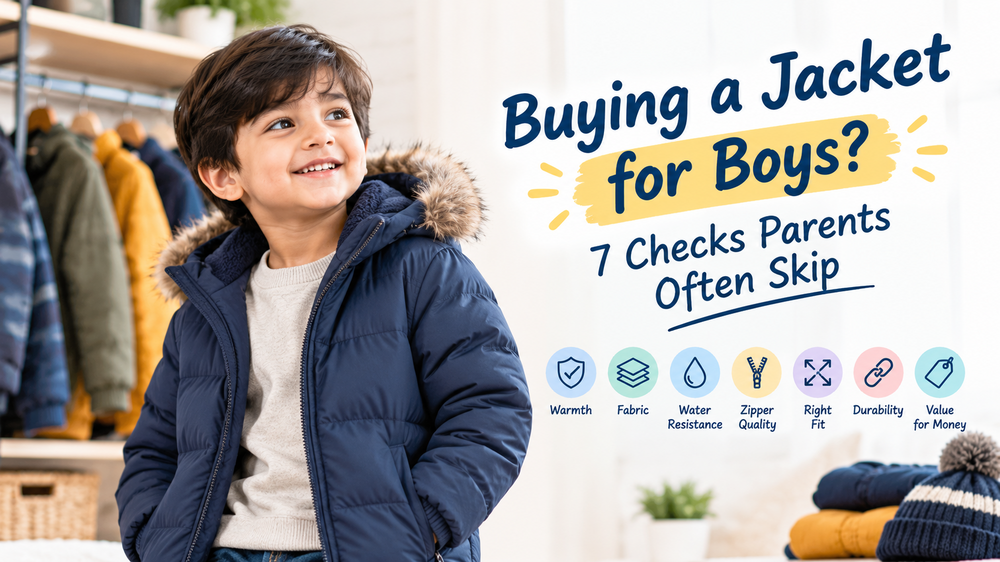

A winter jacket is one of the few clothing purchases a child uses almost every day for three or four months. It gets stuffed into school bags, dragged across playgrounds and washed more often than most parents would like. Even so, many families choose one based on colour and price alone, then discover in December that the sleeves ride up, the zip jams or the fabric has lost its shape.
This guide covers seven practical checks that separate a jacket that survives the season from one that doesn’t. They apply whether you shop in a market, a mall or online.
The Short Answer
A good boys winter jacket fits over one layer, closes fully at the front and wrists, has a zip that runs smoothly, and uses fabric suited to your city’s winter. Check these points before you consider style, and most poor purchases can be avoided.
1. Match the Jacket to Your City, Not Just the Calendar
Winter feels very different from Karachi to Murree. A light denim or knitted layer can be plenty for a mild coastal evening, but the same jacket will leave a child shivering on a foggy morning in Lahore or Rawalpindi. In the northern areas, a single jacket is rarely enough, and the real warmth comes from layers underneath.
Before shopping, decide what the coldest regular situation is, such as a bike ride, an early school run or an outdoor event. Buy for that situation, then layer down on warmer days.
2. Test the Fit With the Layer He Will Actually Wear
The most common sizing mistake is trying a jacket on over a thin t-shirt. By January, your son will wear it over a sweatshirt or sweater.
-
Bring the thickest layer he’ll use, or imagine it.
-
Make sure he can lift both arms without the hem rising.
-
Check that the sleeves end at the wrist bone and not over the knuckles.
-
Look for a slightly roomy shoulder, which is more forgiving as he grows.
Buying two sizes up “to last two winters” usually backfires. Excess fabric lets cold air in, and oversized sleeves get caught on bikes, doors and playground equipment.
3. Open and Close the Zip Ten Times
The zip is often the first thing to fail on a child’s jacket, so it deserves more attention than it gets. Run it up and down several times and watch for these signs:
-
It catches halfway or needs two hands to move.
-
The teeth don’t line up behind the slider.
-
The tape puckers or looks loosely stitched at the ends.
A child will not struggle with a stiff zip for long. He will leave the jacket open, which defeats the purpose.
4. Look at the Cuffs, Collar and Hem
Cold air usually sneaks in at openings: wrists, neck and the bottom of the back. A good jacket handles all three.
-
Cuffs should sit snug without cutting off circulation.
-
The collar should cover the neck rather than lying flat.
-
The back hem should stay covered when he sits or leans forward.
Boys who bike or run during recess feel these gaps more than anyone, so test them by having him move around, not just stand still.
5. Choose Fabric According to How the Jacket Will Be Used
Different fabrics suit different routines.
|
Fabric type |
What it does well |
What to keep in mind |
|
Denim |
Durable, good for school and outings |
Best for mild to cool weather or layering |
|
Woven fabric |
Keeps its shape, resists stretching at elbows |
Check the lining for comfort |
|
Knitted fabric |
Soft, light, easy to layer |
Less wind-resistant than woven |
|
Padded or insulated |
Highest warmth for the weight |
Can feel heavy indoors |
None of these is universally best. A denim jacket over a hoodie works well in a Karachi winter, while a lined woven jacket makes more sense for a daily commute in colder inland cities.
6. Think About Washing Before You Buy
Children’s jackets get dirty quickly, so how a jacket handles washing matters as much as how it looks.
-
Read the care label before purchase, not after the first wash.
-
Prefer fabric that keeps its colour evenly, especially at the shoulders and cuffs.
-
Check that pockets and seams look reinforced, since these take the most strain.
-
Choose darker or mid-tone colours for daily wear, and lighter shades for occasions.
Airing a jacket overnight between wears can reduce how often it needs washing, which also helps it last longer.
7. Plan the Layers Underneath
A jacket works best as the top layer of a system, not as the only warm item. A simple setup that works for most Pakistani winters:
-
Base layer: a cotton tee or thin full-sleeve top.
-
Middle layer: a sweater or sweatshirt, added or removed as the day changes.
-
Outer layer: the jacket.
-
Extras: warm socks, a cap and gloves for very cold mornings.
This approach lets a child adjust to changing temperatures instead of overheating at noon and freezing at dusk. It also makes one well-fitted jacket far more useful than two thin ones.
Where to Compare Options
Once you know your priorities, comparing several jackets side by side saves time and avoids impulse buying. Online collection pages that let you filter by size, colour, price and brand make this easier, and you can browse kids jackets for boys in this way before deciding what to try in person. Whichever store you use, check the size chart, read the product details carefully and look at the return or exchange policy in case the fit is off.
Common Questions
How much room should a boys winter jacket have?
Enough to wear over a sweatshirt or sweater without pulling across the shoulders, with sleeves ending at the wrist. A slightly roomy fit is fine, but a very large one lets in cold air.
Is a denim jacket warm enough for a Pakistani winter?
It depends on where you live. Denim suits mild and cool days, especially over a hoodie. In colder cities, a lined woven jacket or an extra sweater underneath is a safer choice.
How many jackets does a boy need?
For many families, one reliable jacket is enough. A second is worth considering if your son wears one every day and needs a spare while it dries.
What colour is most practical?
Navy, black, olive, grey and charcoal hide dirt well and suit most outfits. Light colours look good but show marks quickly.
When should I start shopping?
Early in the season, usually October or November, when sizes and colours are still widely available. Popular sizes can sell out as temperatures drop.
Final Thoughts
The best jacket for a boy is rarely the most expensive or the most fashionable one. It is the one that fits over his winter layers, closes properly, suits his routine and washes well. Run through these seven checks before paying, and you are far more likely to buy a boys winter jacket that your son actually wears and that lasts through the cold months.

