


Businesses, government agencies, and individuals need to understand the concept of a fiscal year to effectively manage their financial records. A 12-month period of time used to structure financial transactions and to prepare annual reporting and provide for tax and accounting needs. A fiscal year is not necessarily the same length as a calendar year. Financial reporting periods can be customized to best fit the needs of an organization.
The fiscal year meaning is important for business owners, as this information can help them know when to prepare financial statements, review profits, calculate expenses, and plan budgets. Keeping good financial records during the fiscal year also enables organisations to make better decisions and plan for financial obligations.
What Is a Fiscal Year? Definition and Meaning
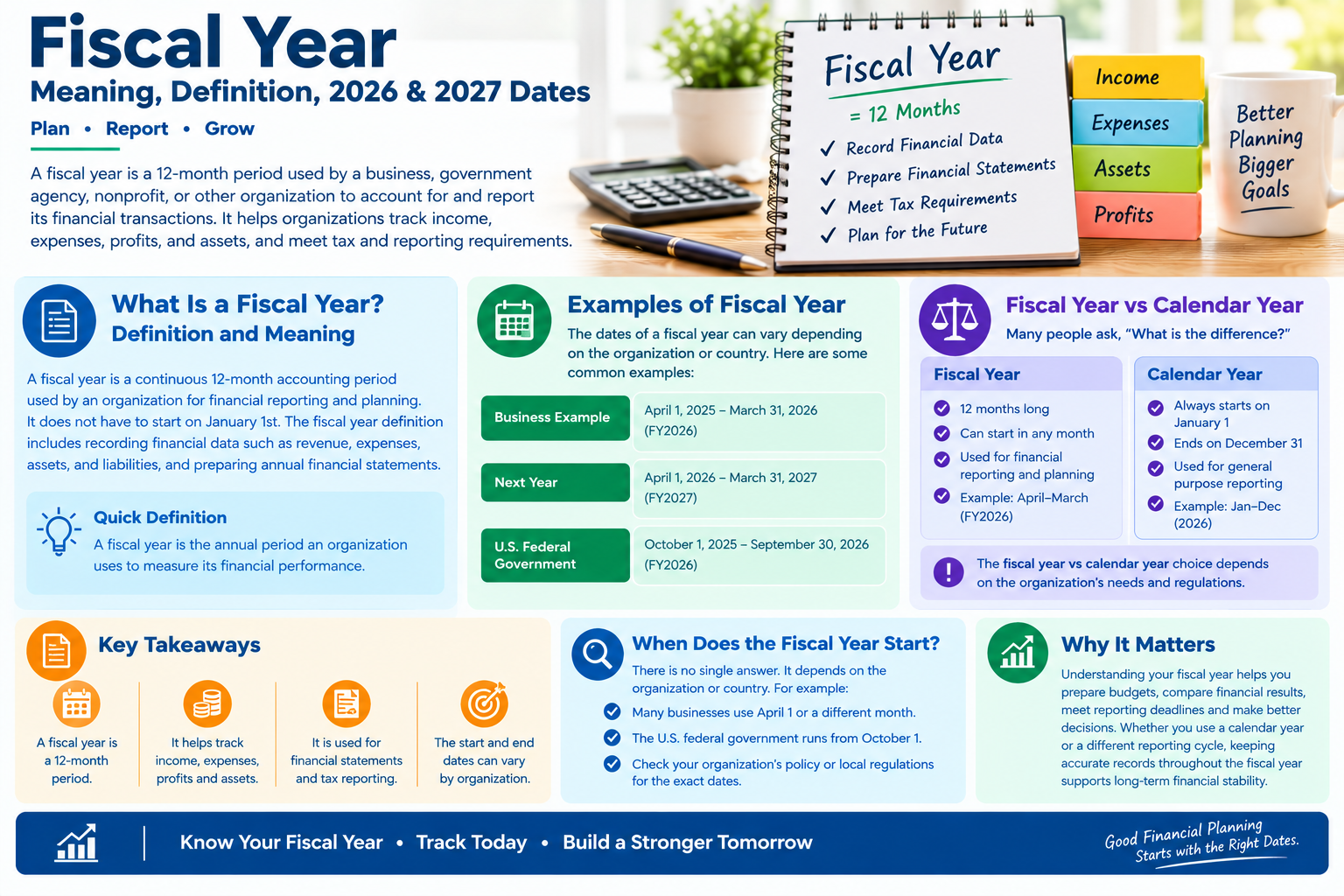
It's basically a 12-month period of accounting that is used by an organization for its financial reporting and planning, referred to as a fiscal year. Fiscal year definition refers to any financial period of time over which an organization runs its business affairs.
In a simple sense, the fiscal year is the 12 month period in which an organization tracks its financial activities. For instance, a company could have April 1st to March 31st as fiscal year rather than January 1st to December 31st. This indicates that the reports of its financial activities span two calendar years.
The term fiscal year often leads to the question of what is actually meant by the term. Generally, a company's revenue, expenses and profits are recorded on an annual basis for a fiscal year. Managerial analysis can be used to identify the financial trends and business performance by comparing the same reporting periods.
The fiscal year definition may be different from one country to another or from one organisation to another or from one reporting period to another. Some organizations follow the calendar year, others select a different 12 month period. This may be subject to local laws and industry conventions and the fiscal year of the business.
Fiscal Year 2026, Fiscal Year 2027, and Fiscal Year vs Calendar Year
FY26 and FY27 are common search terms for people who want to know which dates they refer to. These dates vary according to the organisation or government in question. For instance, a company that reports from April to March would consider fiscal year 2026 to be from April 1, 2025 to March 31, 2026. Its fiscal year 2027 would run from April 1, 2026, through March 31, 2027.
For the United States, fiscal year is October 1 through September 30 of the next calendar year. For this reason, federal fiscal year 2026 will begin on October 1st, 2025 and end on September 30th, 2026, and federal fiscal year 2027 will begin on October 1st, 2026 and end on September 30th, 2027.
One of the many questions that is asked is: What is the beginning of the fiscal year? It's an individual solution for each organisation. Businesses should review their accounting policies, and the government reporting periods are established by the jurisdiction.
Fiscal year vs. calendar year is easy to understand. Each calendar year starts January 1 and ends December 31. Fiscal Year is a 12-month period, which can start in a different month. A fiscal year, for instance, April to March, will contain portions of two calendar years.
Adopting and sticking to a particular fiscal year makes it easier for organizations to prepare their annual accounts, compare financial activities, budget their operations, and report on time. The process is made easier by having accurate bookkeeping throughout the year that results in an organized list of income and expenses.
In conclusion, the fiscal year is a crucial concept for businesses to grasp, as it enables them to keep track of their financial status and make informed decisions for the future. For any organisation, whether they are using the calendar year or a different accounting period, having full and accurate records, and analysing their financial results on a regular basis, makes for informed decision making and long-term financial stability.
For more details visit us - Accountance

