

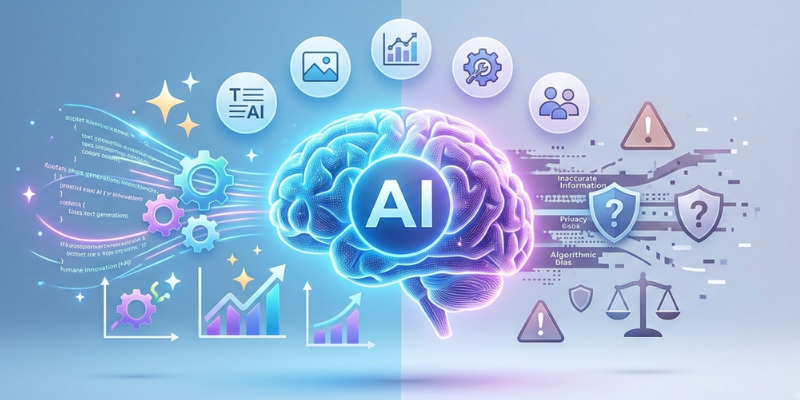

Generative Artificial Intelligence (AI) is changing how people create content, solve problems, and work with information. It can generate text, images, audio, videos, and computer code based on user instructions. From answering questions to supporting creative projects, generative AI offers many opportunities for individuals and businesses. However, understanding its capabilities and limitations is important for using this technology effectively. Beginners who want to build a strong foundation in AI can explore AI Courses in Gurgaon at FITA Academy to develop their knowledge and explore the real-world uses of artificial intelligence.
What is Generative AI?
Generative AI refers to a form of artificial intelligence that produces original content by analyzing patterns from existing information. It uses trained models to understand the relationships between words, images, sounds, and other information. When a user gives a prompt, the model generates a response according to its training background.
Popular applications include AI chatbots, image generators, writing assistants, and virtual assistants. These tools can help users brainstorm ideas, summarize documents, explain difficult topics, and create different forms of digital content. Their usefulness depends on the task, the quality of the instructions, and the information available to the model.
Key Capabilities of Generative AI
1. Content Creation
Generative AI can produce blog posts, emails, product descriptions, stories, and social media content. It can also suggest titles, improve sentence structure, and adjust writing styles. These capabilities help users save time and develop ideas more efficiently. However, human review remains important to ensure accuracy, originality, and relevance.
2. Data Analysis and Summarization
AI tools can summarize lengthy documents, identify important points, and organize information into clear explanations. Some systems can also analyze structured data and help users identify patterns. These capabilities support research, reporting, and decision-making. However, users should verify important findings against reliable data before acting on them.
3. Creative and Multimodal Applications
Generative AI can create images from text descriptions, produce synthetic voices, and assist with video creation. Some advanced models can also process different types of information together, such as text and images. These features support designers, educators, marketers, and content creators in developing new ideas and visual materials.
4. Productivity and Task Assistance
Generative AI can help users draft emails, prepare presentations, explain technical concepts, and organize routine tasks. When integrated into workplace tools, it can reduce repetitive work and support faster workflows. However, its output should be reviewed before being used in important business communications or professional decisions.
Major Limitations of Generative AI
1. Incorrect or Misleading Information
Generative AI can produce answers that sound convincing but contain factual errors. This problem is often called an AI hallucination. Models generate responses based on learned patterns and do not always verify facts against reliable sources. Users should independently check important claims, especially when dealing with financial, legal, medical, or technical information.
2. Dependence on Training Data
The quality of AI output depends partly on the data used to train the model. Incomplete, outdated, or biased data can affect its responses. A model may also lack knowledge of recent events or specialized information. Providing relevant context and checking trustworthy sources can help users identify these limitations.
3. Limited Human Understanding
Generative AI can produce language that appears thoughtful and natural, but this does not mean it understands the world in the same way humans do. It may miss subtle context, cultural differences, emotions, or the real purpose behind a question. Human judgment remains essential when a task requires empathy, responsibility, or complex reasoning.
4. Privacy and Security Concerns
Sharing confidential information with AI tools can create privacy and security risks. Users should understand how a platform handles submitted data before entering sensitive business documents, personal details, or customer information. Organizations should establish clear policies for responsible AI use and select tools that meet their security requirements.
How to Use Generative AI Effectively
To get better results, write clear prompts that explain your goal, provide relevant context, and specify the expected output. Review generated content for factual errors, bias, and missing details. Use AI as an assistant rather than treating every response as a final answer.
For important tasks, combine AI-generated suggestions with human expertise and reliable references. Avoid sharing sensitive information unless the tool is approved for that purpose. Regular evaluation also helps users understand which tasks benefit from automation and which require human involvement.
Generative AI offers powerful capabilities for content creation, research, productivity, and creative problem-solving. At the same time, its limitations include inaccurate information, biased outputs, privacy risks, and gaps in contextual understanding. Learning how these systems work helps users make informed decisions and use AI responsibly. If you want to strengthen your practical knowledge and understand modern AI applications, consider enrolling in Generative AI Training in Gurgaon to explore essential concepts, tools, and real-world use cases.

