

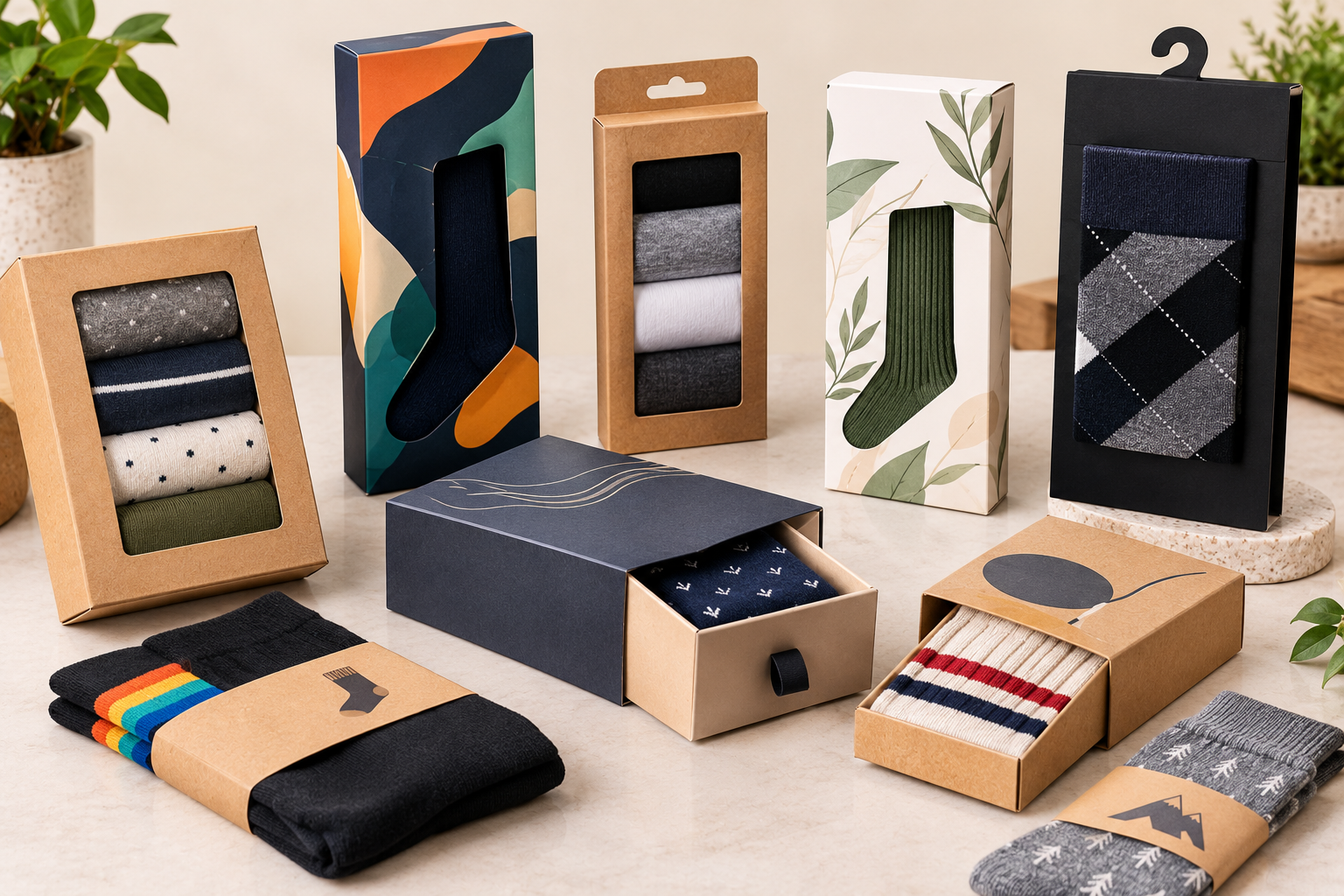

Packaging plays an important role in how customers perceive clothing and accessory products. For sock manufacturers, fashion retailers, and e-commerce businesses, Customized Sock Packaging offers an opportunity to present products professionally while building a recognizable brand identity. From everyday socks to premium gift sets and specialty collections, well-designed packaging can improve product presentation, keep pairs organized, and communicate a consistent visual style.
Custom Sock Packaging can be developed in different formats, including paperboard boxes, printed sleeves, hanging cards, and retail-ready packages. The right option depends on the product type, target audience, sales channel, and budget. By combining practical construction with thoughtful design, businesses can make their sock products more attractive while supporting efficient storage, display, and distribution.
Why Customized Sock Packaging Matters for Retail Products
Socks are available in many styles, including athletic, casual, formal, novelty, and premium varieties. Packaging helps distinguish these products and gives customers useful information before they make a purchase.
Personalized Sock Packaging allows businesses to select colors, graphics, typography, and layouts that suit their product range. A sportswear brand might choose a clean design with bold graphics, while a premium sock collection may use understated colors and a refined presentation.
Packaging also helps keep pairs together and makes products easier to organize during storage and retail handling. Depending on the format, it can provide space for size details, material information, care instructions, and other relevant product information.
For online retailers, packaging contributes to the experience customers receive when their orders arrive. For physical stores, it helps products look organized on shelves, racks, or display stands. A consistent approach can support a professional appearance across both environments.
Choosing the Right Format for Sock Packaging
The best packaging format depends on how socks will be sold, displayed, and transported. Businesses should consider product dimensions, the number of pairs in each package, and the level of protection required.
Paperboard Boxes for Premium Collections
Paperboard boxes can provide a structured presentation for premium socks, gift sets, and coordinated collections. They offer space for branded graphics and can be customized with different colors, finishes, and internal arrangements.
Boxes are especially useful when the packaging itself is intended to form part of a gift or premium retail presentation. However, businesses should consider storage space, shipping costs, and material usage when selecting this option.
Printed Sleeves for Simple Packaging
Printed sleeves provide a compact way to group folded socks while keeping the product visible. They can display a brand name, product information, and decorative graphics without requiring a fully enclosed box.
This format may suit businesses seeking a straightforward presentation for everyday products. The sleeve dimensions should be suitable for the folded socks so that the package remains secure during handling.
Hanging Cards for Retail Displays
Hanging cards are commonly useful for products displayed on hooks or racks. They can help maintain a neat presentation while providing room for branding and product details.
Businesses should ensure that the card is strong enough for the intended display method and that any opening or attachment is positioned correctly.
How Custom Sock Packaging with Logo Builds Recognition
A recognizable logo helps customers connect a product with the company that makes or sells it. Custom Sock Packaging with Logo gives businesses an opportunity to display their brand identity consistently across product collections.
Logo placement should complement the packaging format. A box may provide room for a larger design, while a small sleeve or hanging card may require a more compact arrangement. The artwork should remain clear and readable at the final printed size.
Businesses can also coordinate logo placement with brand colors, typography, and other visual elements. When the same design language appears across packaging, labels, and promotional materials, customers can more easily recognize the product range.
High-resolution artwork and careful proof approval help reduce printing problems. Before production, businesses should review the logo size, contrast, alignment, and appearance against the selected background.
Improving Product Appeal Through Custom Apparel Boxes
Printing allows sock brands to communicate their personality through color, illustrations, patterns, and typography. Customized apparel boxes can be designed for individual products, seasonal collections, promotional campaigns, or coordinated gift sets.
Printed Sock Packaging can also help customers distinguish between different product categories. For example, a brand may use one layout for athletic socks and another color variation for formal or casual styles while maintaining consistent branding.
Effective packaging should balance decoration with clarity. Product names, sizes, material details, and other important information should remain easy to read. Too many graphics or competing colors can make the package harder to understand.
Before approving production, businesses should confirm the artwork dimensions, print specifications, and material compatibility. Reviewing a sample or digital proof can help identify issues before a larger quantity is manufactured.
Selecting Materials for Practical and Attractive Packaging
Material selection affects packaging appearance, durability, and cost. Businesses should consider the product's weight, display requirements, and shipping conditions before choosing a suitable material.
Paperboard can support printed graphics and structured packaging, while lighter paper-based options may work for sleeves and cards. Corrugated materials may be useful for outer shipping cartons when additional strength is required.
The chosen material should support the intended packaging purpose without adding unnecessary complexity. For example, a hanging card may be sufficient for socks sold individually, whereas a gift collection may benefit from a box with compartments or a coordinated internal arrangement.
Businesses should also verify any environmental claims associated with packaging materials. Recyclability and other disposal characteristics depend on the specific material, coatings, adhesives, and local waste-management facilities.
Creating a Consistent Brand Presentation
Packaging is most effective when it supports the broader visual identity of a business. Consistent colors, logo treatments, typography, and design elements can help connect individual sock products with the wider brand.
Branded Sock Packaging can be coordinated with clothing labels, shipping boxes, shopping bags, and promotional inserts. A business does not need to make every package identical; instead, it can establish a recognizable design system that accommodates different product categories.
For example, a company may use the same logo and typography across all sock packaging while changing the background color to distinguish product types. This approach can simplify product identification without losing visual consistency.
Businesses should also consider how packaging appears in product photographs. Clear branding and an organized layout can help online listings present products more professionally. The design should remain understandable both on a retail shelf and in a small image on a digital storefront.
Planning Custom Sock Packaging Packaging for Different Sales Channels
Packaging requirements can vary between physical retail, online orders, wholesale distribution, and gift sales. Custom Sock Packaging Packaging should be planned according to the product's actual use rather than relying on one format for every situation.
Retail packaging may prioritize product visibility, hanging options, and clear product information. E-commerce packaging may place greater emphasis on compact dimensions, protection during delivery, and efficient packing procedures.
Wholesale shipments may require packaging that keeps products grouped and organized in larger quantities. Gift sets, meanwhile, may need a more decorative presentation and compartments to separate multiple pairs.
Before finalizing a design, businesses should test how the package fits the socks, whether it is easy to handle, and how efficiently it can be stored and shipped. Practical testing can reveal sizing or usability issues that are difficult to identify from artwork alone.
Benefits of Ordering Custom Sock Packaging in Bulk
Businesses with regular packaging requirements may consider Custom Sock Packaging in bulk to maintain a consistent supply and potentially reduce unit costs. Actual savings depend on order quantity, materials, printing specifications, and supplier pricing.
Bulk purchasing is often more practical when product designs and demand are reasonably predictable. Before committing to a large order, businesses should estimate expected usage, review storage capacity, and consider whether upcoming product launches may require packaging changes.
A useful purchasing checklist includes:
-
Demand forecasting: Estimate the number of packages needed over a realistic period.
-
Storage planning: Keep packaging in suitable conditions to avoid moisture or physical damage.
-
Design approval: Confirm that artwork, dimensions, and product information are final.
-
Production schedules: Check manufacturing and delivery timelines.
-
Quality control: Ask about sample reviews, print consistency, and defective products.
New businesses may prefer to test a smaller quantity before increasing their order size. Established brands can use previous sales figures to plan inventory more accurately.
Comparing Custom Sock Packaging Wholesale Suppliers
Selecting a supplier requires more than comparing the lowest quoted price. Custom Sock Packaging wholesale options should be evaluated according to material quality, customization capabilities, production reliability, and overall order terms.
| Evaluation factor | What to check |
|---|---|
| Materials | Paper type, thickness, and durability |
| Packaging formats | Boxes, sleeves, cards, and other available styles |
| Printing | Color options, artwork requirements, and print quality |
| Customization | Sizes, branding, and finishing options |
| Order quantities | Minimum requirements and volume pricing |
| Delivery | Production time, shipping costs, and estimated arrival |
| Quality assurance | Samples, proof approval, and defect policies |
Businesses should clarify whether setup fees, sample costs, artwork adjustments, and shipping are included in the quotation. Comparing equivalent specifications makes supplier pricing easier to evaluate.
Reliable communication is also important. Clear agreements about production schedules and quality expectations can help businesses coordinate packaging purchases with product launches and inventory requirements.
Common Mistakes to Avoid
Even attractive packaging can create problems when practical details are overlooked. Businesses should review the following points before approving production.
-
Incorrect dimensions: Packaging that is too small can distort the product arrangement, while oversized packaging may waste space.
-
Poor logo visibility: Low contrast or overly small artwork can weaken brand recognition.
-
Excessive decoration: Too many graphics may make product information harder to read.
-
Insufficient strength: Materials should suit the intended handling and display conditions.
-
Skipping proof approval: Unchecked artwork can contain avoidable spelling, color, or alignment errors.
-
Overordering: Excess stock can become expensive if product designs or branding change.
Accurate measurements, a clear design brief, and careful proof review can help businesses prevent these issues while maintaining a professional packaging standard.
Conclusion
Customized Sock Packaging helps businesses improve product appeal, organize merchandise, and reinforce brand recognition through consistent visual presentation. By selecting an appropriate packaging format, using clear printed designs, incorporating logos effectively, and planning order quantities carefully, sock brands can balance appearance with practical business requirements. Evaluating materials, suppliers, and production schedules can further support quality and consistency across different sales channels. Businesses exploring coordinated packaging solutions can consider Personalized Boxes In Bulk when choosing options that suit their product range, branding goals, and operational needs.
Frequently Asked Questions
1. What is customized sock packaging?
It is packaging designed for sock products using selected materials, dimensions, printed graphics, colors, and branding elements.
2. Which packaging formats are suitable for socks?
Common options include paperboard boxes, printed sleeves, and hanging cards. The best choice depends on the product, sales channel, and presentation requirements.
3. Can sock packaging include a company logo?
Yes. Logos can be printed on boxes, sleeves, cards, and other packaging formats, depending on the selected design and production method.
4. Is bulk sock packaging suitable for small businesses?
It can be, but businesses should compare minimum order quantities, pricing, storage capacity, and expected demand before purchasing large quantities.
5. How can businesses choose a packaging supplier?
Compare material specifications, printing quality, customization options, minimum quantities, delivery schedules, pricing, and quality-control procedures.
6. What should be checked before printing sock packaging?
Review the dimensions, artwork, spelling, colors, logo placement, material specifications, and order requirements before approving production.

