

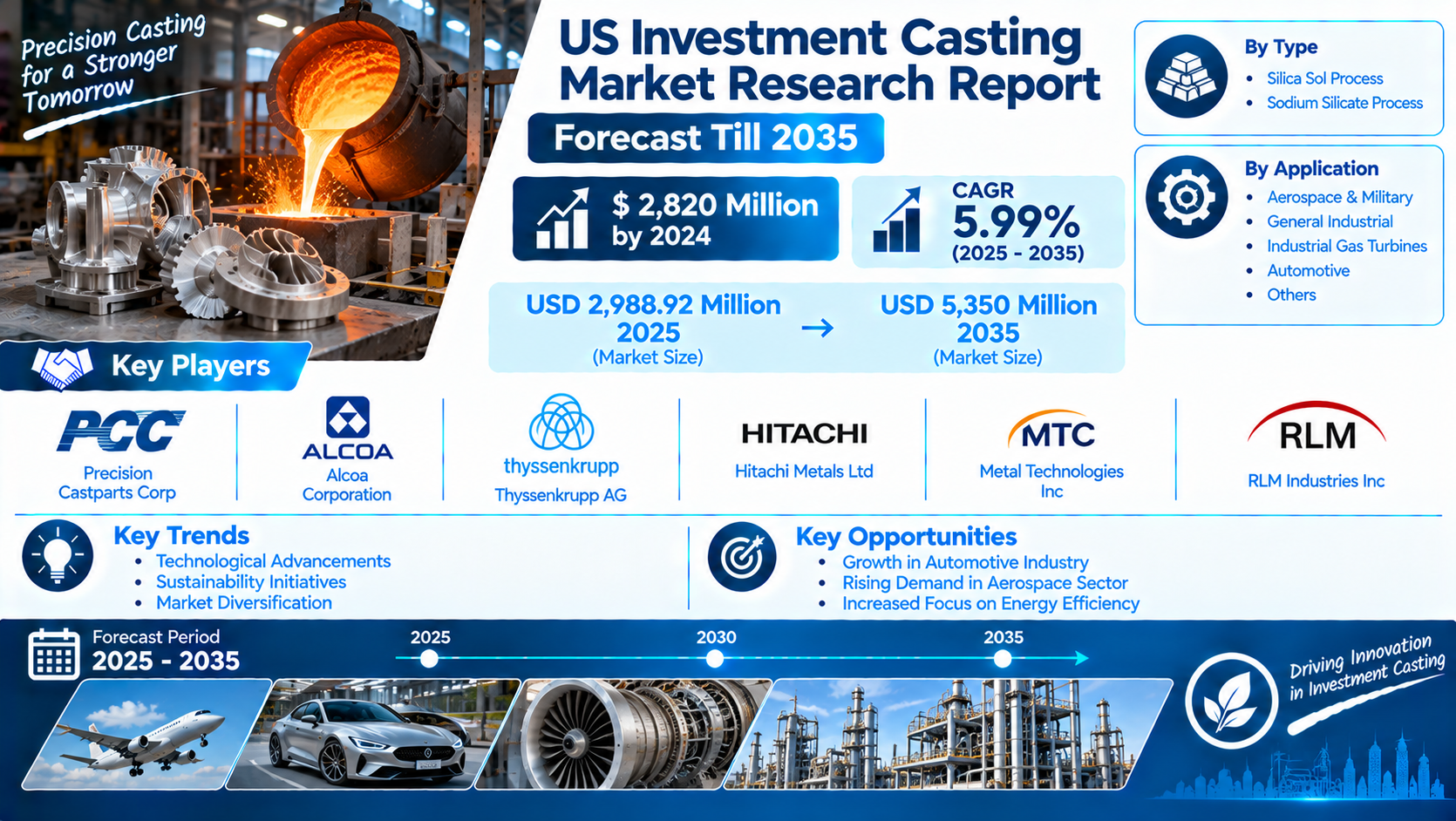

According to Market Research Future® (MRFR), the US Investment Casting Market was valued at USD 2,820 million in 2024 and is projected to increase from USD 2,988.92 million in 2025 to USD 5,350 million by 2035, registering a compound annual growth rate (CAGR) of 5.99% during the forecast period from 2025 to 2035. Investment casting continues to serve as an important manufacturing process for producing complex metal components with detailed geometries, dimensional accuracy, and consistent quality. Demand across aerospace, military, automotive, and general industrial applications is expected to support market development throughout the forecast period.
Market Overview
Investment casting, also known as lost-wax casting, enables manufacturers to create intricate components that may be difficult or costly to produce through conventional manufacturing methods. The process involves creating a pattern, forming a ceramic shell around it, removing the pattern, and pouring molten metal into the resulting cavity. Its ability to accommodate complex shapes and detailed designs makes it relevant to industries that require precision-engineered components.
The US market benefits from demand for specialized cast parts used in aircraft systems, industrial equipment, automotive components, and power-generation applications. Manufacturers are also responding to requirements for improved production efficiency, material performance, and product consistency. These factors contribute to the importance of investment casting within the country's advanced manufacturing landscape.
Market Growth Drivers
Aerospace and military demand represents an important growth driver. Aircraft and defense equipment manufacturers require components that can meet demanding performance, reliability, and design requirements. Investment casting supports the production of intricate parts for applications where component geometry and material characteristics are important. Continued activity in aerospace manufacturing and defense-related production can therefore create opportunities for specialized foundries.
The automotive industry also contributes to market demand. Vehicle manufacturers and suppliers use precision cast components in several systems, while ongoing engineering developments encourage the production of parts with complex designs and specific performance characteristics. As manufacturers pursue improved vehicle efficiency and evolving powertrain technologies, investment casting suppliers may benefit from demand for specialized metal components.
General industrial applications provide another source of demand. Machinery producers and industrial equipment manufacturers require components that can withstand operational stresses while meeting dimensional and quality specifications. Investment casting can support these requirements across a range of equipment categories.
Market Segmentation
The market is segmented by type into the silica sol process and sodium silicate process. The silica sol process is associated with applications requiring detailed surface quality and dimensional precision. Its suitability for producing complex components makes it relevant to demanding industrial and aerospace manufacturing requirements.
The sodium silicate process offers an alternative production route and is used in applications where process economics and component specifications influence manufacturing decisions. The selection between these methods depends on factors such as required accuracy, surface finish, production volume, material requirements, and cost considerations.
By application, the market includes aerospace and military, general industrial, industrial gas turbines, automotive, and other applications. Aerospace and military manufacturing requires components designed for demanding operating environments. General industrial applications cover a broad range of machinery and equipment requirements. Industrial gas turbines create demand for specialized components used in power-generation systems, while automotive manufacturing supports the need for precision-engineered parts. Other applications provide additional opportunities across specialized manufacturing activities.
Technology and Industry Trends
Technological advancements are influencing investment casting through improvements in pattern production, process monitoring, materials, and quality control. Digital design tools and advanced manufacturing technologies can help foundries refine component designs and improve production planning. Automation and more precise process controls may also support consistency and operational efficiency.
Manufacturers are increasingly examining sustainability initiatives as part of broader industrial priorities. Foundries face pressure to manage energy consumption, material use, emissions, and production waste. Improvements in resource efficiency and process management can support environmental objectives while helping manufacturers control operating costs.
Market diversification is another notable trend. Investment casting suppliers are serving a range of industries rather than depending on a single application area. Expanding customer relationships across aerospace, automotive, industrial machinery, and energy-related markets can help manufacturers respond to changing demand patterns.
Competitive Landscape
The US investment casting market includes established metal producers and specialized manufacturing companies. Key participants identified in the market include Precision Castparts Corp, Alcoa Corporation, Thyssenkrupp AG, Hitachi Metals Ltd, Metal Technologies Inc, and RLM Industries Inc.
Competition is shaped by production capabilities, technical expertise, product quality, customer relationships, and the ability to meet application-specific requirements. Companies can strengthen their market positions by investing in manufacturing technology, improving operational efficiency, and developing capabilities for complex components. Maintaining consistent quality and reliable delivery is particularly important when serving demanding industrial and aerospace customers.
Opportunities and Future Outlook
Growth in the automotive industry offers opportunities for investment casting manufacturers supplying precision components to vehicle producers and their suppliers. Changes in vehicle engineering and continued attention to efficiency may encourage demand for specialized cast parts.
The aerospace sector presents another important opportunity. Aircraft production and military applications require components that satisfy demanding technical specifications, creating scope for suppliers with advanced casting capabilities. Industrial gas turbines and other energy-related applications may also support demand as manufacturers focus on equipment performance and energy efficiency.
Overall, the US investment casting market is positioned for steady expansion through 2035. Technological progress, sustainability initiatives, and market diversification are expected to influence competitive strategies. Companies that combine process innovation, quality management, and responsiveness to customer requirements may be better positioned to participate in the market's projected growth.

