

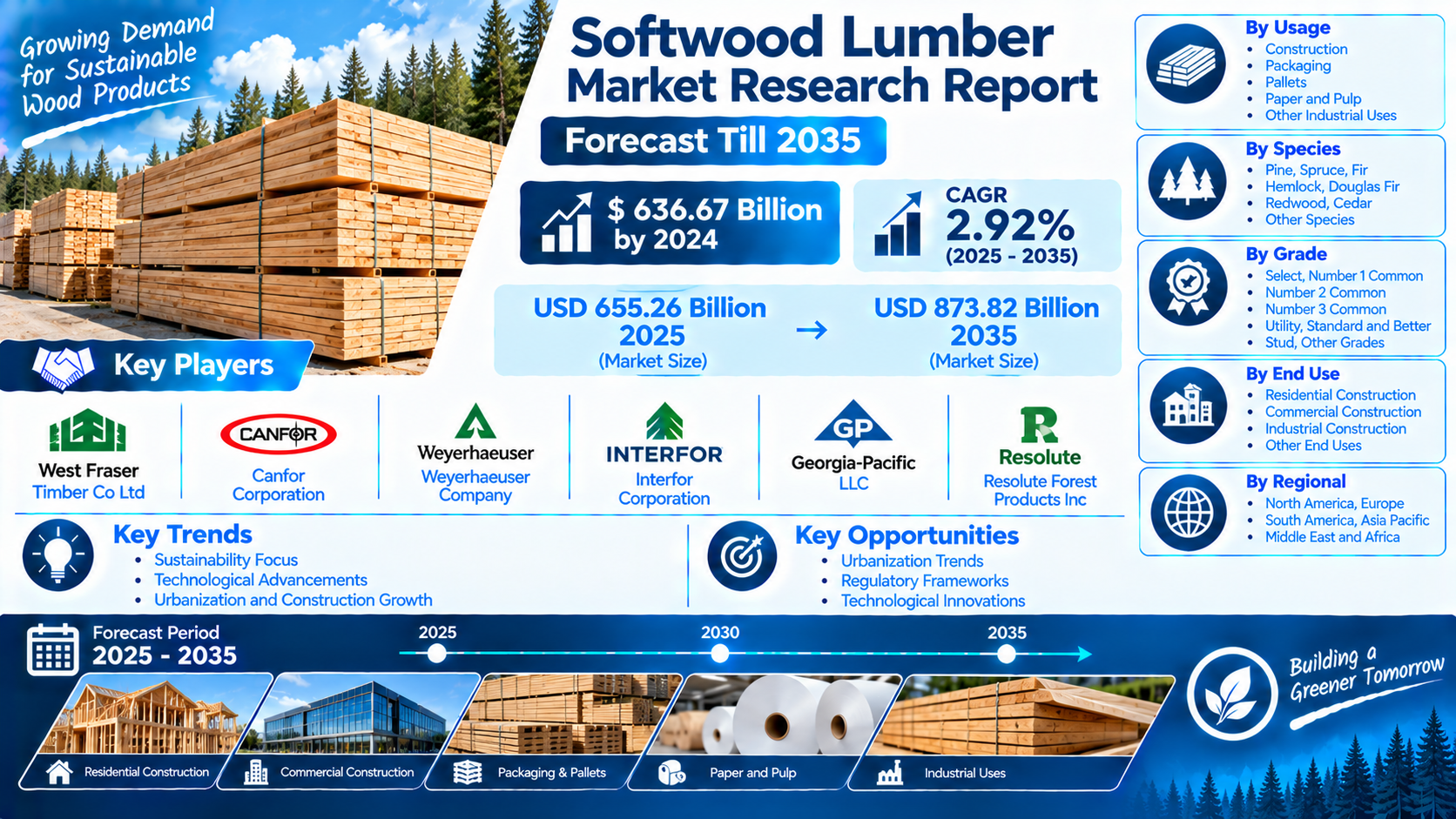

According to Market Research Future® (MRFR), the Softwood Lumber Market is expected to increase from USD 655.26 billion in 2025 to USD 873.82 billion by 2035, advancing at a CAGR of 2.92% over the 2025–2035 forecast period. The market recorded a valuation of USD 636.67 billion in 2024. Its development reflects the importance of softwood lumber to building activity and industrial supply chains, where product specifications, availability, sourcing practices and processing capabilities influence purchasing decisions. Demand across construction, packaging, pallets, paper and pulp, and other industrial uses provides the market with a broad application base.
Building Activity Shapes Consumption Patterns
The relationship between construction activity and lumber consumption is a defining feature of this market. Softwood lumber is used in numerous building components, making it relevant to residential, commercial and industrial projects. Housing construction can generate demand for framing materials and other structural applications, while commercial developments require lumber for building systems and supporting elements. Industrial construction adds another source of consumption through facilities and related infrastructure.
Urbanization supports this demand by increasing the need for housing, commercial space and infrastructure. However, the strength of the construction market depends on economic conditions, financing costs, building approvals and the availability of materials. When projects are delayed or construction budgets come under pressure, buyers may adjust procurement schedules or reconsider material choices. Lumber suppliers therefore need to monitor construction activity and maintain the flexibility to serve customers with different project timelines.
Application Diversity Supports Market Participation
Softwood lumber is not limited to building projects. Packaging and pallet applications connect the market to manufacturing, logistics and distribution. Pallets are used to move and store products across supply chains, while wood packaging can provide support and protection for goods during handling and transportation. Industrial production and trade volumes can consequently influence purchasing requirements in these segments.
Paper and pulp represent another usage category, linking the forestry sector with downstream paper production. Other industrial uses further extend the market's reach. This diversity creates opportunities for producers to serve customers across multiple industries, although each application has its own material requirements. Dimensions, grade, processing characteristics and consistency can determine whether a particular lumber product is suitable for a specific purpose. Suppliers that understand these differences can better align production and inventory with customer demand.
Species Selection Reflects Performance Requirements
Species diversity is an important element of the market's product structure. The report identifies pine, spruce, fir, hemlock, Douglas fir, redwood, cedar and other species. Each category can have distinct characteristics relating to strength, density, appearance, workability and availability. Buyers consider these properties when choosing materials for structural, industrial or other applications. Local forestry resources, established building practices and transportation economics can also shape purchasing preferences.
The selection process is closely connected to grade specifications. The market covers Select, Number 1 Common, Number 2 Common, Number 3 Common, Utility, Standard and Better, Stud and other grades. These classifications help buyers identify products suited to particular quality and performance requirements. Construction projects may require specific structural characteristics, whereas other applications can prioritize cost, dimensions or appearance. Reliable grading and quality assurance are therefore important for maintaining consistency between supplier output and end-user expectations.
Efficiency and Responsible Sourcing Become Strategic Priorities
Technological advancements are changing how softwood lumber is processed and distributed. Automation in sawmills, digital measurement, improved sorting systems and process monitoring can help manufacturers achieve consistent product specifications and improve operational efficiency. Better drying and cutting processes can also support material utilization by reducing avoidable losses. Digital inventory and logistics systems may improve coordination between mills, distributors and customers.
Sustainability is another major industry consideration. Forest resources require responsible management to support long-term availability, and buyers increasingly consider the origin and environmental credentials of wood products. Producers may respond through traceable sourcing, forest-management practices and efforts to use timber more efficiently. Regulatory frameworks can establish requirements for harvesting, processing and trade, making compliance an important operational responsibility. The specific obligations differ by jurisdiction, so companies serving international markets must understand the rules applicable to their sourcing and sales activities.
Regional Markets and Industry Competition
The market spans North America, Europe, South America, Asia Pacific, and the Middle East and Africa. Regional performance is influenced by the availability of forest resources, construction demand, manufacturing activity and trade conditions. Markets with established timber industries have different supply structures from regions where demand is supported more strongly by urban development and expanding construction activity. Freight costs, import requirements and local product standards also affect competition.
Key companies identified in the market include West Fraser Timber Co Ltd, Canfor Corporation, Weyerhaeuser Company, Interfor Corporation, Georgia-Pacific LLC and Resolute Forest Products Inc. Competitive positioning can depend on access to timber, mill capacity, operating efficiency, product consistency and distribution networks. Companies also need to manage exposure to fluctuations in input costs and changing demand across end-use industries. Maintaining dependable customer relationships and adapting product offerings to local requirements can support their market presence.
Opportunities, Risks and Future Direction
Urbanization trends provide opportunities through the need for additional housing, commercial facilities and industrial infrastructure. Regulatory frameworks may create demand for products that meet defined sourcing and quality requirements, while also increasing the importance of compliance and documentation. Technological innovations offer scope to improve production processes, enhance sorting accuracy and make better use of available resources. These developments can support manufacturers seeking to improve productivity and respond to customer expectations.
Nevertheless, market participants must manage several risks. Timber availability can be affected by forest-management restrictions and supply conditions, while raw-material, energy and transportation costs influence production economics. Construction slowdowns can affect orders, and competition from alternative building materials may shape purchasing decisions in certain applications. Companies must balance operational efficiency with responsible resource management.
The market's projected increase from USD 655.26 billion in 2025 to USD 873.82 billion in 2035 indicates continued expansion across its application base. With a forecast CAGR of 2.92%, the outlook reflects steady demand rather than an assumption of uniform growth across every region or end-use category. Producers that combine dependable supply, suitable species and grades, efficient processing and responsible sourcing practices will be better equipped to address changing requirements through 2035.

