

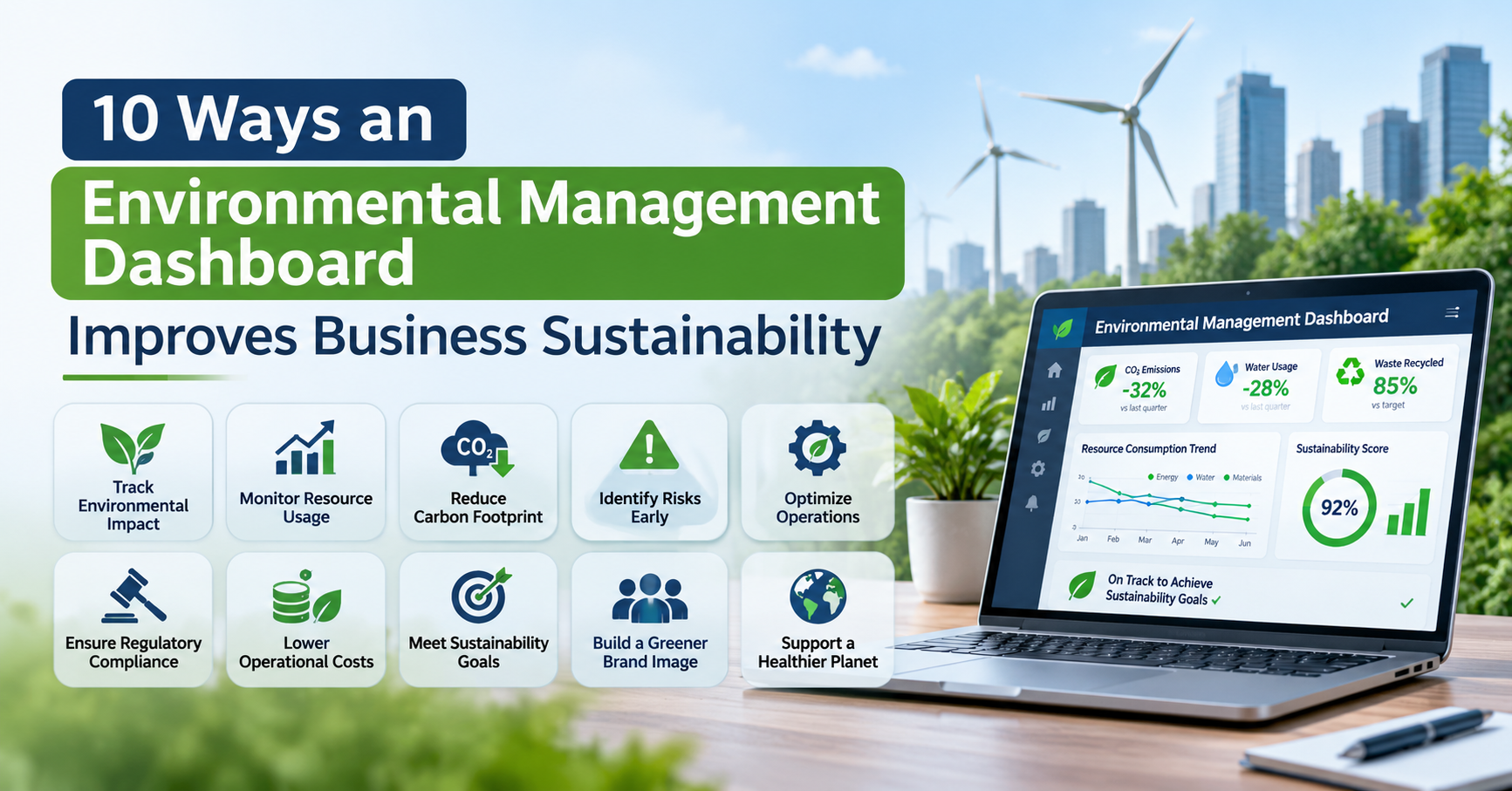
10 Ways an Environmental Management Dashboard Improves Business Sustainability

Business sustainability has become an important priority for organizations across industries. Growing environmental concerns, stricter regulatory requirements, rising operational costs, and increasing customer expectations are encouraging businesses to adopt more responsible practices. Organizations are now expected to monitor their environmental impact, reduce resource consumption, manage waste efficiently, and demonstrate measurable progress toward sustainability goals.
However, managing environmental performance across multiple departments, facilities, and business operations can be challenging. Data is often scattered across spreadsheets, disconnected systems, manual reports, and different monitoring tools. This makes it difficult for businesses to identify environmental risks, measure progress, and make informed decisions.
An environmental management dashboard addresses these challenges by bringing important environmental information into a centralized platform. It helps organizations monitor key sustainability indicators, analyze environmental performance, and identify opportunities for improvement.
With the support of Environmental management software, businesses can transform environmental data into actionable insights and develop more effective sustainability strategies.
In this blog, we explore 10 ways an environmental management dashboard improves business sustainability and helps organizations build more environmentally responsible operations.
What Is an Environmental Management Dashboard?
An environmental management dashboard is a digital platform that collects, organizes, monitors, and visualizes environmental performance data from different business operations.
It provides a centralized view of important environmental metrics, allowing organizations to track their progress toward sustainability objectives.
Depending on business requirements, an environmental management dashboard can monitor:
-
Energy consumption and efficiency.
-
Water usage and conservation.
-
Greenhouse gas emissions.
-
Waste generation and disposal.
-
Air and water quality.
-
Environmental compliance.
-
Resource utilization.
-
Sustainability performance indicators.
By consolidating this information into an accessible interface, the dashboard enables management teams to understand environmental performance without relying on time-consuming manual reporting.
10 Ways an Environmental Management Dashboard Improves Business Sustainability
An environmental management dashboard offers several advantages beyond basic environmental monitoring. It helps organizations improve operational efficiency, strengthen compliance, reduce costs, and make sustainability a measurable part of business strategy.
Here are ten important ways it contributes to business sustainability.
1. Provides Real-Time Environmental Performance Monitoring
One of the biggest challenges in environmental management is identifying problems before they affect business operations.
Traditional monitoring methods often depend on periodic inspections and manually prepared reports. By the time an issue is identified, organizations may have already experienced unnecessary resource consumption or environmental damage.
An environmental management dashboard provides centralized visibility into environmental performance through continuously updated or regularly synchronized data.
For example, businesses can monitor energy consumption across different facilities, track water usage in production units, and observe waste generation trends.
When integrated with IoT sensors and connected monitoring systems, the dashboard can provide near-real-time information about environmental conditions.
This enables management teams to:
-
Identify unusual energy consumption patterns.
-
Detect excessive water usage.
-
Monitor environmental conditions across facilities.
-
Recognize operational inefficiencies.
-
Respond quickly to emerging environmental issues.
Business benefit: Better visibility helps organizations take timely action, reduce resource wastage, and maintain greater control over their environmental impact.
2. Helps Reduce Energy Consumption and Operational Costs
Energy consumption is a major contributor to both operational expenses and environmental impact.
Businesses operating manufacturing facilities, warehouses, commercial buildings, and data centers often consume significant amounts of electricity and fuel.
An environmental management dashboard helps organizations understand where energy is being consumed and identify opportunities for improvement.
For example, managers can compare electricity consumption across departments, production lines, or business locations.
The dashboard can also highlight unusual consumption patterns that may indicate inefficient equipment, unnecessary operating hours, or maintenance issues.
With this information, businesses can:
-
Identify energy-intensive processes.
-
Monitor electricity consumption trends.
-
Evaluate energy-saving initiatives.
-
Compare performance across facilities.
-
Track renewable energy usage.
Organizations can use these insights to optimize equipment schedules, improve building efficiency, and introduce energy conservation measures.
Business benefit: Lower energy consumption reduces utility expenses while supporting carbon reduction objectives.
3. Improves Water Management and Conservation
Water is an essential resource for industries such as manufacturing, agriculture, hospitality, pharmaceuticals, and food processing.
Inefficient water management can increase operational expenses and create environmental risks, particularly in regions experiencing water scarcity.
An environmental management dashboard allows businesses to monitor water consumption, identify excessive usage, and evaluate conservation initiatives.
For example, a manufacturing company can track water consumption across different production processes and compare usage against production output.
The dashboard can help organizations identify:
-
Unusually high water consumption.
-
Potential leakage patterns.
-
Inefficient water-intensive processes.
-
Opportunities for water recycling.
-
Progress toward water conservation targets.
Businesses can also establish water consumption benchmarks to evaluate performance across facilities.
Business benefit: Improved water monitoring reduces unnecessary consumption, lowers operating expenses, and supports responsible resource management.
4. Enables Better Waste Management and Reduction
Waste generation is another important factor affecting business sustainability.
Poor waste management can lead to higher disposal expenses, regulatory problems, resource inefficiencies, and environmental pollution.
An environmental management dashboard provides organizations with a structured way to monitor waste generation, segregation, recycling, and disposal activities.
Businesses can use the platform to understand how much waste is generated by different departments and identify opportunities to reduce it.
For example, a manufacturing facility may discover that a particular production process generates significantly more material waste than other processes.
Using this information, management can review production methods, improve material utilization, and introduce recycling initiatives.
A dashboard can also help monitor:
-
Total waste generated.
-
Hazardous and non-hazardous waste.
-
Recycled material quantities.
-
Waste disposal methods.
-
Waste reduction targets.
Business benefit: Better waste visibility supports recycling initiatives, reduces disposal costs, and encourages more efficient material utilization.
5. Simplifies Environmental Compliance and Reporting
Businesses must comply with environmental regulations, reporting requirements, and industry-specific standards.
Managing these obligations manually can be complicated, especially for organizations operating across multiple locations or jurisdictions.
An environmental management dashboard simplifies compliance management by organizing relevant environmental data in one place.
It can help businesses monitor regulatory indicators, maintain environmental records, and prepare reports using structured information.
Depending on the platform's capabilities, organizations can track metrics related to:
-
Greenhouse gas emissions.
-
Waste disposal.
-
Water consumption.
-
Air pollution.
-
Environmental permits.
-
Compliance deadlines.
The dashboard can also provide notifications for upcoming reporting deadlines or compliance-related activities.
However, automated monitoring does not automatically guarantee regulatory compliance. Organizations must ensure that their reporting methods, data quality, and calculations meet applicable regulatory requirements.
Business benefit: Centralized environmental information reduces administrative effort, improves reporting consistency, and helps businesses manage compliance responsibilities more effectively.
6. Supports Greenhouse Gas Emission Tracking and Carbon Reduction
Reducing greenhouse gas emissions is a major objective of corporate sustainability programs.
Businesses need accurate information about their emissions to establish realistic reduction targets and measure environmental progress.
An environmental management dashboard helps organizations monitor emissions-related data across business activities.
Depending on the available integrations and calculation methods, it can consolidate information about:
-
Direct emissions from company-owned operations.
-
Indirect emissions from purchased electricity and energy.
-
Relevant value-chain emissions.
-
Fuel consumption.
-
Business travel and transportation.
-
Industrial processes.
Organizations can use this information to establish emissions baselines, identify high-emission activities, and evaluate carbon reduction initiatives.
For example, a logistics company can compare fuel consumption and associated emissions across vehicle fleets to identify opportunities for route optimization and fuel efficiency improvements.
Business benefit: Better emissions visibility helps businesses develop measurable decarbonization strategies and monitor progress toward environmental targets.
7. Improves Sustainability Decision-Making Through Data Analytics
Sustainability initiatives are more effective when they are supported by accurate data rather than assumptions.
An environmental management dashboard converts environmental information into visual reports, performance indicators, and analytical insights.
Instead of manually reviewing multiple spreadsheets, management teams can use charts, graphs, and comparative reports to understand environmental performance.
For example, analytics can help businesses identify seasonal energy consumption patterns, compare water usage across facilities, and evaluate the effectiveness of waste reduction programs.
Advanced dashboards may also incorporate predictive analytics to identify potential inefficiencies and forecast resource consumption.
This information supports better decisions about:
-
Equipment upgrades.
-
Resource allocation.
-
Sustainability investments.
-
Operational improvements.
-
Environmental risk management.
Business benefit: Data-driven decision-making helps organizations prioritize sustainability investments and focus on initiatives with measurable environmental and financial value.
8. Strengthens Employee Accountability and Environmental Awareness
Business sustainability is not solely the responsibility of environmental or compliance departments. Employees across different teams influence energy consumption, resource utilization, and waste generation.
An environmental management dashboard can make sustainability performance more visible throughout an organization.
For example, department-level dashboards can display energy consumption, waste reduction achievements, and progress toward environmental targets.
Managers can use this information to establish departmental responsibilities and encourage employees to adopt sustainable working practices.
Organizations can also introduce performance benchmarks and internal sustainability campaigns based on dashboard insights.
Useful initiatives include:
-
Encouraging energy-efficient equipment usage.
-
Promoting waste segregation.
-
Reducing unnecessary water consumption.
-
Monitoring resource utilization.
-
Recognizing departments that achieve sustainability targets.
Business benefit: Greater transparency encourages employee participation and helps establish a workplace culture that values environmental responsibility.
9. Improves Supply Chain Sustainability
A company's environmental impact extends beyond its internal operations. Suppliers, transportation providers, manufacturing partners, and other external stakeholders can contribute significantly to its overall environmental footprint.
An environmental management dashboard can help organizations collect and analyze sustainability-related information from different supply chain participants.
Depending on available integrations, businesses can monitor supplier environmental indicators, transportation emissions, material sourcing information, and resource consumption data.
For example, a manufacturer can compare supplier sustainability performance based on available emissions information, certifications, waste management practices, and environmental reporting.
This allows organizations to identify potential environmental risks and prioritize engagement with suppliers that need improvement.
It is important to establish consistent data collection methods because supplier information may vary in accuracy and reporting standards.
Business benefit: Better supply chain visibility supports responsible sourcing, environmental risk management, and more sustainable procurement decisions.
10. Helps Achieve Long-Term Sustainability Goals and Business Growth
Sustainability is an ongoing process rather than a one-time initiative. Businesses need to continuously measure performance, review targets, identify improvement opportunities, and adjust their strategies as operational requirements change.
An environmental management dashboard provides a centralized way to track sustainability performance over time. Organizations can establish measurable objectives for energy efficiency, emissions reduction, water conservation, and waste management.
The dashboard helps management compare actual performance against planned targets and identify areas requiring additional attention. It can also support sustainability reporting and provide stakeholders with a clearer picture of environmental progress.
Businesses that demonstrate responsible environmental practices may also strengthen their reputation, improve stakeholder confidence, and become more attractive to environmentally conscious customers and business partners.
Business benefit: Consistent sustainability tracking helps organizations build long-term environmental resilience while supporting responsible business growth.
Key Features to Look for in an Environmental Management Dashboard
Choosing the right dashboard is essential to achieving meaningful sustainability improvements.
Businesses should evaluate platforms based on their operational requirements, environmental objectives, and existing technology infrastructure.
Some important features include:
|
Feature |
Business value |
|
Real-time data integration |
Improves environmental visibility |
|
Customizable KPI tracking |
Supports business-specific sustainability goals |
|
Automated reporting |
Reduces manual reporting effort |
|
Data visualization |
Makes environmental trends easier to understand |
|
Alerts and notifications |
Helps identify potential issues |
|
IoT integration |
Enables connected environmental monitoring |
|
Historical data analysis |
Supports performance comparisons |
|
Role-based access |
Improves data access management |
|
Scalability |
Supports future business expansion |
A well-designed dashboard should also offer secure data management, user-friendly navigation, and integration capabilities with existing enterprise systems.
Conclusion
An environmental management dashboard can transform how organizations monitor, manage, and improve their environmental performance.
From reducing energy consumption and optimizing water usage to managing waste, tracking emissions, and simplifying compliance reporting, it provides the visibility businesses need to make informed sustainability decisions.
The ten benefits discussed above demonstrate that environmental monitoring is not just about meeting regulatory expectations. It can also improve operational efficiency, reduce unnecessary expenses, strengthen employee accountability, and support long-term business growth.
By adopting effective Environmental management software, organizations can move beyond manual reporting and establish a more structured, measurable approach to sustainability.
To achieve these outcomes, businesses should choose a solution that aligns with their environmental objectives, operational requirements, and future growth plans.

