

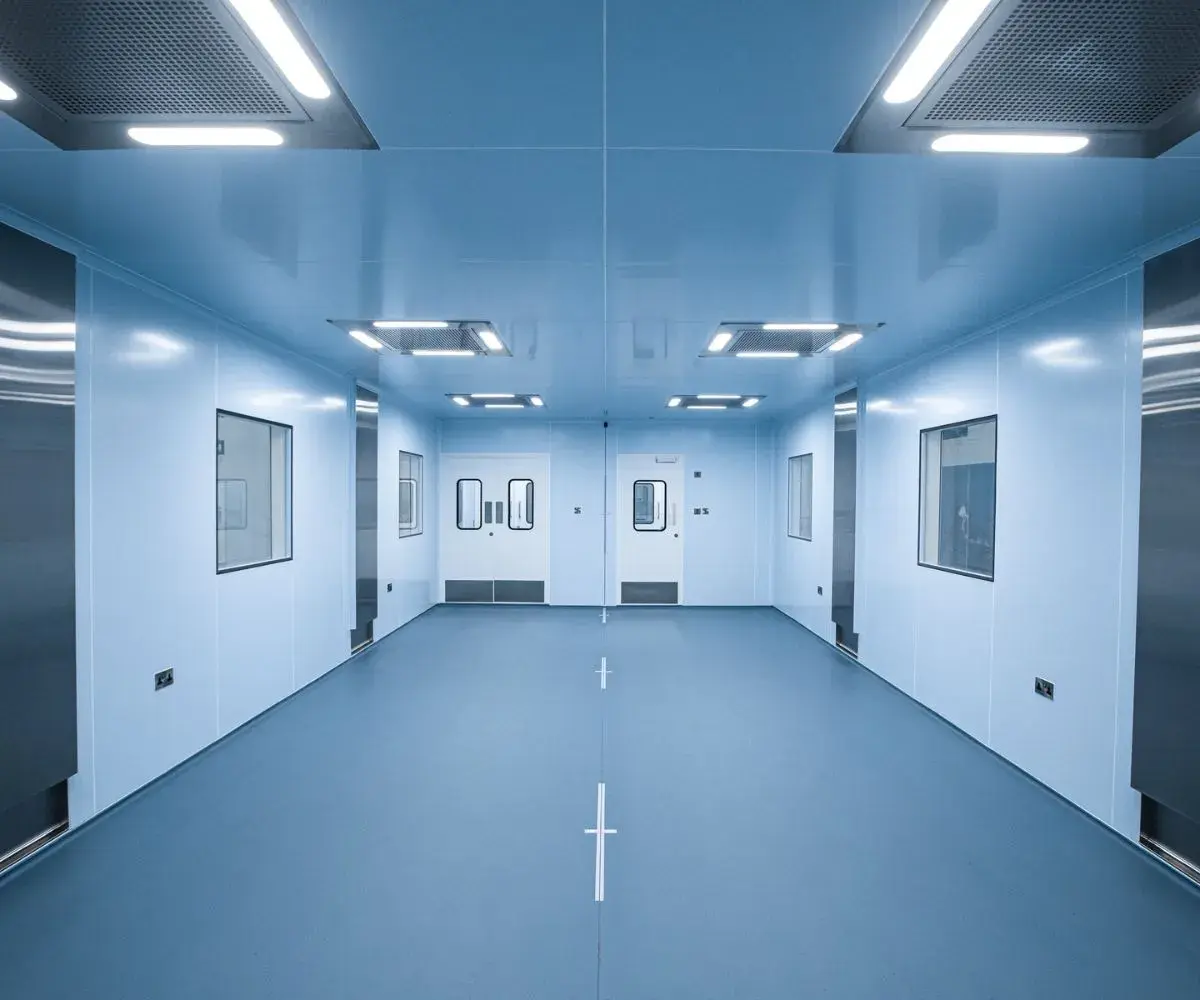
Pharmaceutical Cleanroom Contractor Bahrain: Start With the Inspection, Not the Price

Most pharmaceutical cleanroom projects don't fail at inspection. They fail much earlier, on the day someone signs with a builder who has never had to explain a pressure cascade to a regulator.
That might sound dramatic, but anyone who has sat through a GMP audit will recognise the pattern. The facility looks spotless at handover. The panels are flush, the floors are coved, the lighting is perfect. Then production starts, doors open and close all shift, and the room can't recover its classification in the time the protocol demands. Suddenly the problem isn't cosmetic. It's a batch release problem.
If you're planning a sterile suite, a QC laboratory or an oral solid dose area in the Kingdom, the contractor you choose will shape your regulatory record for years. Here's what to look for.
Bahrain is building a real pharmaceutical industry.
For decades, Bahrain imported almost every medicine it used. That's changing. Bahrain Pharma, the Kingdom's first drug factory, based at Bahrain International Investment Park in Hidd, received its manufacturing licence from the National Health Regulatory Authority (NHRA) in 2020 and its GMP certification in 2022. Gulf Biotech followed as the first facility licensed to produce injectable medicines locally. The Ministry of Industry and Commerce lists pharmaceuticals as a target sector in its industrial strategy, and MPs have proposed a dedicated pharmaceutical manufacturing zone.
For anyone building now, this matters in a practical way. The NHRA has inspected working plants, not just drawings, and its expectations follow international GMP. Much of what gets made here is destined for export across the GCC, so your cleanroom needs to satisfy more than one set of inspectors.
What the contractor is actually responsible for
A fit-out firm can install wall panels. A pharmaceutical cleanroom contractor in Bahrain has to deliver a controlled environment that holds its specification every single day, under full production load.
That starts with the HVAC design: air change rates, HEPA filter placement, and pressure differentials that keep air moving from cleaner grades towards less clean ones. It covers finishes that won't shed particles or harbour microbes, airlocks that keep personnel and material flows apart, and an environmental monitoring system that logs particles, pressure, temperature and humidity around the clock. And it ends with qualification: the DQ, IQ, OQ and PQ documentation that proves the room does what the design said it would.
The rulebook has moved, too. The revised EU GMP Annex 1, in force since August 2023, expects sterile manufacturers to maintain a documented Contamination Control Strategy. Your contractor's design decisions feed straight into that document. If they can't explain why a return air grille sits where it does, you'll be the one explaining it to an auditor.
The climate problem outside contractors underestimate
Any pharmaceutical cleanroom contractor Bahrain manufacturers hire has to design for the summer first. Temperatures often pass 40°C, and because the Kingdom is an island, humidity stays high for months. Dust storms add fine particulate to fresh air intakes.
This is where inexperienced firms get caught out. They size cooling coils for temperature and forget the latent load from humid outdoor air. The result is a room that holds 20°C but drifts above its humidity limit every afternoon in August. Condensation forms at duct joints. Microbial counts creep up. Pre-filters clog faster than the maintenance schedule allows for.
A contractor with genuine Gulf experience designs dehumidification from day one, specifies pre-filtration for sand and dust, and models energy use honestly, because air handling units running 24 hours a day in this heat cost real money.
Questions worth asking before you sign
Don't rely on the company profile. Before you shortlist any pharmaceutical cleanroom contractor, Bahrain-based or international, ask:
- Which GMP-graded facilities have you delivered, and can we speak to the QA manager there?
- Who writes and executes the qualification protocols?
- What temperature and humidity tolerances will you guarantee in August, not January?
- How do you manage design changes once panels are on site?
- Why modular or conventional construction for this project specifically?
The answers tell you more than any brochure. A contractor who hesitates on the first two is usually a builder, not a cleanroom specialist.
Modular or conventional?
For most mid-sized pharmaceutical projects in Bahrain, modular cleanroom systems make more sense. Panels arrive prefabricated, which cuts on-site dust and shortens installation. Walls can be reconfigured when a new product line arrives, and that flexibility matters for young manufacturers planning to grow in phases.
Conventional construction still has its place, particularly for very large, simple spaces where cost per square metre outweighs flexibility. But it takes longer, generates more site contamination and makes later changes expensive. Whichever route you take, insist the contractor sets out the trade-off in writing.
Compare qualification plans, not just prices.
The lowest bid nearly always prices the build and treats qualification as an afterthought. That's where projects lose months. Before you compare numbers, ask every bidder for their response to your user requirement specification, their room data sheets and their outline OQ plan. Lay them side by side.
You'll see very quickly who has done this before. In a market where the NHRA inspects real plants and the wider GCC is watching, that's the only comparison that counts.

