

UK Biomass Pellets Market Research: Power Generation and Industrial Heating Demand

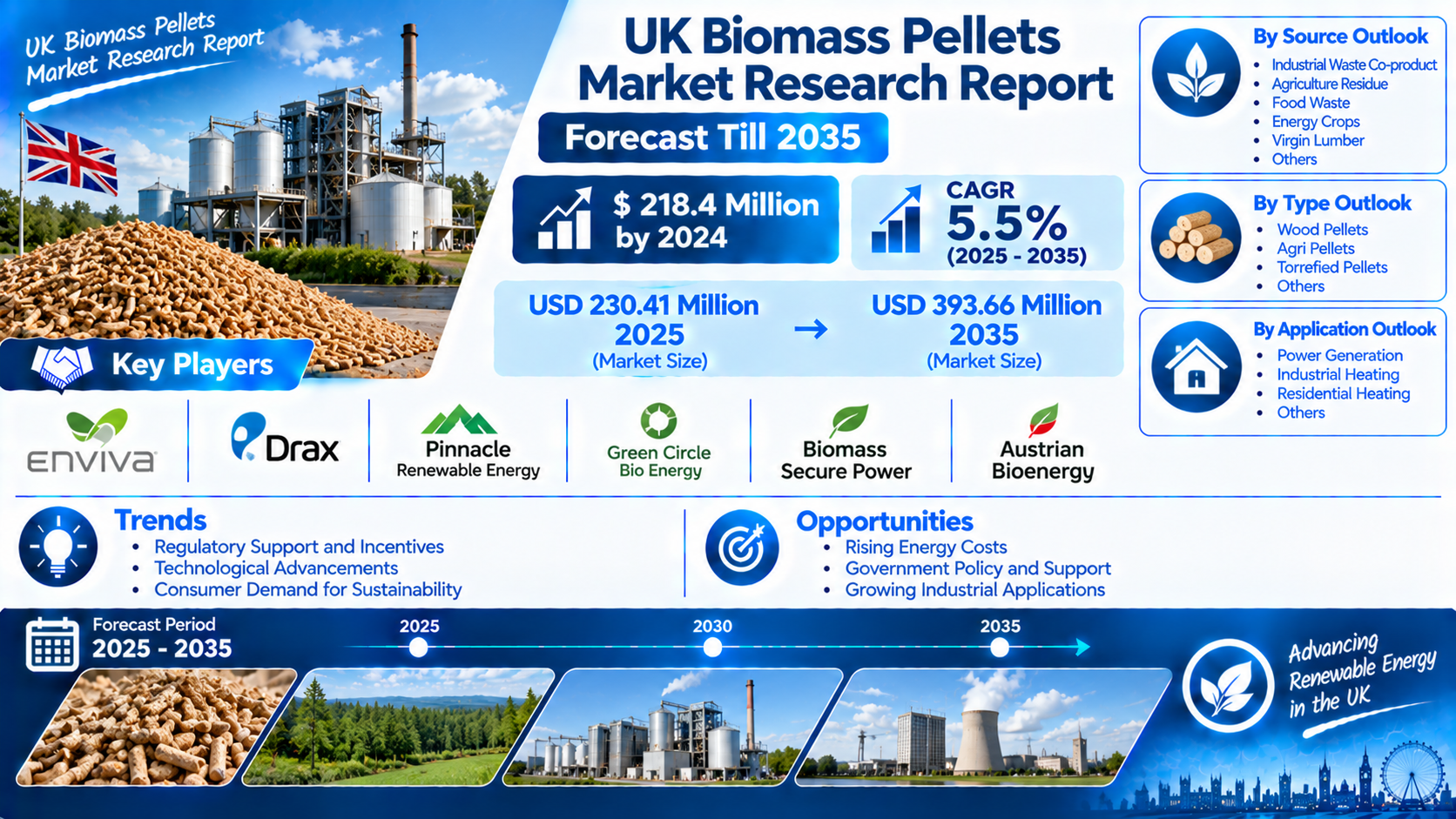
According to Market Research Future® (MRFR), the UK Biomass Pellets Market is expected to expand at a CAGR of 5.5% between 2025 and 2035, with its value forecast to rise from USD 230.41 million to USD 393.66 million. The market recorded USD 218.4 million in 2024. Its outlook is shaped by the UK's interest in renewable energy, the need for alternative heating fuels and the development of biomass processing technologies. Demand across power generation, industrial heating and residential heating will depend on fuel availability, conversion economics and the policy environment.
Market Dynamics and Industry Development
Biomass pellets are manufactured by compressing prepared organic material into dense, standardized fuel units. Feedstocks can include wood-processing residues, agricultural by-products and other biomass sources. Pelletization creates a fuel that can be stored, transported and handled using systems designed for solid fuels. Its consistent physical form can support automated feeding in suitable boilers and energy-generation facilities.
The UK market serves users with different energy requirements. Power generators may procure pellets in large volumes under structured supply arrangements, while industrial facilities evaluate them as a possible source of process heat. Residential customers generally require accessible fuel distribution and compatible heating equipment. These different purchasing patterns influence product specifications, logistics and supplier strategies.
MRFR reports a market value of USD 218.4 million in 2024, increasing to USD 230.41 million in 2025. By 2035, the market is projected to reach USD 393.66 million. The forecast reflects an expected CAGR of 5.5% over 2025–2035. Policy developments, energy prices and the availability of suitable biomass feedstocks will be important factors affecting whether the market achieves this growth trajectory.
Feedstock Sources and Supply Considerations
The market's source segmentation includes industrial waste co-product, agriculture residue, food waste, energy crops, virgin lumber and others. Each feedstock category presents different collection, processing and quality-control requirements.
Industrial waste co-products can offer manufacturers access to materials generated by industrial operations. Their use in pellet production depends on the composition and consistency of the residue, as well as its suitability for combustion. Producers must ensure that feedstocks meet fuel specifications and do not introduce undesirable contaminants.
Agriculture residue can contribute to the supply base by turning selected crop by-products into usable fuel. Availability is affected by agricultural production cycles, harvesting practices and competing uses for residues. Collection and storage are important because untreated biomass can be bulky and may require drying or other preparation before pelletization.
Food waste is another listed source, but it requires careful sorting and processing. Not all food-related waste is suitable for fuel production, and the material must meet applicable environmental and technical requirements. Energy crops may provide a cultivated feedstock option, although land use, resource inputs and competition with food production need consideration.
Virgin lumber is also included in the source outlook. Its role in a sustainable fuel supply depends on responsible forestry and the origin of the wood. Using suitable by-products and residues can support resource efficiency, but the environmental performance of any biomass pathway must be assessed across its lifecycle.
Wood, Agricultural and Torrefied Pellets
Wood pellets are a central product category in the market segmentation. They are commonly manufactured from wood residues and other suitable timber materials. Their quality is influenced by moisture content, density, ash characteristics and production controls. These factors affect storage, combustion and the performance of heating systems.
Agri pellets are produced from agricultural feedstocks and can provide an alternative to wood-based fuels. Their properties vary according to the crop material and processing method. Some agricultural feedstocks may have higher ash content or different combustion characteristics, requiring suitable boiler design and operating practices. Fuel testing is therefore important for industrial and power-generation users.
Torrefied pellets are produced through a thermal treatment process that changes certain physical and chemical characteristics of biomass. The process can improve handling and storage properties and may increase energy density. Their use depends on the economics of production, the performance of the resulting fuel and compatibility with existing energy infrastructure.
The report also includes other pellet types. Across all categories, technological advancements can support improvements in drying, size reduction, densification and product testing. Manufacturers must maintain consistent output while managing feedstock variability and production costs.
Power Generation and Heating Applications
Power generation is a significant application because biomass pellets can supply energy at facilities designed or adapted to use solid biomass fuels. Procurement decisions are influenced by fuel specifications, plant operating requirements, logistics and the terms of supply agreements. Long-term demand depends on the role assigned to biomass within the UK's energy mix and the sustainability criteria applied to its use.
Industrial heating provides another opportunity. Facilities requiring process heat may consider biomass pellets where appropriate boilers and fuel-handling systems are available. Adoption involves assessing equipment investment, conversion costs, maintenance, fuel prices and operational reliability. Rising energy costs can encourage businesses to review their fuel options, but the decision remains dependent on site-specific economics.
Residential heating demand is shaped by household preferences, equipment availability and the convenience of pellet supply. Consumers may consider pellet systems as an alternative to other heating arrangements, particularly where suitable distribution and servicing networks exist. Installation expenses, storage requirements and ongoing maintenance can influence purchasing decisions.
Policy, Sustainability and Technology Trends
Regulatory support and incentives are important trends because policy frameworks can influence renewable energy investment and the economics of biomass use. Clear sustainability criteria and predictable regulations can help businesses assess long-term projects. Changes in incentives or compliance requirements may also affect the relative attractiveness of biomass compared with other energy sources.
Consumer demand for sustainability is encouraging interest in renewable heating and lower-carbon energy pathways. Nevertheless, biomass should not be assumed to be carbon-neutral in every circumstance. Its environmental performance depends on feedstock sourcing, forestry and land-use practices, processing energy, transportation and emissions during combustion. Transparent sourcing and lifecycle assessment are important to understanding its contribution.
Technological advancements are supporting developments in pellet production and energy conversion. Better process control can improve product consistency, while equipment improvements may help manage energy use and manufacturing costs. Innovation in combustion and fuel-handling systems can also influence the range of applications that can use biomass pellets.
Growth Opportunities and Market Participants
The report identifies rising energy costs, government policy and support, and growing industrial applications as key opportunities. Higher conventional energy costs can encourage industrial and residential users to compare alternative fuels. Policy support may strengthen investment confidence, while additional industrial applications can broaden the customer base.
The companies profiled include Enviva, Drax Group, Pinnacle Renewable Energy, Green Circle Bio Energy, Biomass Secure Power and Austrian Bioenergy. Competition among suppliers can depend on feedstock access, production capacity, fuel quality, transport infrastructure and the ability to secure dependable supply agreements. Sustainability credentials and compliance with applicable standards can also influence customer selection.
Regional and Market Outlook
Although this report focuses on the UK, the broader market framework reflects the importance of regional energy policy, biomass availability and infrastructure. Within the country, demand conditions can differ according to industrial concentration, heating requirements, access to pellet distribution and the presence of suitable power-generation facilities.
The market is forecast to rise from USD 230.41 million in 2025 to USD 393.66 million in 2035, supported by a CAGR of 5.5%. Its 2024 value was USD 218.4 million. The outlook will depend on the alignment of policy incentives, sustainable feedstock supply, production technology and end-user economics. Power generation, industrial heating and residential heating offer distinct demand channels, while rising energy costs and growing industrial applications provide potential avenues for expansion.

