

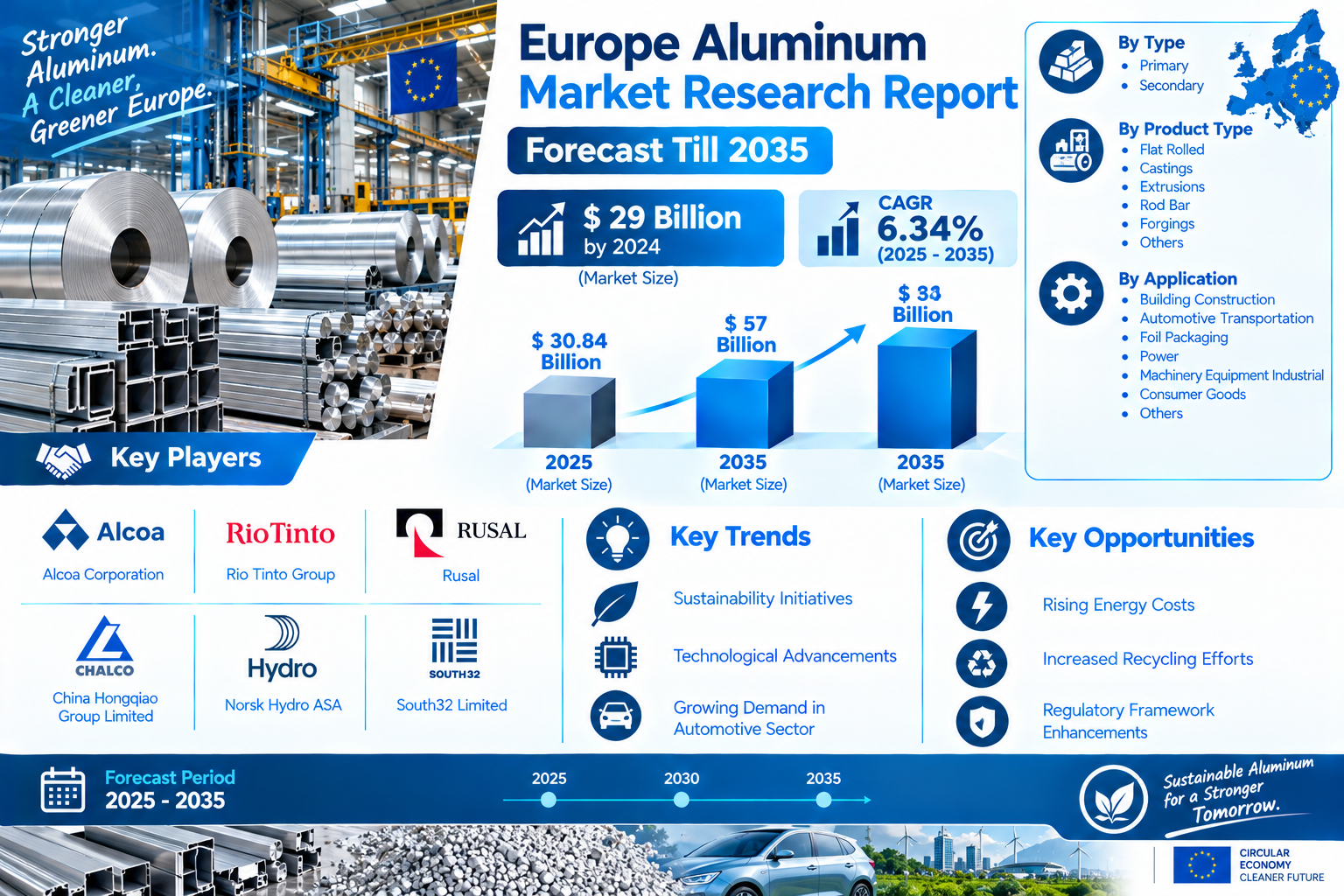

The European aluminum industry is being shaped by two connected priorities: supplying a wide range of manufacturing sectors and improving the efficiency with which the metal is produced, processed and recovered. According to Market Research Future® (MRFR), the Europe Aluminum Market is expected to reach USD 57 Billion by 2035, rising from USD 30.84 Billion in 2025. The market was valued at USD 29 Billion in 2024 and is projected to register a CAGR of 6.34% over the 2025–2035 forecast period. Sustainability initiatives, technological advancements and growing automotive demand are among the developments influencing this outlook.
A Diverse Industrial Demand Base
Aluminum's combination of low weight, corrosion resistance, formability and recyclability supports its use across a broad range of industries. In Europe, its applications extend from building materials and vehicle components to packaging, electrical systems, machinery and consumer products. This diversity gives the market exposure to several industrial demand cycles.
Building construction uses aluminum in architectural profiles, windows, doors, façades, roofing and other fabricated components. The metal's ability to be shaped into different profiles gives designers and manufacturers flexibility, while its resistance to corrosion can be valuable in applications exposed to changing weather conditions. Renovation activity and construction standards can influence the choice of aluminum products in building projects.
Automotive and transportation manufacturers use aluminum where component weight, strength and design requirements justify its selection. The material can be incorporated into vehicle structures and other components, supporting lightweighting strategies. The growing demand in the automotive sector is therefore a notable market trend. Electric vehicle development may also create opportunities for selected aluminum applications, although each component must meet specific safety, performance and manufacturing requirements.
Foil packaging represents another established area of use. Aluminum foil is valued for its barrier characteristics and suitability for packaging applications. Power-related products, machinery and industrial equipment provide further demand, while consumer goods add applications across a variety of manufactured products.
Primary and Secondary Metal Have Distinct Roles
The market's type segmentation covers Primary and Secondary aluminum. Primary aluminum originates from alumina and is produced through electrolytic smelting. The process requires substantial electricity, making energy costs a major factor in production economics. Changes in power prices can affect operating margins and influence decisions about production capacity, investment and sourcing.
Secondary aluminum is recovered from scrap and processed for reuse. It is an important contributor to circular manufacturing because aluminum can be recycled repeatedly, provided the material is collected and processed appropriately. Recycling can require considerably less energy than primary production, although the final environmental benefit depends on collection, sorting, remelting, transport and the energy used throughout the process.
The availability of suitable scrap is central to secondary production. Different aluminum alloys and product categories have specific composition requirements, so scrap sorting and quality control are necessary to produce metal that meets customer specifications. Better recycling systems can improve the supply of recovered material, while advances in separation and processing can help address contamination and alloy-mixing challenges.
Primary and secondary aluminum therefore serve complementary roles. Primary production supplies metal from newly processed raw materials, while secondary production recovers material already in circulation. The balance between them is influenced by industrial demand, scrap availability, energy economics and product-quality requirements.
Product Portfolio Matches Different End Uses
Product type segmentation includes Flat Rolled, Castings, Extrusions, Rod Bar, Forgings and Others. These forms are manufactured through different processes and are selected according to the technical requirements of downstream applications.
Flat rolled products include sheets, plates and foil. They serve packaging, construction, transportation and industrial manufacturing. Castings allow producers to manufacture components with complex shapes and are used in automotive and machinery applications. Extrusions are created by pushing aluminum through dies to form profiles with defined cross-sections. These products are relevant to construction systems, vehicle components and industrial assemblies.
Rod Bar products are used in engineering, electrical and manufacturing applications, while forgings are selected for components that require particular mechanical properties and structural performance. Other product forms address additional requirements within the market's reported segmentation. Across these categories, buyers assess dimensions, alloy composition, surface finish, mechanical characteristics and consistency of supply.
Recycling and Sustainability Become Strategic Priorities
Sustainability initiatives are a defining trend in the European aluminum sector. Manufacturers face growing attention to energy use, emissions, resource efficiency and the environmental characteristics of supplied materials. Aluminum's recyclability gives it a role in circular-economy strategies, but recyclability alone does not establish the environmental footprint of a product. Primary production, electricity sourcing, transportation and end-of-life recovery all affect lifecycle performance.
Increased recycling efforts offer an important market opportunity. Better collection of packaging, automotive components, construction materials and industrial scrap can increase the volume of aluminum available for reuse. Improved sorting technologies can help separate alloys and reduce contamination, while efficient remelting processes can support the production of secondary metal for industrial customers.
Regulatory framework enhancements may reinforce these changes. Policies concerning waste recovery, industrial emissions, energy use and material reporting can influence investment in production and recycling facilities. Companies need to understand the requirements applicable to their products and markets, particularly where customers require evidence of material origin or recycled content.
Technology and Energy Economics Influence Producers
Technological advancements are affecting the way aluminum is produced and converted into finished products. Developments in smelting, casting, extrusion, rolling and surface treatment can help improve product consistency and process efficiency. Digital monitoring and automation can also support production control, reduce process variation and improve the use of raw materials.
Energy economics remain especially important for primary aluminum producers. Rising energy costs are identified as an opportunity area in the market outlook, although they also present a cost challenge. Companies may respond by improving energy efficiency, reviewing power procurement arrangements and investing in production technologies. The impact will vary according to facility configuration, energy contracts and local operating conditions.
Recycling can provide an additional route to manage energy exposure because secondary production generally uses less energy than primary smelting. However, recycled supply cannot automatically replace primary metal in every application. Product specifications, alloy availability and the quality of recovered scrap determine where secondary aluminum can be used.
Competitive Environment and Industry Participants
The Europe Aluminum Market includes major international producers and suppliers. The key players identified by MRFR are Alcoa Corporation, Rio Tinto Group, Rusal, China Hongqiao Group Limited, Norsk Hydro ASA and South32 Limited.
Competition in the industry depends on production costs, access to raw materials and energy, manufacturing capabilities, product quality and the ability to meet customer requirements. Recycling capacity and the availability of secondary metal are also becoming important considerations as customers seek to improve resource efficiency. Producers that can coordinate primary supply, recycled inputs and downstream processing may be better placed to respond to changing demand.
Opportunities linked to regulatory enhancements and increased recycling efforts could encourage investment in sorting, processing and material recovery. At the same time, demand from automotive, construction, packaging and industrial customers will continue to influence product mix and capacity utilisation.
Market Outlook Through 2035
The Europe Aluminum Market is projected to rise from USD 30.84 Billion in 2025 to USD 57 Billion by 2035, reflecting a CAGR of 6.34%. The 2024 market value of USD 29 Billion provides the starting point for the forecast's broader growth trajectory.
Future performance will depend on the strength of downstream demand, energy-cost conditions, technology investment and the development of recycling systems. Automotive lightweighting and construction applications provide important demand channels, while packaging, power and machinery contribute to the industry's diverse customer base. As sustainability and regulatory expectations evolve, the ability to deliver consistent products while improving material recovery and production efficiency will remain central to competitive positioning.

