

Portugal Construction Market Forecast 2025–2035: Industry Developments and Prospects

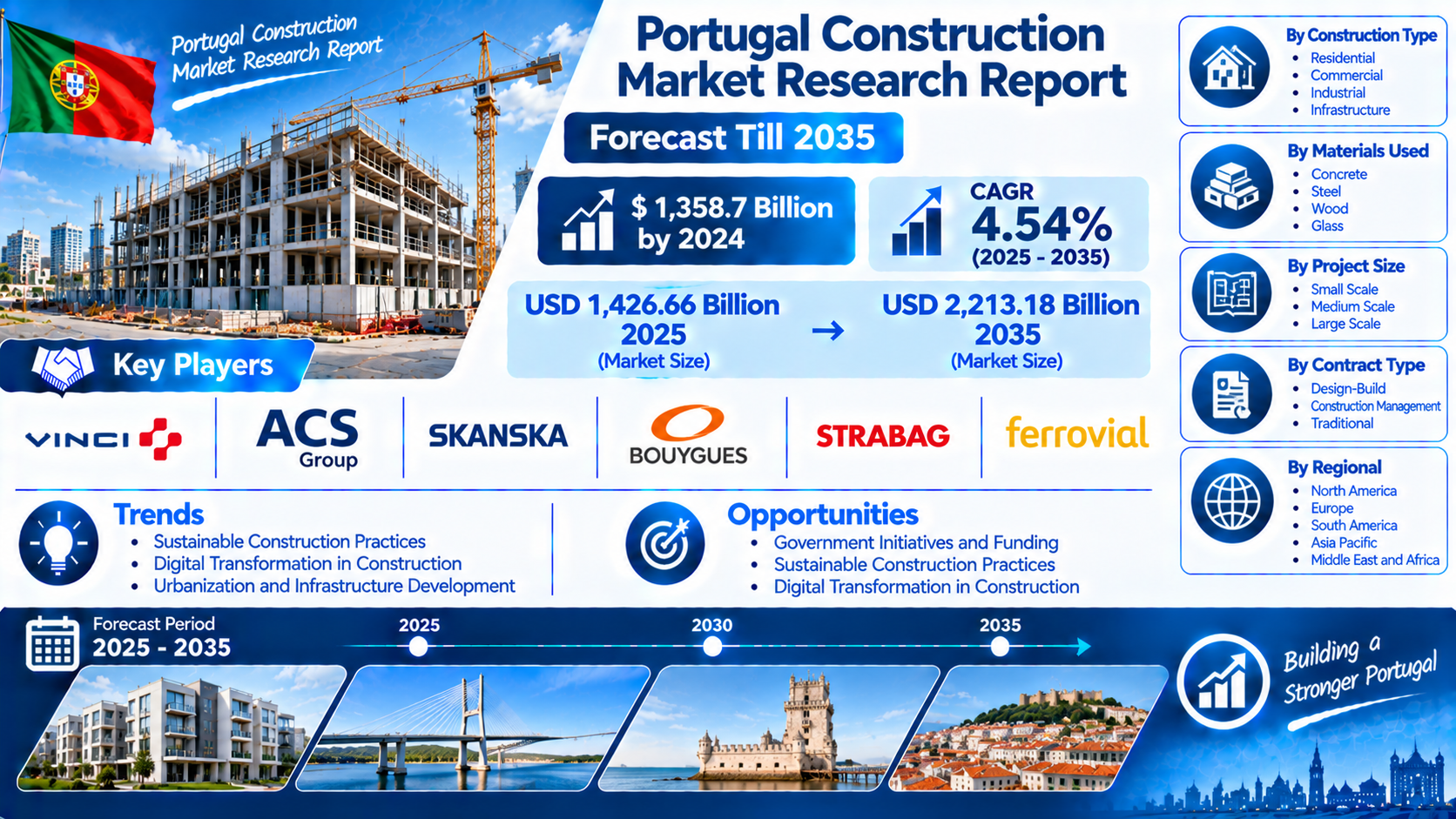
According to Market Research Future® (MRFR), the Portugal Construction Market is expected to reach USD 2,213.18 billion by 2035, up from USD 1,426.66 billion in 2025. The market recorded a value of USD 1,358.7 billion in 2024 and is forecast to advance at a CAGR of 4.54% over the 2025–2035 period. The industry's outlook reflects activity across housing, commercial buildings, industrial facilities and infrastructure, with material choices, project scale and contract arrangements shaping how construction demand is addressed.
Market Direction and Industry Context
The construction sector brings together developers, contractors, material suppliers, designers and project owners. Their work spans the development of new assets and the delivery of projects with different technical and commercial requirements. In Portugal, the market's reported structure covers four principal construction categories: residential, commercial, industrial and infrastructure.
These categories respond to different forms of demand. Residential projects are associated with housing development, while commercial construction serves business and service-related requirements. Industrial construction focuses on facilities designed for industrial activities. Infrastructure construction involves projects that support wider connectivity and essential services. Each category requires its own combination of planning, materials, technical capabilities and delivery arrangements.
The forecast increase in market value points to an expanding construction environment through 2035. However, the market's growth rate should not be interpreted as an identical performance level across all project types. Individual developments can be affected by financing availability, project approvals, construction costs, procurement schedules and the capacity of contractors to deliver work. These factors make project preparation and execution important considerations for industry participants.
Demand Across Construction Categories
Residential construction is one of the market's four principal segments. Its requirements can differ according to project size, building configuration, intended use and location. Developers and contractors must coordinate structural work, building materials and construction schedules while meeting the specifications established for each development.
Commercial construction includes buildings intended for business and service activities. Project requirements can place emphasis on functional layouts, building systems, access and the ability to accommodate the intended use. Industrial construction has more specialized requirements, which may involve structural design, operational layouts and coordination with equipment or production-related systems.
Infrastructure projects form the fourth category. Their delivery can involve extensive planning, technical assessment and coordination among several parties. The project scope and funding structure influence the procurement and construction approach. Across these categories, the ability to match resources and technical expertise with project requirements remains central to effective execution.
Material Selection and Construction Methods
Concrete, steel, wood and glass are the four material categories identified in the report. Their roles differ according to design, structural specifications and intended building performance. Concrete is used in numerous structural and building applications. Steel can support structural systems where its strength and design characteristics are required. Wood has applications in building structures and architectural elements, while glass is used in windows, façades and other building features.
Material decisions involve more than initial purchase cost. Contractors and designers must consider technical suitability, availability, installation methods, durability expectations and compatibility with the wider construction design. Procurement planning is also important because material availability and delivery schedules can influence project timelines. Selecting materials that meet the required specifications helps align construction execution with the intended design.
Sustainable construction practices are increasingly relevant to these decisions. The trend encourages project participants to consider resource efficiency and the broader performance of buildings and construction processes. The appropriate approach depends on project conditions and the technical requirements of each material or system. Sustainability objectives therefore need to be considered alongside budget, performance and delivery constraints.
Project Size and Contract Structure
The market's project-size segmentation includes small-scale, medium-scale and large-scale construction. These categories reflect differences in scope and the level of coordination required. Small-scale projects may involve fewer work packages and a more limited resource base. Medium-scale developments can require coordination across a wider range of activities, while large-scale projects may involve complex schedules, multiple contractors and substantial procurement requirements.
Project size can influence how companies organize labor, equipment, suppliers and management resources. Larger developments generally require careful sequencing and communication to maintain alignment among different workstreams. Smaller projects also require effective planning, although the level of coordination may be different.
Contract type provides another way to understand how construction projects are organized. The report identifies design-build, construction management and traditional arrangements. Design-build brings design and construction responsibilities together under an integrated structure. Construction management focuses on managing and coordinating project delivery, while traditional contracting separates design and construction responsibilities. The selection of a contract model depends on the project's requirements, the owner's preferred allocation of responsibilities and the capabilities of the participating organizations.
Digital Transformation and Urban Development
Digital transformation is one of the trends shaping the construction market. Digital systems can support project planning, design coordination, scheduling, document management and communication. These capabilities can be relevant when several organizations are working toward shared project milestones. Their effectiveness depends on the quality of implementation, the skills of project teams and the compatibility of systems used by different participants.
Urbanization and infrastructure development are also identified as market trends. These themes are connected to the need for buildings and physical assets that support residential, commercial, industrial and wider infrastructure requirements. The type and scale of construction activity depend on specific development plans and project funding. Companies must therefore assess individual opportunities rather than assume that demand will be evenly distributed across all categories.
Competitive Environment and Growth Opportunities
Vinci, ACS Group, Skanska, Bouygues, Strabag and Ferrovial are listed as key players in the Portugal construction market report. Competition in the sector involves the ability to secure projects, manage complex delivery requirements, coordinate subcontractors and suppliers, and meet contractual specifications. Technical experience and project-management capabilities can be important considerations when companies compete for construction opportunities.
Government initiatives and funding are identified as potential sources of market opportunity. Public support can contribute to project development when funding is allocated and projects proceed through the relevant approval and procurement stages. The timing and impact of these initiatives depend on implementation and the specific projects involved.
Sustainable construction creates opportunities for companies that can address project requirements related to materials, resource use and building performance. Digital transformation offers a further area for development through improved planning and coordination. Both opportunities require investment and practical implementation. Companies need to assess whether proposed methods and technologies are suitable for their projects and can deliver value within commercial and technical constraints.
Outlook Through 2035
The Portugal construction market is projected to increase from USD 1,426.66 billion in 2025 to USD 2,213.18 billion in 2035, representing a CAGR of 4.54%. Its development will continue to be shaped by the balance of residential, commercial, industrial and infrastructure activity. Material selection, project scale and contract structure will influence the resources and capabilities required across the sector.
The report's outlook highlights sustainable construction practices, digital transformation, urbanization and infrastructure development as significant themes. Government initiatives and funding, alongside investment in sustainable methods and digital capabilities, provide potential opportunities for market participants. Contractors and suppliers that combine appropriate technical expertise with disciplined project planning and coordination may be positioned to respond to evolving construction requirements over the forecast period.

