

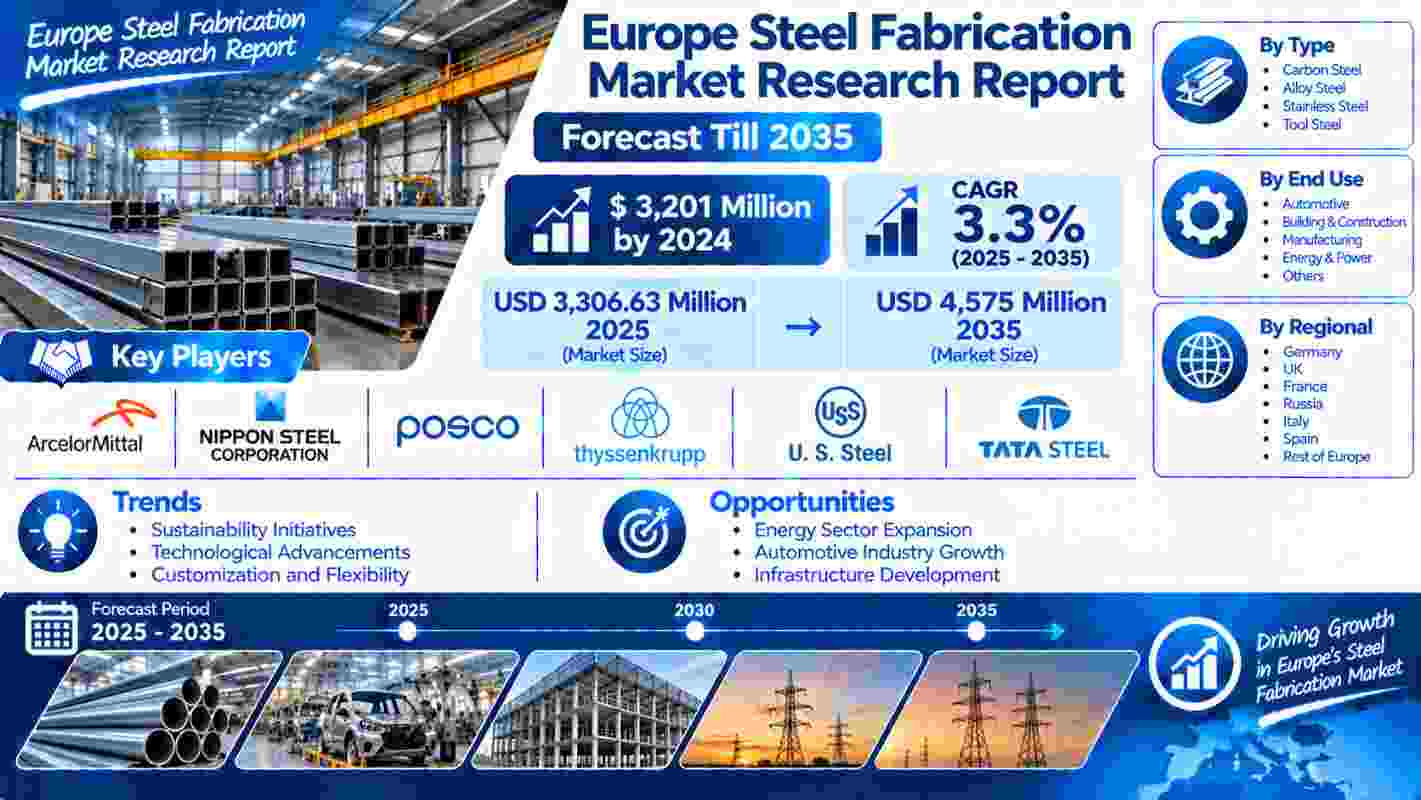

According to Market Research Future® (MRFR), the Europe Steel Fabrication Market is expected to increase from USD 3,306.63 million in 2025 to USD 4,575 million by 2035, reflecting a CAGR of 3.3% over the 2025–2035 forecast period. The market's 2024 valuation stood at USD 3,201 million. Demand is connected to the use of fabricated steel across Europe's construction, automotive, manufacturing, and energy and power industries. As industrial and infrastructure projects evolve, suppliers are responding to requirements for reliable components, specialized material grades, and fabrication solutions that can accommodate different designs and operating conditions.
Fabricated Steel's Role Across European Industries
Steel fabrication supports the conversion of steel materials into components and assemblies designed for specific industrial and commercial uses. The process can involve cutting, shaping, joining, and finishing steel according to engineering drawings and customer specifications. The resulting products serve a wide range of purposes, from structural elements in construction to components used in manufacturing and energy infrastructure. Demand is therefore influenced by activity across several sectors rather than by a single industry.
Building and construction represents a significant source of demand. Buildings and infrastructure projects require steel components that meet defined structural, dimensional, and installation requirements. Fabrication enables steel products to be prepared for incorporation into larger structures and project assemblies. Infrastructure development creates additional opportunities where transport facilities, industrial sites, and other public or private projects require fabricated components. Project schedules, technical specifications, and investment decisions all affect the timing and volume of orders.
The automotive industry is another relevant end-use market. Vehicle manufacturers and their supply chains require components that meet design, strength, and production specifications. Fabricated steel can contribute to automotive structures and other vehicle-related applications, depending on the material grade and component design. Changes in vehicle production, manufacturing processes, and material preferences can influence the type and volume of steel fabrication services and products required.
Manufacturing adds a broad range of industrial requirements. Equipment producers and other manufacturers may need steel parts and assemblies tailored to particular machines, facilities, or operating conditions. These customers can place importance on precision, repeatability, material characteristics, and the ability to meet delivery schedules. As a result, fabrication companies must combine technical capability with operational flexibility.
Material Categories and Their Application Requirements
The market is segmented into carbon steel, alloy steel, stainless steel, and tool steel. These categories differ in composition and performance characteristics, making material selection an important part of fabrication planning. Carbon steel is used across many general structural and industrial applications. Alloy steel can be selected where additional mechanical properties are required, while stainless steel is relevant in environments where corrosion resistance is a consideration. Tool steel is associated with applications that require particular hardness and wear resistance.
The appropriate steel type depends on the final component's intended function, exposure conditions, manufacturing process, and technical specifications. Fabricators must work with material grades that satisfy customer and project requirements. They also need to consider the relationship between material properties, processing methods, component tolerances, and final performance. This makes material knowledge and production control important elements of service quality.
End-use segmentation includes automotive, building and construction, manufacturing, energy and power, and other applications. The range of these categories illustrates the market's varied demand base. While construction projects may prioritize structural performance and project-scale supply, manufacturing customers may require specialized components and repeatable production. Automotive and energy-related applications can involve their own technical and quality requirements.
Energy Expansion and Infrastructure Development
Energy sector expansion is a notable opportunity for steel fabricators in Europe. Energy facilities and supporting infrastructure can require fabricated structures and components designed for specific technical and operating conditions. The nature of demand depends on the type of project, its engineering design, and the materials specified. As energy investment develops, companies with appropriate fabrication capabilities may have opportunities to participate in supply chains serving these projects.
Infrastructure development is also important to the market's longer-term prospects. Public and private investment can generate requirements for steel components across construction and industrial projects. The ability to deliver products that meet project specifications and schedules can influence supplier selection. Fabricators may therefore focus on production planning, quality assurance, and coordination with contractors and other project participants.
Automotive industry growth offers another opportunity. Demand from vehicle manufacturing can support the need for fabricated steel components, although requirements differ by vehicle type, component design, and manufacturing strategy. Suppliers must remain responsive to changing specifications and production volumes while maintaining consistency and cost competitiveness.
Sustainability and Technology Influence Industry Practices
Sustainability initiatives are shaping industrial priorities across Europe. For steel fabrication companies, relevant considerations include material efficiency, energy consumption, production waste, and the environmental performance of manufacturing operations. Better planning and process control can help reduce unnecessary material losses and improve resource utilization. Companies may also evaluate equipment and operating practices that support more efficient production.
Technological advancements are changing the capabilities available to fabricators. Improvements in machinery, digital design, process monitoring, and automation can support more accurate production and consistent output. Technology adoption may also help companies handle complex component designs and improve coordination between design and manufacturing activities. The extent of these benefits depends on the level of investment, the skills available within the workforce, and the integration of new systems into existing facilities.
Customization and flexibility are increasingly relevant because customers across different industries do not necessarily require standardized products. Fabricated components may need to match specific dimensions, material grades, assembly methods, and operating conditions. Suppliers that can adapt production to different requirements may be able to serve a wider customer base. At the same time, flexible production must be managed carefully to maintain quality, delivery reliability, and commercially viable operating costs.
Regional Markets and Competitive Positioning
The report covers Germany, the UK, France, Russia, Italy, Spain, and the Rest of Europe. These markets differ in their industrial composition, construction activity, automotive manufacturing presence, and energy infrastructure requirements. Consequently, demand for fabricated steel can vary across countries. Regional investment patterns and the development of major end-use industries will influence opportunities for suppliers.
The companies identified as key players are ArcelorMittal, Nippon Steel Corporation, POSCO, Thyssenkrupp AG, United States Steel Corporation, and Tata Steel Limited. They are included in the report's competitive landscape, although their activities may span different parts of the steel value chain. Competition in the European market can reflect access to steel materials, processing capabilities, production scale, technical expertise, quality management, and relationships with industrial customers.
Outlook Through 2035
The Europe steel fabrication market is forecast to reach USD 4,575 million by 2035, compared with USD 3,306.63 million in 2025. Its projected CAGR of 3.3% indicates steady expansion supported by demand across several end-use industries. Construction and infrastructure activity, automotive manufacturing, and energy sector investment provide important areas of opportunity.
Future market development will also depend on how effectively companies respond to sustainability expectations, technological change, and customer demand for customized products. Fabricators that combine dependable production with material expertise and adaptable manufacturing capabilities may be better positioned to serve the region's diverse industrial requirements. These factors will shape the market's competitive environment over the forecast period.

