

Rubber Flooring Market Forecast to 2035: Opportunities Across Transportation and Industrial Facilities

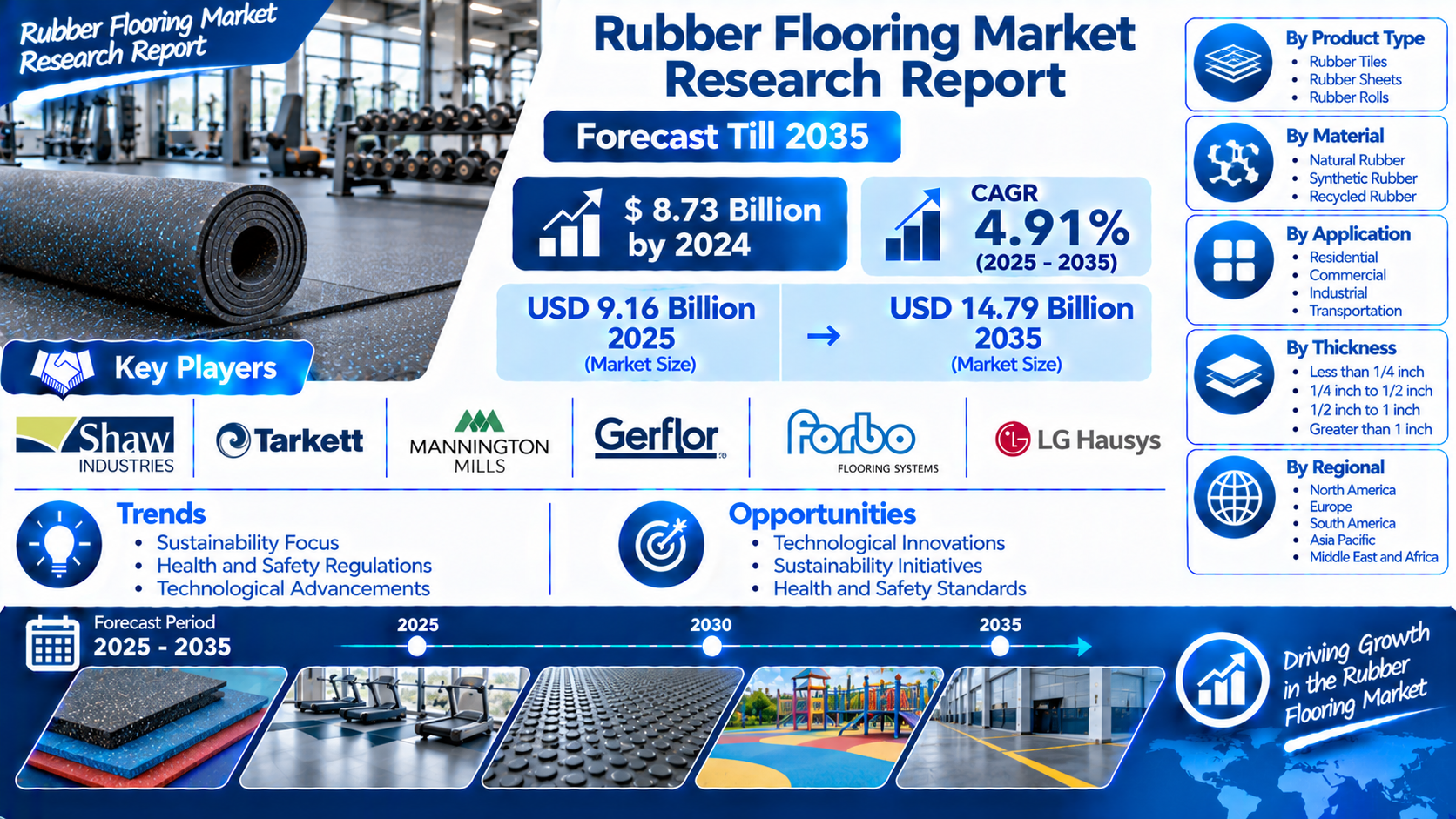
According to Market Research Future® (MRFR), the Rubber Flooring Market is expected to increase from USD 9.16 billion in 2025 to USD 14.79 billion by 2035, reflecting a CAGR of 4.91% over the 2025–2035 forecast period. The market's 2024 valuation stood at USD 8.73 billion. Its growth outlook is linked to the use of rubber-based surfaces in residential, commercial, industrial, and transportation settings, where buyers assess factors such as durability, comfort, traction, and maintenance. Product innovation, sustainability initiatives, and health and safety standards are shaping the priorities of manufacturers and customers.
Performance Requirements Shape Purchasing Decisions
Flooring selection is closely connected to the conditions in which a surface will be installed. A residential property, a busy commercial building, an industrial facility, and a transportation environment can all have different requirements for surface performance. Rubber flooring addresses a range of these needs through product formats and material formulations designed for different operating conditions.
Resilience and durability are important considerations in applications involving repeated foot traffic or regular use. Depending on the product, rubber flooring can also provide cushioning and slip-resistant surface characteristics. These features make it relevant to buyers looking beyond appearance alone. Installation requirements, cleaning routines, expected service life, and total ownership costs can also influence procurement decisions.
The market's development is therefore not determined by a single end-use sector. Instead, demand reflects the combined requirements of customers across multiple settings, each of which evaluates flooring products according to its own functional and budgetary priorities.
Product Formats Address Different Installation Needs
Rubber tiles, rubber sheets, and rubber rolls form the product-type categories in the market. Each format offers a different approach to installation and surface design. Tiles are modular units that can provide flexibility when a flooring layout includes distinct sections or when localized replacement is desirable. Their individual format may also support patterns and color combinations.
Sheets are suited to projects where a more continuous surface is preferred. A sheet format can reduce the number of visible joints compared with a tiled layout, although the final result depends on the dimensions of the space and installation quality. Rubber rolls provide another option for covering larger areas. Their suitability depends on site conditions, handling requirements, and the installation method selected.
Material choice further distinguishes products. The market includes natural rubber, synthetic rubber, and recycled rubber. Natural rubber offers elasticity, while synthetic formulations can be designed to meet particular product-performance requirements. Recycled rubber is relevant to manufacturers and buyers seeking to incorporate recovered material into flooring. The choice among these materials requires consideration of the intended application, required performance, and product specifications rather than a general assumption that one material is suitable for all environments.
End-Use Demand Spans Four Application Groups
Residential demand is influenced by the need for flooring that combines practical performance with comfort and visual suitability. Homeowners and property developers may consider rubber products for spaces where resilience and maintenance are relevant. The specific product selected depends on the room's use, installation conditions, and design preferences.
Commercial applications cover facilities that serve employees, customers, visitors, or members of the public. In these environments, regular movement can make durability and maintenance important purchasing criteria. Surface texture and slip resistance may also be considered in relation to the facility's use and applicable safety requirements.
Industrial buyers often evaluate flooring in the context of operational demands. Equipment movement, repeated use, and site-specific conditions can influence the required material and thickness. The flooring specification must be suitable for the actual environment, since industrial settings can differ significantly in their exposure to wear and other stresses.
Transportation is the fourth application category. Vehicles and transportation facilities may require flooring that addresses traction, durability, cleaning, and installation constraints. These requirements vary across transportation uses, making application-specific product assessment important.
Thickness Categories and Specification
The market covers four thickness ranges: less than 1/4 inch, 1/4 inch to 1/2 inch, 1/2 inch to 1 inch, and greater than 1 inch. This range allows buyers to consider products with different physical profiles and functional characteristics. Thickness can affect cushioning, underfoot feel, and how a flooring product fits the requirements of a particular site.
A project that requires a low-profile surface may evaluate a thinner option, while an application emphasizing cushioning may consider a thicker product. Nevertheless, thickness should not be treated as a standalone measure of quality or suitability. Rubber composition, surface design, manufacturing consistency, substrate preparation, and installation practices also contribute to the performance of the finished floor.
Clear product specifications are consequently important for manufacturers, contractors, and end users. Matching the flooring to site conditions can help avoid selecting a product based only on one characteristic while overlooking other requirements.
Sustainability, Regulation, and Technology
Sustainability focus is a prominent market trend. Recycled rubber can support the reuse of recovered materials in flooring production, while manufacturers may pursue initiatives related to material efficiency and more responsible production. Buyers evaluating environmental claims may consider the proportion and source of recycled content, manufacturing processes, product durability, and available end-of-life options.
Health and safety regulations also influence the market. In spaces used by employees, customers, or the public, flooring may be assessed for slip resistance and other performance characteristics relevant to the setting. Requirements differ across applications and jurisdictions, so manufacturers need to communicate product specifications clearly and ensure that claims are supported by appropriate testing and documentation.
Technological advancements provide another route for market development. Improvements in manufacturing and product design can support consistency, expanded design choices, and specialized surface characteristics. Technological innovation is also an opportunity for suppliers seeking to respond to changing customer expectations and more demanding installation requirements.
Regional Opportunities and Competitive Activity
The market's regional coverage includes North America, Europe, South America, Asia Pacific, and the Middle East and Africa. Demand conditions vary according to construction and infrastructure activity, industrial development, commercial property requirements, and regional preferences. Established markets may place emphasis on product performance, regulatory considerations, and sustainability. Regions experiencing growth in commercial and industrial infrastructure may provide opportunities for suppliers able to meet local project specifications and purchasing requirements.
Asia Pacific, South America, and the Middle East and Africa form part of the market's geographic opportunity base alongside North America and Europe. However, growth prospects are not uniform across these regions. Local investment levels, economic conditions, distribution networks, and the adoption of rubber flooring in different applications will influence market development.
The companies identified as key players include Shaw Industries, Tarkett, Mannington Mills, Gerflor, Forbo Flooring Systems, and LG Hausys. Competitive activity can involve product portfolios, quality, design capabilities, material innovation, and distribution reach. Companies serving different flooring categories may have varied market roles, making product-level comparisons more useful than assuming that every participant has an identical offering.
Outlook for the Forecast Period
The Rubber Flooring Market is forecast to grow from USD 9.16 billion in 2025 to USD 14.79 billion in 2035, with a projected CAGR of 4.91%. Technological innovations, sustainability initiatives, and health and safety standards are identified as major opportunities. Manufacturers will need to address differences between end-use sectors, select materials suited to specific performance needs, and offer products that meet installation and maintenance expectations. The market's long-term prospects will depend on the ability to combine practical surface performance with evolving environmental and safety priorities.

