

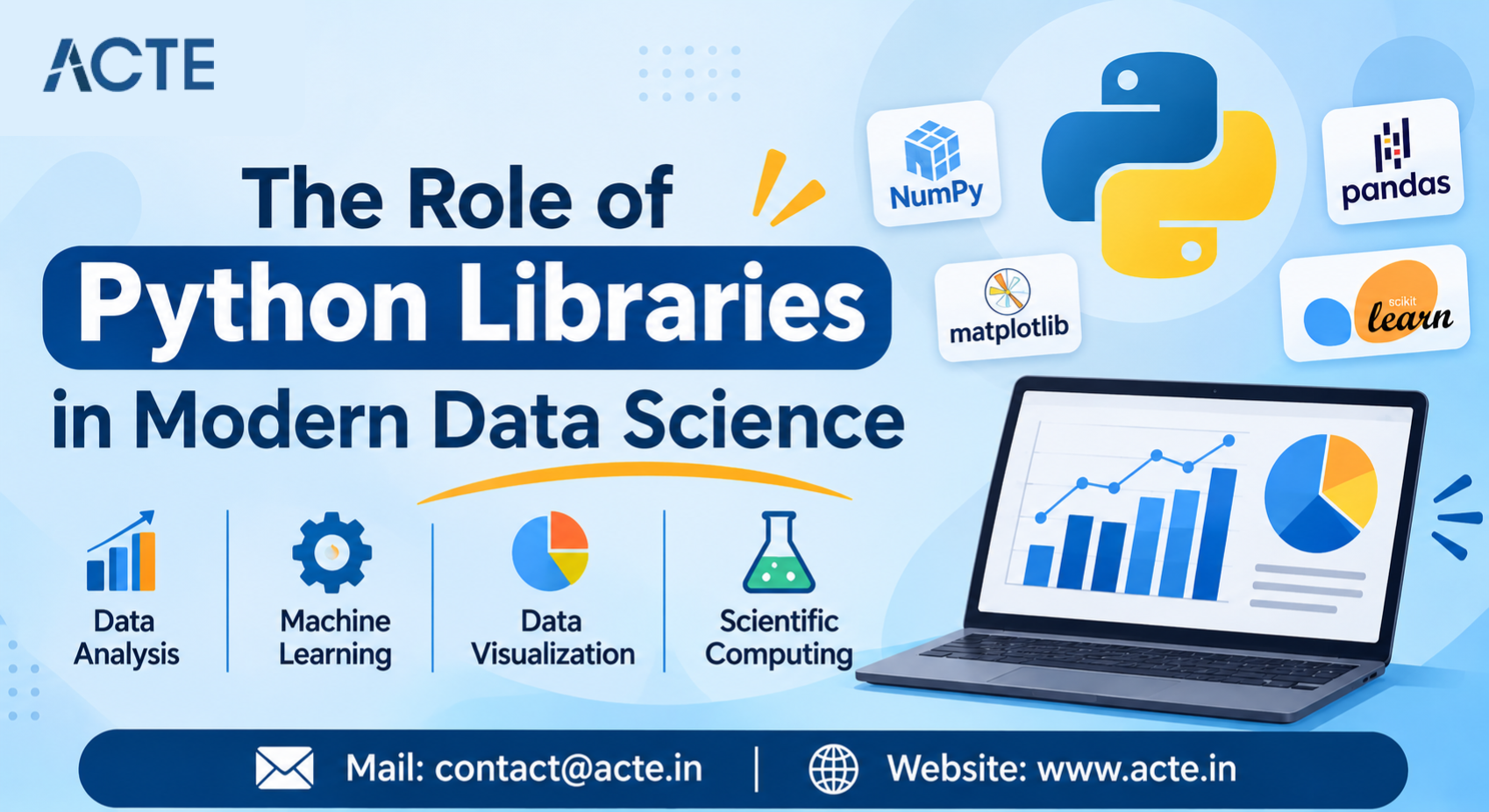

Python has become a leading programming language in the data science industry because of its flexibility, straightforward syntax, and extensive library support. Businesses increasingly depend on data to understand market conditions, improve customer experiences, and make informed decisions. Python Data Science Course in Chennai libraries provide ready-to-use tools that simplify complicated analytical operations and reduce development time. They help professionals perform activities such as collecting information, cleaning datasets, conducting statistical analysis, creating visual reports, and developing machine learning applications. These capabilities make Python an important part of modern data science solutions.

Enhancing Data Collection and Preparation
Accurate data preparation is necessary for producing meaningful analytical results. Raw information frequently contains incomplete records, duplicate entries, and inconsistent values that must be corrected before analysis. Python libraries such as Pandas and NumPy help professionals manage these challenges. Pandas provides functions for organizing datasets, filtering information, merging tables, and handling missing values. NumPy supports mathematical calculations and efficient numerical processing. Together, these libraries help data scientists prepare structured information and improve the reliability of their analytical work.
Making Data Visualization More Accessible
Data visualization helps transform complex numerical information into clear graphical insights. Python libraries such as Matplotlib, Seaborn, and Plotly provide features for creating different types of charts, graphs, and interactive dashboards. Professionals can use these tools to identify relationships, compare Data Science Course in Bangalore performance, and understand changing business trends. For instance, companies can analyze customer purchasing patterns, monitor revenue growth, and evaluate marketing activities through visual reports. These visualizations also make it easier to communicate analytical findings to non-technical stakeholders.

Supporting Machine Learning and Predictive Modelling
Machine learning is an important area of modern data science, and Python libraries provide the necessary tools to develop intelligent models. Scikit-learn supports classification, regression, clustering, and model Data Science Course in Hyderabad evaluation. TensorFlow and PyTorch offer advanced capabilities for deep learning and neural network development. Data scientists use these libraries to build applications for fraud detection, customer segmentation, product recommendations, and demand forecasting. Their built-in algorithms and reusable components simplify experimentation and help professionals improve predictive performance.
Streamlining Data Processing Through Automation
Handling large datasets often involves repetitive operations that consume valuable time. Python libraries help automate these processes and improve overall productivity. Requests and BeautifulSoup support web data collection, while Dask enables parallel processing for larger datasets. These tools help professionals collect, organize, and process information with less manual intervention. Automated workflows also improve consistency and allow data science teams to focus on understanding results, identifying opportunities, and developing effective business solutions.
Strengthening Artificial Intelligence Development
Python libraries have expanded the possibilities of artificial intelligence in modern data science. Hugging Face Transformers supports natural language processing applications such as text classification, translation, and summarization. OpenCV provides tools for image processing, object recognition, and computer vision. TensorFlow and PyTorch also support advanced AI model development. These Data Science Online Course technologies help organizations create intelligent applications that automate tasks, process complex information, and improve operational efficiency across different industries.
Conclusion
Python libraries play a significant role in modern data science by providing practical solutions for data preparation, visualization, predictive modelling, automation, and artificial intelligence. Tools such as Pandas, NumPy, Matplotlib, Scikit-learn, TensorFlow, and PyTorch help professionals complete complex analytical tasks more effectively. Learning these libraries and applying them through practical projects can improve technical expertise and problem-solving abilities. For individuals interested in data science careers, developing strong Python library skills is an important step toward working with real-world datasets and emerging technologies.

