

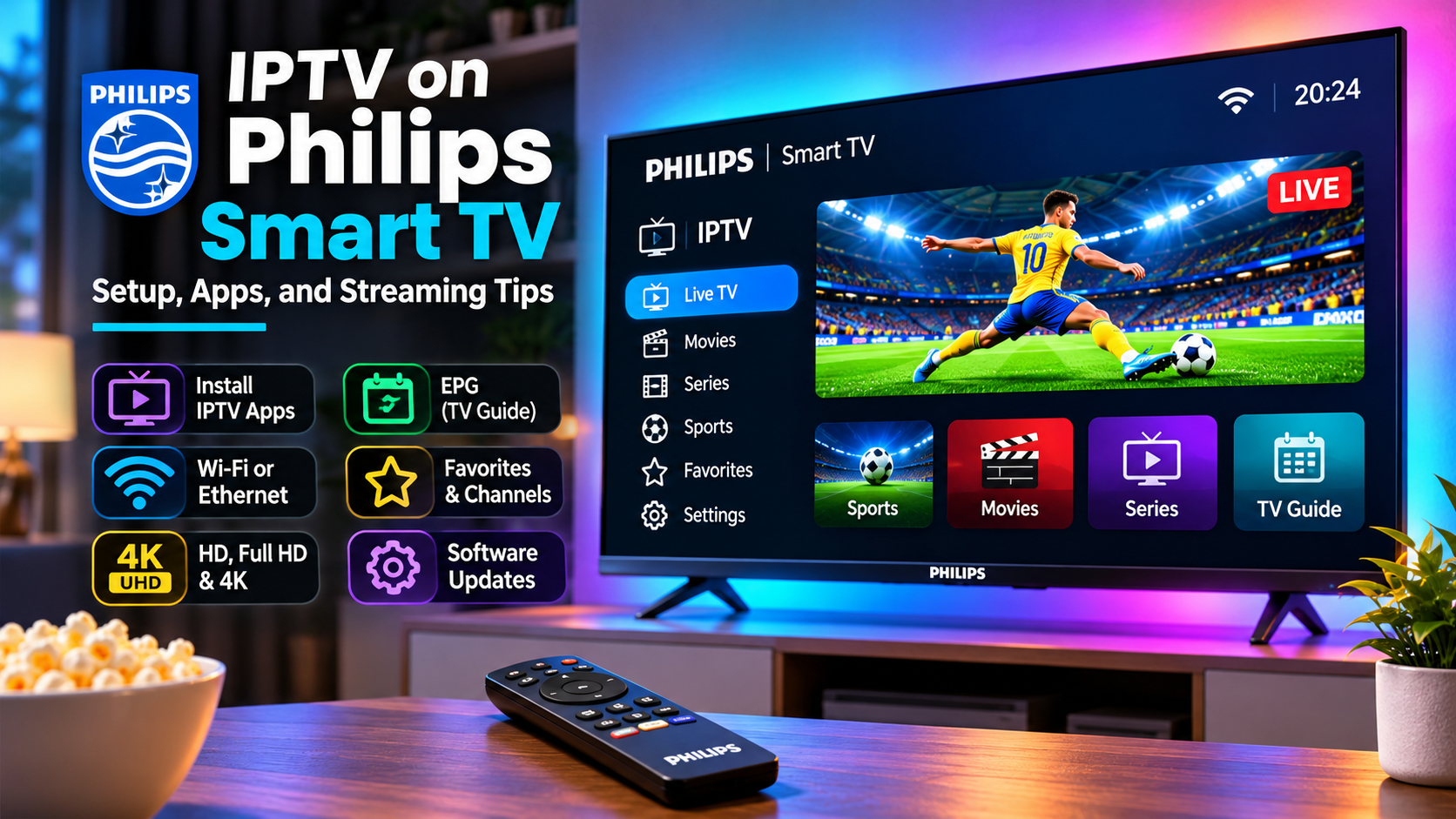
Philips Smart TVs can provide a convenient way to watch internet-based television without adding unnecessary hardware. Depending on the television model and operating system, users may be able to install a compatible IPTV player directly and access live TV, sports, movies, series, and other supported content.
A reliable experience depends on app compatibility, network stability, available storage, software updates, and the login method supplied by the IPTV service.
This guide explains how IPTV works on Philips Smart TVs and what users should check before setting up their preferred player.
Can You Use IPTV on a Philips Smart TV?
Yes. Many Philips Smart TVs support streaming applications, although compatibility depends on the model and operating system.
Philips televisions may use platforms such as:
-
Android TV
-
Google TV
-
Other Philips smart platforms
The available IPTV applications can therefore differ between televisions.
Before installing anything, check the exact model and operating system of the TV.
What You Need for IPTV
A typical setup requires:
-
Philips Smart TV
-
Stable internet connection
-
Compatible IPTV player
-
Valid IPTV subscription details
The television does not provide IPTV channels automatically. The installed player connects to the service using the credentials or playlist provided to the user.
Choose a Compatible IPTV Player
Different IPTV players support different connection methods.
Common formats include:
M3U Playlist
An M3U playlist contains stream information inside a playlist URL or file.
Username and Password
Some players allow users to enter a server address together with account credentials.
Xtream-Style Login
Compatible applications may organize live TV, movies, and series automatically after the required login information is entered.
Portal Connection
Some services use a portal-based connection, although this is more common on dedicated IPTV devices.
Users comparing service compatibility and setup information can also review MONSTER IPTV when deciding which IPTV configuration best matches their Philips television and other streaming devices.
Check Whether Your TV Uses Android TV or Google TV
This is an important step.
Philips televisions running Android TV or Google TV can often access applications through Google Play.
This may provide a wider selection of IPTV players than televisions using a more limited smart platform.
To check the operating system, look inside the television settings or consult the model information.
Installing an IPTV Application
The exact installation process depends on the Philips television.
On Android TV or Google TV models, the basic process may include:
-
Open the application store.
-
Search for a compatible IPTV player.
-
Review the supported features.
-
Install the application.
-
Open the player.
-
Enter the required IPTV credentials.
-
Allow the playlist and guide information to load.
Avoid installing unknown applications from untrusted sources.
Use a Stable Internet Connection
IPTV requires continuous internet delivery.
If the connection is unstable, users may experience:
-
Buffering
-
Freezing
-
Delayed channel changes
-
Audio interruptions
-
Reduced picture quality
A fast internet package is helpful, but local network stability is equally important.
Wi-Fi or Ethernet?
Philips Smart TVs commonly support Wi-Fi, and many models also include Ethernet.
Wi-Fi
Wireless networking provides a simple setup without additional cables.
It can work well when:
-
The router is nearby
-
Signal strength is good
-
Network congestion is low
Ethernet
A wired connection can provide more consistent performance.
Ethernet may be particularly useful for:
-
Live sports
-
Long streaming sessions
-
Full HD content
-
4K streams
If Wi-Fi performance is unreliable, testing Ethernet is a useful troubleshooting step.
Improve Wi-Fi Performance
If the television must use Wi-Fi, router placement matters.
Try to keep the router:
-
In an open location
-
Away from thick walls
-
Away from large metal objects
-
Relatively close to the television
Avoid hiding the router inside furniture.
A stronger signal can improve channel loading and reduce buffering.
Choose the Right Video Resolution
Higher resolution requires more bandwidth.
HD
HD uses less bandwidth and can work well on smaller screens or slower connections.
Full HD
Full HD provides more detail and is suitable for many Philips televisions.
4K UHD
4K requires a compatible television, suitable IPTV player, appropriate source quality, and stable internet connection.
If 4K playback repeatedly buffers, Full HD may provide a better overall experience.
Use the Electronic Program Guide
A compatible IPTV player may include an Electronic Program Guide.
An EPG can display:
-
Current programs
-
Upcoming programs
-
Start and finish times
-
Channel schedules
-
Program descriptions
This makes live television easier to navigate.
If the guide shows incorrect times, check the TV's date and time zone settings.
Organize Channels With Favorites
Large IPTV playlists can contain many categories.
Favorites allow users to create a shorter list of frequently watched channels.
For example:
Swedish Channels
Save regularly watched Swedish television channels.
Sports
Keep football, hockey, motorsport, and other sports channels together.
Movies
Create a separate movie category.
News
Group preferred national and international news channels.
Favorites can make remote-control navigation significantly easier.
Keep the TV Software Updated
Philips may release software updates for supported televisions.
Updates can include:
-
Security improvements
-
App compatibility changes
-
Bug fixes
-
Performance improvements
The IPTV application should also be kept reasonably current.
Updating both the television and player can reduce compatibility problems.
Avoid Filling the TV With Unused Apps
Smart TVs generally have less storage than computers.
Installing too many applications may leave less space for:
-
Updates
-
Cache files
-
EPG data
-
Temporary app information
Remove apps that are no longer needed.
A cleaner system is also easier to troubleshoot.
Restart the Television When Needed
Philips televisions may spend long periods in standby.
If the IPTV player becomes slow or unresponsive, restart the television.
A restart can sometimes resolve:
-
Frozen apps
-
Slow menus
-
Network glitches
-
Playback errors
Try this before reinstalling the application or changing advanced settings.
Clear IPTV App Cache on Android-Based Models
Android TV and Google TV devices may allow users to clear application cache.
This can help when an IPTV player becomes unusually slow.
Be careful to distinguish between:
Clear Cache: Removes temporary files.
Clear Data: May remove login details and reset the application.
Clearing cache is usually the safer first step.
Audio Problems
If the video works but sound does not, check:
-
Available audio tracks
-
Television sound settings
-
HDMI audio configuration
-
External soundbar settings
-
IPTV player options
Some streams contain multiple audio languages.
Trying another audio track can help determine whether the issue is specific to the channel.
Subtitle Support
Movies and series may provide subtitles when supported by the source.
A compatible IPTV player may allow users to:
-
Enable subtitles
-
Select a language
-
Change subtitle tracks
-
Adjust timing
If subtitle options are missing, either the content or player may not support them.
Older Philips Smart TVs
Older Philips televisions may still provide good picture quality even when their smart platform becomes outdated.
Possible signs include:
-
Limited app selection
-
Slow menus
-
Frequent crashes
-
Missing updates
-
Poor IPTV app performance
This does not necessarily mean the television needs to be replaced.
Use an External Streaming Device When Necessary
If a compatible IPTV application is unavailable, an external device can provide another option.
Examples include:
-
Android TV box
-
Google TV device
-
Apple TV
-
Fire TV
-
Nvidia Shield
The external device handles applications and processing while the Philips television continues to act as the display.
This can extend the practical life of an older TV.
IPTV on Multiple Philips TVs
Households may install IPTV players on several televisions.
However, simultaneous playback depends on the IPTV subscription.
Installing one account on multiple devices does not automatically mean all of them can stream at the same time.
Check the connection allowance before using several televisions simultaneously.
Protect IPTV Credentials
IPTV login information should remain private.
Avoid publicly sharing:
-
M3U URLs
-
Usernames
-
Passwords
-
Server addresses
-
Portal details
These credentials may provide direct access to the subscription.
Store them securely in case the application needs to be configured again.
Common Philips IPTV Problems
IPTV App Is Missing
Check the television model, operating system, and regional app availability.
Channels Buffer
Test the internet connection and Wi-Fi strength.
EPG Is Incorrect
Refresh guide data and check the time zone.
App Freezes
Restart the television and check available storage.
No Sound
Try another audio track and review sound settings.
Login Does Not Work
Verify the playlist URL, username, password, and server address carefully.
Final Thoughts
Philips Smart TVs can provide a straightforward IPTV experience when a compatible player is available.
Start by checking the television model and operating system, then choose an application that supports the login method supplied by the IPTV service.
A stable network, appropriate video resolution, updated software, and an organized favorites list can all improve everyday viewing.
If an older Philips television no longer supports the required IPTV app, adding a modern streaming device can provide an effective upgrade without replacing the screen.
With the right setup, a Philips Smart TV can serve as a practical platform for live television, sports, movies, series, and other IPTV content.

