

Germany 3PL Market Forecast: Services, Transport Modes and Applications Through 2035

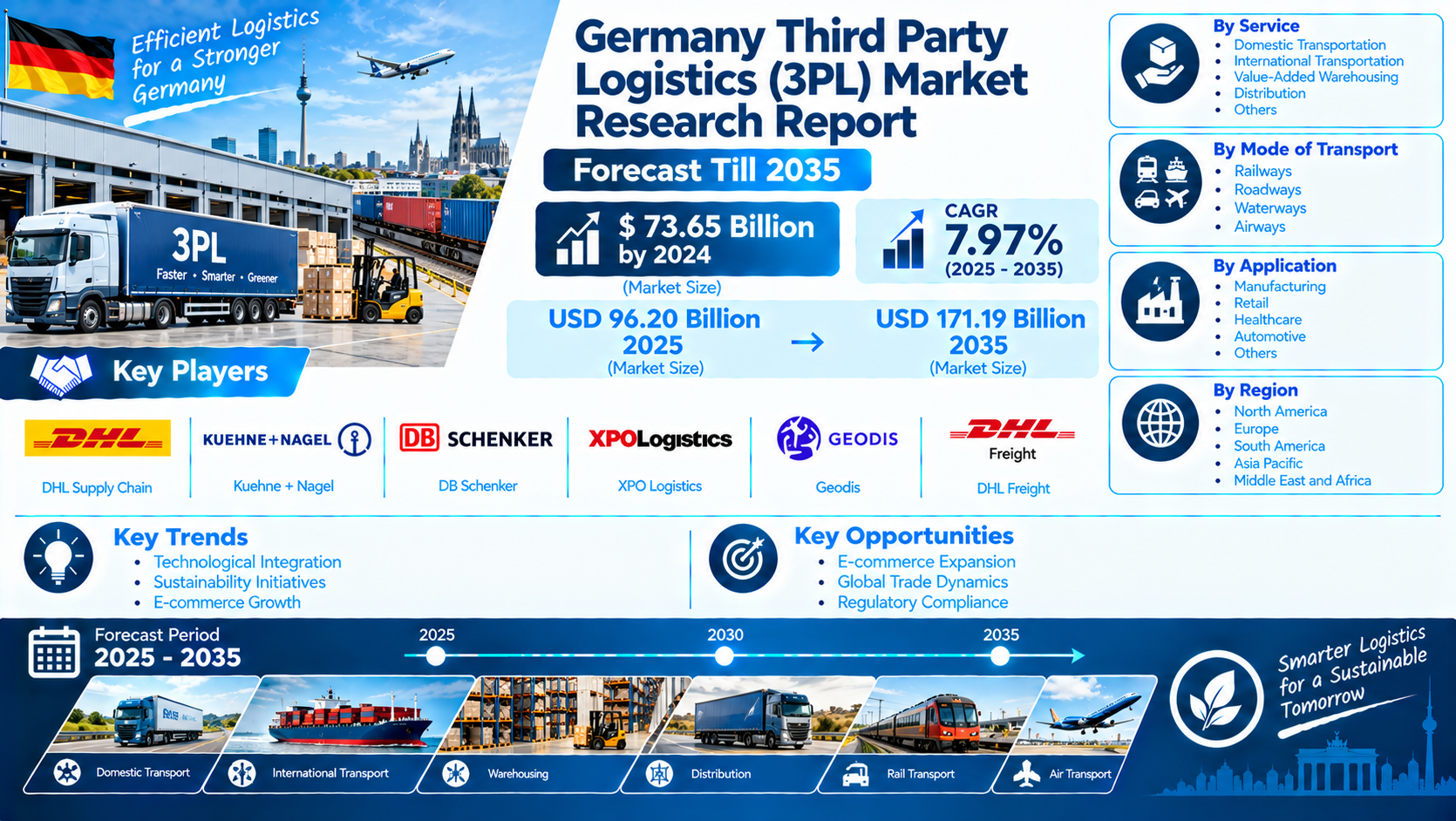
According to Market Research Future® (MRFR), the Germany Third Party Logistics 3PL Market is projected to expand through 2035 as businesses continue to rely on external logistics providers for transportation, warehousing, distribution and related services. The report identifies a CAGR of 7.97% for the 2025–2035 forecast period and places the 2035 market value at USD 171.19 billion. The supplied figures list the 2024 market size as USD 73.65 billion and the 2025 market size as USD 96,202.64 billion. The 2025 figure requires verification because it is inconsistent with the surrounding market values and stated growth trajectory.
Germany Third Party Logistics Market Overview
Third-party logistics providers manage logistics activities on behalf of businesses, offering services that can include transportation, warehousing and distribution. Outsourcing these functions allows companies to use external logistics capabilities rather than managing every operational requirement internally. The Germany 3PL market covers a range of services and transport modes, serving customers across manufacturing, retail, healthcare and automotive industries.
The market's reported forecast indicates continued expansion, with the 2035 value estimated at USD 171.19 billion and the stated CAGR at 7.97% for 2025–2035. However, the supplied 2025 market size of USD 96,202.64 billion is substantially higher than both the 2024 value of USD 73.65 billion and the 2035 forecast. This discrepancy should be clarified before the 2025 figure is used as a reliable basis for market comparisons.
Service-Based Market Segmentation
The Germany Third Party Logistics 3PL Market is segmented by service into domestic transportation, international transportation, value-added warehousing, distribution and others. These categories reflect the different functions businesses may outsource to logistics providers.
Domestic transportation supports the movement of goods within Germany, while international transportation addresses shipments that cross national borders. Both services are relevant to companies managing supply chains that extend across domestic and international markets. The requirements of customers can vary according to shipment characteristics, delivery schedules and the geographic reach of their operations.
Value-added warehousing provides another service category. Beyond basic storage, value-added warehousing can encompass additional logistics activities associated with preparing or managing goods, depending on the services offered by individual providers. Distribution is also a key segment, connecting logistics operations with the movement of products toward customers and other destinations. The others category captures additional services included within the market's scope.
Modes of Transport
The market's transport-mode segmentation includes railways, roadways, waterways and airways. These modes provide different options for moving goods and form an important part of the service capabilities offered by third-party logistics providers.
Roadways are one of the listed transportation categories and support road-based freight movement. Railways provide a separate option for cargo transportation, while waterways and airways add maritime and air transport to the market's mode structure. The selection of a transport mode depends on the requirements of a shipment and the logistics arrangements needed by the customer.
For 3PL providers, coordinating transport options with warehousing and distribution services is an important part of managing customer supply chains. Businesses may require different combinations of services and transport modes depending on their products, destinations and operational priorities.
Demand Across Application Industries
By application, the Germany 3PL market is segmented into manufacturing, retail, healthcare, automotive and others. These industries have distinct logistics requirements, creating demand for different combinations of transportation, warehousing and distribution.
Manufacturing companies use logistics services to coordinate the movement of materials, components and finished products. Retail businesses require distribution arrangements that connect goods with sales channels and customers. Healthcare is another application category, while automotive adds demand associated with the movement of products and components across the automotive supply chain.
The others segment broadens the market's application coverage beyond the specifically listed industries. This diversity provides third-party logistics companies with opportunities to serve customers across multiple sectors. However, service requirements can differ substantially between industries, making operational flexibility and customer-specific logistics planning important.
Technological Integration and Digital Logistics
Technological integration is identified as a major trend in the German 3PL market. Logistics providers manage multiple operational activities, including transportation coordination, warehousing and distribution. Technology can support the organization and monitoring of these functions, helping providers manage information and coordinate services across supply chains.
The adoption of technology is relevant to customers seeking visibility and coordination across logistics operations. As businesses outsource more activities, their expectations of service providers can include effective communication and the ability to manage different logistics requirements. Technological integration therefore forms part of the industry's broader development.
The extent and type of technology adoption may vary among providers and service categories. The supplied market information identifies technological integration as a trend but does not specify particular platforms, systems or adoption rates.
Sustainability and E-Commerce Growth
Sustainability initiatives are another trend shaping the market. Logistics companies face growing attention to the environmental implications of transportation and supply chain operations. This can encourage providers to consider how services are organized and how operational practices align with sustainability objectives.
E-commerce growth is also influencing demand for third-party logistics services. Online retail creates requirements for transportation, distribution and warehousing as products move through supply chains toward customers. The identified opportunity of e-commerce expansion reflects the potential for logistics providers to serve businesses responding to online purchasing activity.
The impact of e-commerce can extend across several service categories, including domestic transportation, warehousing and distribution. Providers that can coordinate these functions may be positioned to address the needs of customers operating through digital sales channels.
Growth Opportunities and Global Trade
Global trade dynamics represent another opportunity for the Germany 3PL market. Businesses engaged in international commerce require logistics arrangements that connect suppliers, production operations and markets across borders. International transportation is directly included in the service segmentation, highlighting its relevance to the market.
Regulatory compliance is also identified as an opportunity area. Logistics providers must account for applicable requirements when organizing services and managing shipments. Compliance considerations can influence documentation, operational procedures and the coordination of international transportation. Providers that understand relevant requirements can support customers navigating complex logistics arrangements.
Together, e-commerce expansion, global trade dynamics and regulatory compliance create opportunities for service providers to strengthen their logistics offerings and address changing customer needs.
Competitive Landscape
The key players identified in the Germany Third Party Logistics 3PL Market include DHL Supply Chain, Kuehne + Nagel, DB Schenker, XPO Logistics, Geodis and DHL Freight. These companies form part of the competitive landscape covered by the report.
Competition in the market involves the ability to provide transportation, warehousing, distribution and related services across different customer industries. Service breadth, transport coordination, technological integration and the ability to respond to customer requirements are relevant considerations for logistics providers. Sustainability initiatives and e-commerce-related demand also influence the environment in which companies operate.
Market Outlook Through 2035
The Germany Third Party Logistics 3PL Market is forecast to reach USD 171.19 billion by 2035, with a reported CAGR of 7.97% for 2025–2035. Its segmentation across domestic and international transportation, value-added warehousing, distribution and other services reflects the broad role of external logistics providers in business operations.
Technological integration, sustainability initiatives and e-commerce growth are key trends, while e-commerce expansion, global trade dynamics and regulatory compliance are identified opportunities. Manufacturing, retail, healthcare and automotive applications provide a diverse customer base.
Data verification note: The supplied 2025 market size of USD 96,202.64 billion appears inconsistent with the 2024 value of USD 73.65 billion and the 2035 forecast of USD 171.19 billion. The figure should be checked against the original report before publication. It has been retained here as supplied rather than silently corrected.

