

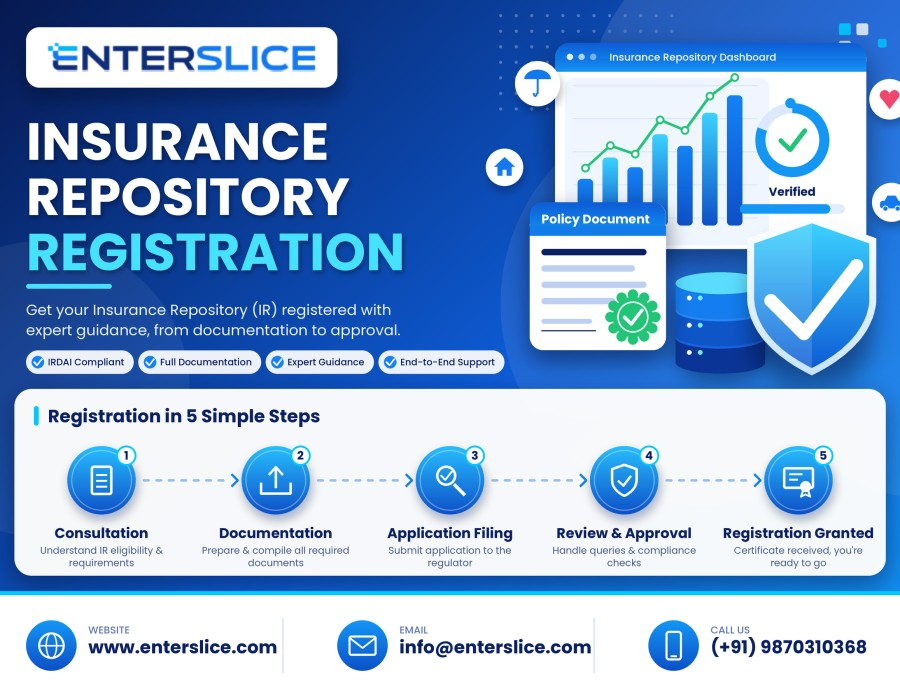
IRDAI Insurance Repository Registration in India: Eligibility, Process and Compliance

India's insurance sector is steadily moving towards digital policy issuance and electronic record management. Policyholders increasingly expect convenient access to their insurance documents without depending on physical files. Insurance repositories play an important role in this transition by providing a regulated system for maintaining insurance policies in electronic form.
For businesses planning to enter this segment, IRDAI Insurance Repository Registration is an important regulatory requirement. It allows an eligible entity to operate as an insurance repository and provide electronic insurance policy management services in accordance with the applicable guidelines of the Insurance Regulatory and Development Authority of India (IRDAI).
However, establishing an insurance repository involves more than developing a digital platform. Applicants must understand the eligibility conditions, financial requirements, technology infrastructure, data protection measures and regulatory responsibilities associated with this activity.
This article explains the insurance repository registration process in India, its regulatory framework and the key considerations for prospective applicants.
What Is IRDAI Insurance Repository Registration?
An insurance repository is an entity authorised by IRDAI to maintain insurance policy records in electronic form on behalf of insurers. It provides a digital infrastructure through which policyholders can hold and manage their insurance policies.
IRDAI Insurance Repository Registration refers to the regulatory approval required for an eligible entity to function as an insurance repository.
The system is designed to improve the accessibility, security and management of insurance records. Instead of maintaining separate physical policy documents, policyholders can use an electronic insurance account to access their policies.
An important feature of this system is the e-Insurance Account (eIA). It allows an individual to maintain multiple insurance policies in electronic form through a single account.
Insurance repositories are different from insurance brokers, corporate agents and web aggregators. Their primary role is electronic policy record management and related servicing activities permitted under the regulatory framework. They are not independently authorised to solicit or sell insurance policies merely because they hold repository registration.
Why Is Insurance Repository Registration Important?
The insurance repository framework supports the digital transformation of India's insurance industry. It benefits insurers, policyholders and the wider insurance ecosystem.
Some important objectives include:
1. Centralised Policy Management
Policyholders can maintain eligible insurance policies through a single electronic insurance account instead of managing multiple physical documents.
2. Reduced Paperwork
Electronic records reduce the dependence on physical policy documents, making storage and retrieval more convenient.
3. Improved Policy Servicing
The repository system facilitates authorised policy servicing requests, including changes and modifications, subject to the applicable procedures and insurer approval.
4. Better Record Accessibility
Policyholders can access their electronic insurance records through the relevant digital facilities.
5. Improved Record Security
Repositories are expected to maintain appropriate safeguards against unauthorised access, manipulation, loss and disclosure of policyholder information.
6. Operational Efficiency
Electronic communication between insurers and repositories can streamline policy administration and record management.
Eligibility Criteria for IRDAI Insurance Repository Registration
Eligibility is one of the first areas that prospective applicants should examine before planning an application.
The Revised Guidelines on Insurance Repositories and Electronic Issuance of Insurance Policies, dated 29 May 2015, specify the eligible categories of applicants.
These include:
-
A public limited company registered under the Companies Act, 2013.
-
A public financial institution as defined under the Companies Act.
-
A wholly owned subsidiary of an existing depository registered with SEBI under the Depositories Act, 1996.
-
A company fully promoted by the Life Insurance Council, General Insurance Council, or both, including permitted joint arrangements.
-
Strategic Business Units of eligible institutions, subject to the prescribed conversion requirements.
-
Other institutions specifically permitted by the Authority.
The 2015 guidelines also prescribe important conditions relating to the applicant's business objectives, financial position, management capability and independence.
Financial and Organisational Requirements
The revised guidelines specify a minimum net worth of ₹25 crore at the stage of in-principle approval.
They also specify a minimum share capital of ₹5 lakh for applicants falling under the public limited company category.
However, applicants should not treat these historical figures as a complete statement of current eligibility. The applicable regulatory directions, any subsequent amendments and the availability of an IRDAI invitation or Request for Proposal (RFP) must be checked before proceeding.
Technology and Management Capability
An applicant should demonstrate the ability to establish and operate a reliable electronic insurance record management system.
Its promoters should have relevant experience and financial and organisational strength to undertake the proposed activity.
The regulatory framework also addresses conflicts of interest, management suitability and the operational independence of an insurance repository.
Documents Required for Insurance Repository Registration
The documents required depend on the applicant's legal structure, business background and the information requested by IRDAI.
A prospective applicant should prepare the following documents as an initial checklist:
-
Certificate of Incorporation and company registration details.
-
Memorandum of Association and Articles of Association.
-
Details of promoters, shareholders and directors.
-
Shareholding pattern and ownership structure.
-
Audited financial statements.
-
Net worth certificate and supporting financial records.
-
Business plan and proposed operational model.
-
Details of existing business activities and relevant experience.
-
Information technology infrastructure and system architecture.
-
Data security, privacy and information protection policies.
-
Business continuity and disaster recovery arrangements.
-
Details of key managerial personnel and proposed management structure.
-
Internal control and risk management policies.
-
Declaration and supporting information concerning conflicts of interest.
-
Other declarations, undertakings and documents prescribed by IRDAI.
This is a preparatory checklist rather than a fixed statutory document list. The prescribed application form and the applicable RFP should be treated as the controlling references for the final submission.
Step-by-Step Process for IRDAI Insurance Repository Registration
The registration process involves regulatory scrutiny, infrastructure assessment and verification of the applicant's ability to operate as an insurance repository.
Step 1: Assess Eligibility
The first step is to determine whether the proposed applicant falls within an eligible category under the applicable IRDAI guidelines.
The promoters should examine the company's legal structure, shareholding, financial capacity, business objectives and management experience.
Step 2: Review the Regulatory Framework and RFP
IRDAI has the authority to regulate the number of insurance repositories and call for applications through a Request for Proposal.
Therefore, applicants should verify whether an application window or relevant RFP is available before preparing a formal submission.
Step 3: Prepare the Application
The 2015 revised guidelines prescribe Form Insurance Repository-1 for applications.
The application should contain the required corporate, financial, management and operational information, along with the supporting documents and applicable fee specified by the Authority.
Incomplete applications may face regulatory objections or rejection.
Step 4: Regulatory Examination
IRDAI examines the application against the applicable eligibility conditions and regulatory requirements.
The Authority may request additional information, supporting documents or clarification. Applicants may also be required to make a personal representation.
Step 5: Obtain In-Principle Approval
If the application satisfies the relevant requirements, IRDAI may grant in-principle approval.
This stage allows the applicant to proceed with the prescribed operational and technological preparations.
Step 6: Establish Infrastructure and Security Systems
The applicant must establish the systems, controls and safeguards required under the regulatory framework.
These include secure electronic data processing, controlled access, encryption safeguards, backup arrangements, operational procedures and appropriate communication systems.
The applicant must also provide the prescribed affidavit or supporting confirmation of compliance.
Step 7: Physical Verification and Final Approval
IRDAI may physically verify the applicant's infrastructure and systems before granting the registration certificate.
After examining the application, compliance evidence and verification findings, the Authority may grant a Certificate of Registration if the applicable conditions are satisfied.
An applicant should not commence repository operations merely on the basis of an application or in-principle approval.
Technology and Data Security Requirements
Technology infrastructure is a central part of insurance repository operations because the entity handles sensitive policyholder and insurance information.
The regulatory framework requires repositories to establish appropriate safeguards to protect electronic records and communication systems.
Important areas include:
-
Protection against unauthorised access to electronic records.
-
Secure communication between insurers, repositories and other connected systems.
-
Encryption and safeguards for electronic data transmission.
-
Controlled and monitored access to physical and digital infrastructure.
-
Reliable backup facilities at separate locations.
-
Business continuity and recovery arrangements.
-
Documented operational procedures.
-
Mechanisms for detecting and addressing security incidents.
A repository should also maintain systems to protect policyholder privacy and prevent manipulation of records and transactions.
These controls should be incorporated into the business plan and technology architecture from the beginning rather than treated as requirements to be addressed after registration.
Post-Registration Compliance for Insurance Repositories
Obtaining IRDAI Insurance Repository Registration is only the beginning of the regulatory responsibility. Registered entities must maintain compliance throughout their operations.
Some important responsibilities include:
1. Appointment of a Compliance Officer
The guidelines require an insurance repository to appoint a compliance officer responsible for monitoring applicable regulatory compliance and policyholder grievance-related responsibilities.
2. Maintenance of Electronic Records
Repositories must maintain prescribed records relating to e-Insurance Accounts, electronic policies, policyholder instructions, nominees, beneficiaries and relevant transactions.
3. Data Privacy and Protection
Appropriate controls must be maintained to protect confidential policyholder information and prevent unauthorised changes or disclosure.
4. Annual External Audit
The systems, procedures and safeguards of the repository are subject to periodic external audit.
An important regulatory update was issued on 29 July 2025 through IRDAI reference IRDAI/INT/GDL/MISC/87/7/2025. It amended Clause 15(a) of the 2015 guidelines to specify the eligible external auditors for the annual review, including CISA-qualified auditors, Chartered Accountants holding DISA (ICAI) qualification and CERT-In-certified experts.
5. Grievance Redressal
The repository must maintain appropriate arrangements for handling policyholder complaints and addressing issues within its responsibilities.
6. Regulatory Reporting
Applicable records, reports, audit findings and other information must be maintained or submitted to IRDAI as required under the relevant directions.
Common Challenges in Obtaining Insurance Repository Registration
Applicants may encounter several practical difficulties during the registration process.
Financial Eligibility: Meeting the prescribed financial conditions and demonstrating the ability to sustain repository operations can be challenging.
Technology Infrastructure: Developing a secure, reliable and scalable platform requires considerable planning and technical expertise.
Regulatory Documentation: Preparing complete and consistent corporate, financial and operational documents requires careful coordination.
Data Protection: Insurance repositories handle confidential information, making cybersecurity and privacy safeguards essential.
Regulatory Coordination: Responding to IRDAI's queries and satisfying infrastructure verification requirements can require additional preparation.
Early regulatory assessment and professional guidance can help applicants identify these issues before making a formal submission.
How Enterslice Can Help with Insurance Repository Registration
Establishing an insurance repository requires a clear understanding of regulatory expectations, corporate structuring and technology-related compliance.
Enterslice provides professional assistance to businesses exploring IRDAI Insurance Repository Registration in India.
Our support may include:
-
Initial eligibility and regulatory assessment.
-
Guidance on the applicable IRDAI guidelines.
-
Assistance with corporate and application documentation.
-
Review of the proposed business and operational model.
-
Guidance on regulatory compliance requirements.
-
Assistance in preparing responses to regulatory queries.
-
Support with post-registration compliance planning.
The scope of professional assistance depends on the applicable regulatory process and the requirements of the applicant.
If your organisation is planning to enter India's digital insurance infrastructure segment, consult Enterslice to understand the regulatory requirements and prepare an appropriate registration strategy.
Most popular services :
Financial intelligence unit india
Frequently Asked Questions (FAQs)
1. What is IRDAI Insurance Repository Registration?
IRDAI Insurance Repository Registration is the regulatory approval granted to an eligible entity to operate as an insurance repository. It authorises the entity to maintain electronic insurance policy records and provide permitted repository services.
2. Who is eligible to apply for insurance repository registration in India?
The 2015 revised guidelines identify eligible categories such as public limited companies, public financial institutions, wholly owned subsidiaries of SEBI-registered depositories and qualifying companies promoted by insurance councils. Other institutions may also be considered if permitted by IRDAI.
3. What is the minimum net worth requirement for an insurance repository?
The Revised Guidelines dated 29 May 2015 specify a minimum net worth of ₹25 crore at the in-principle approval stage. Applicants should verify the applicability of this requirement against the latest regulatory directions before applying.
4. What is an e-Insurance Account (eIA)?
An e-Insurance Account is an electronic account maintained with an insurance repository. It enables policyholders to hold and access their eligible insurance policies in electronic form through a single account.
5. Can an insurance repository sell insurance policies?
No. Insurance repository registration does not independently authorise an entity to solicit or sell insurance policies. Its permitted activities relate to maintaining electronic insurance policies and providing authorised repository services.
6. Is physical verification required for insurance repository registration?
The 2015 revised guidelines provide for physical verification of the infrastructure and systems established by the applicant before the grant of a Certificate of Registration.
7. What happens after receiving insurance repository registration?
After registration, the entity must maintain the prescribed technology safeguards, electronic records, privacy controls, compliance arrangements, external audit requirements and policyholder grievance mechanisms, along with other applicable IRDAI obligations.

