

Industrial Indoor Overhead Cranes Market to Reach USD 21.16 Billion by 2035 at 3.81% CAGR

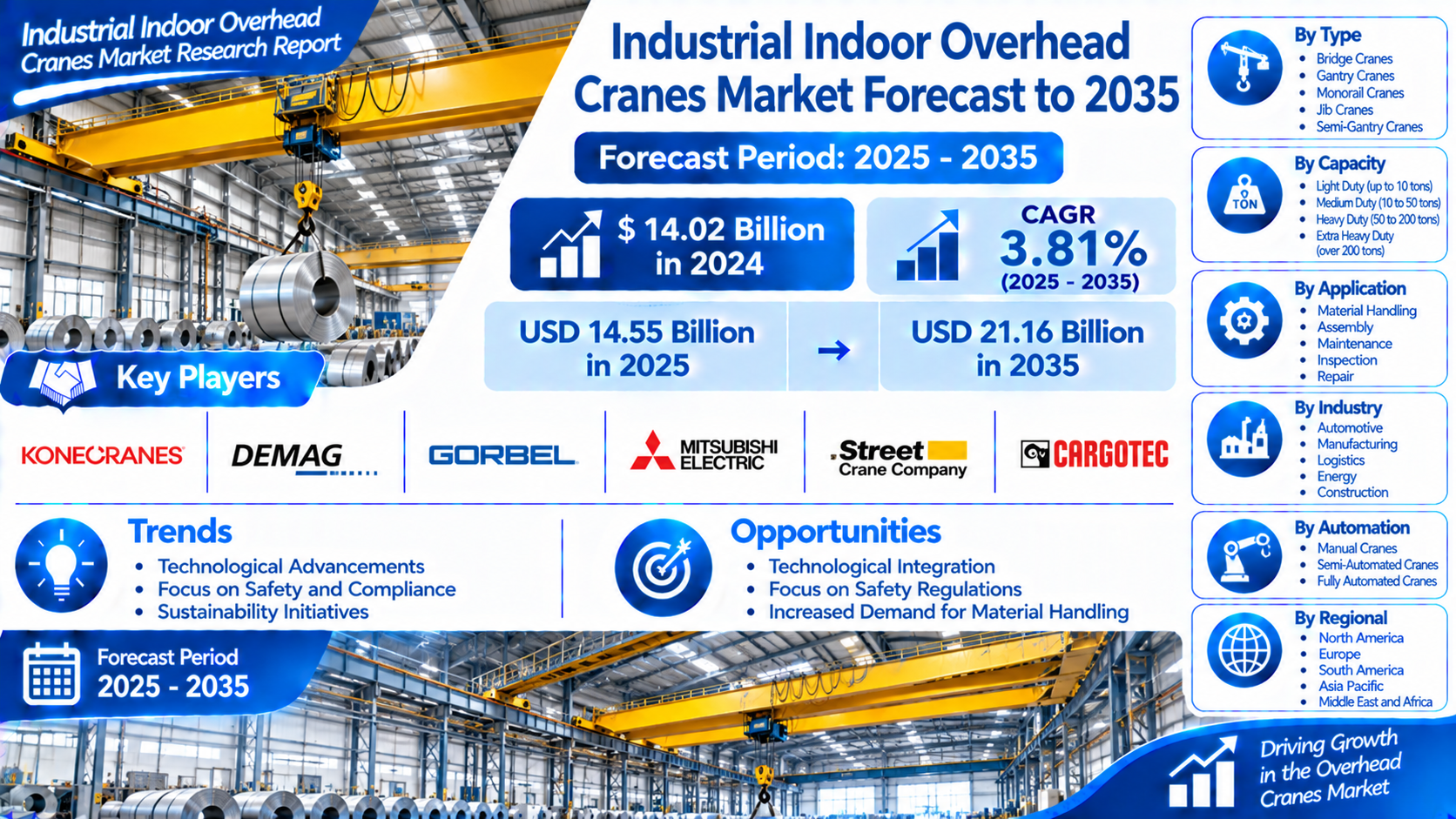
According to Market Research Future® (MRFR), the Industrial Indoor Overhead Cranes Market is projected to increase from USD 14.55 billion in 2025 to USD 21.16 billion by 2035, registering a compound annual growth rate (CAGR) of 3.81% during the forecast period from 2025 to 2035. The market was valued at USD 14.02 billion in 2024. Industrial indoor overhead cranes are used to lift, move, and position materials within enclosed industrial facilities. They support activities such as material handling, assembly, maintenance, inspection, and repair across industries including automotive, manufacturing, logistics, energy, and construction. Their role in moving heavy and bulky loads makes them important equipment for facilities seeking organized and efficient internal material movement.
Role of Overhead Cranes in Industrial Facilities
Indoor overhead cranes operate within industrial buildings and provide lifting and movement capabilities across designated work areas. By moving loads above floor-level operations, they can support material transfer without relying exclusively on mobile handling equipment. Their use is relevant in production facilities, warehouses, workshops, and other industrial environments where materials must be transported between workstations or storage areas.
Material handling is a central application, as overhead cranes can move raw materials, components, equipment, and finished products. In assembly operations, cranes help position heavy parts for installation or processing. Maintenance activities may require lifting machinery components or other equipment to provide access for servicing. Inspection and repair applications also depend on the controlled movement and positioning of loads.
The range of applications reflects the versatility of indoor overhead lifting systems. Individual facilities select crane configurations according to their building layout, lifting requirements, load characteristics, and operating procedures.
Crane Types and Their Applications
The market is segmented by type into bridge cranes, gantry cranes, monorail cranes, jib cranes, and semi-gantry cranes. Bridge cranes move loads across a defined work area using a bridge structure supported by runway systems. They are used in industrial facilities where lifting and horizontal movement are required across production or storage spaces.
Gantry cranes use a supporting structure that can operate independently of building-supported runway arrangements. Monorail cranes move loads along a fixed track, making them suitable for applications involving a defined transportation path. Jib cranes use a projecting arm to provide lifting coverage within a particular area, such as a workstation or production zone. Semi-gantry cranes combine elements of gantry and building-supported configurations, allowing them to serve selected industrial layouts.
The choice of crane type depends on factors such as available floor and overhead space, required lifting coverage, building structure, load movement patterns, and the nature of industrial operations. Different configurations allow facilities to select equipment suited to their specific material-handling needs.
Capacity Categories and Lifting Requirements
Capacity is another important market segment, covering light-duty cranes with capacity up to 10 tons, medium-duty cranes from 10 to 50 tons, heavy-duty cranes from 50 to 200 tons, and extra-heavy-duty cranes over 200 tons. These categories reflect the range of loads that industrial facilities may need to lift and move.
Light-duty systems can serve operations involving comparatively smaller loads, including component handling and selected workshop tasks. Medium-duty cranes address higher lifting requirements in manufacturing and material movement. Heavy-duty systems are relevant to facilities that handle substantial machinery, industrial components, or large materials. Extra-heavy-duty cranes serve applications involving loads exceeding 200 tons.
Capacity selection must account for the weight and characteristics of the load, lifting frequency, operating conditions, and the requirements of the facility. Appropriate capacity planning is also connected to safety procedures and the intended use of the crane.
Industry Applications and Automation
The market serves automotive, manufacturing, logistics, energy, and construction industries. Automotive facilities use lifting equipment to move components and support production activities. Manufacturing operations rely on cranes for transferring materials and positioning equipment during assembly and other processes. Logistics facilities can use indoor overhead cranes to handle goods and materials within warehouses and industrial storage environments.
The energy sector may require lifting systems for handling heavy equipment and components in industrial facilities. Construction-related industrial operations also use overhead cranes for material movement and equipment handling. These industries have different operating requirements, which influence the type, capacity, and configuration of cranes selected.
Automation is a further market segmentation, comprising manual cranes, semi-automated cranes, and fully automated cranes. Manual systems depend more directly on operator control. Semi-automated systems combine operator involvement with automated functions, while fully automated cranes use greater levels of automated control for designated operations. The appropriate configuration depends on operational complexity, investment priorities, safety requirements, and the facility's existing infrastructure.
Technological Advancements and Safety Requirements
Technological advancements are a key trend shaping the market. Developments in crane controls, monitoring systems, and automation can influence how lifting equipment is operated and managed. Technological integration is also identified as an opportunity, particularly as industrial facilities consider ways to connect lifting equipment with broader operational systems.
Safety and compliance are another major focus. Overhead cranes handle loads that can pose risks if lifting, movement, or positioning is not properly controlled. Industrial operators therefore need to consider equipment suitability, operating procedures, inspection, maintenance, and applicable safety requirements. A focus on safety and compliance is an identified market trend, while safety regulations provide a specific opportunity for suppliers and manufacturers to address industry requirements.
Sustainability initiatives also form part of the market landscape. Industrial facilities increasingly consider resource use and operational efficiency when evaluating equipment. Crane design, maintenance, and operating practices can contribute to these considerations, although outcomes depend on the specific system and facility.
Market Opportunities and Competitive Landscape
Increased demand for material handling is an important opportunity for the industrial indoor overhead cranes market. Manufacturing and logistics facilities require equipment capable of moving materials between work areas, storage locations, and production processes. This need can support demand for cranes across different capacity categories and configurations.
Technological integration provides another opportunity as facilities consider connected controls and more automated operations. The focus on safety regulations also creates scope for equipment and systems designed to address compliance requirements.
The key players identified in the market include Konecranes, Demag, Gorbel, Mitsubishi Electric, Street Crane Company, and Cargotec. Competition can involve crane design, lifting capacity, automation options, operational reliability, safety features, and the ability to serve different industrial applications.
Market Outlook Through 2035
The industrial indoor overhead cranes market is expected to grow from USD 14.55 billion in 2025 to USD 21.16 billion by 2035, at a CAGR of 3.81%. Its development is linked to material handling, assembly, maintenance, inspection, and repair requirements across automotive, manufacturing, logistics, energy, and construction facilities.
Bridge, gantry, monorail, jib, and semi-gantry cranes address different industrial layouts, while capacity categories range from light-duty systems up to 10 tons to extra-heavy-duty cranes over 200 tons. Technological advancements, safety and compliance, and sustainability initiatives are identified as important trends. Technological integration, safety regulations, and increased material-handling demand provide opportunities for industry participants over the forecast period.

