

Polypropylene Staple Fibre Market Research Report: Key Players and Competitive Landscape

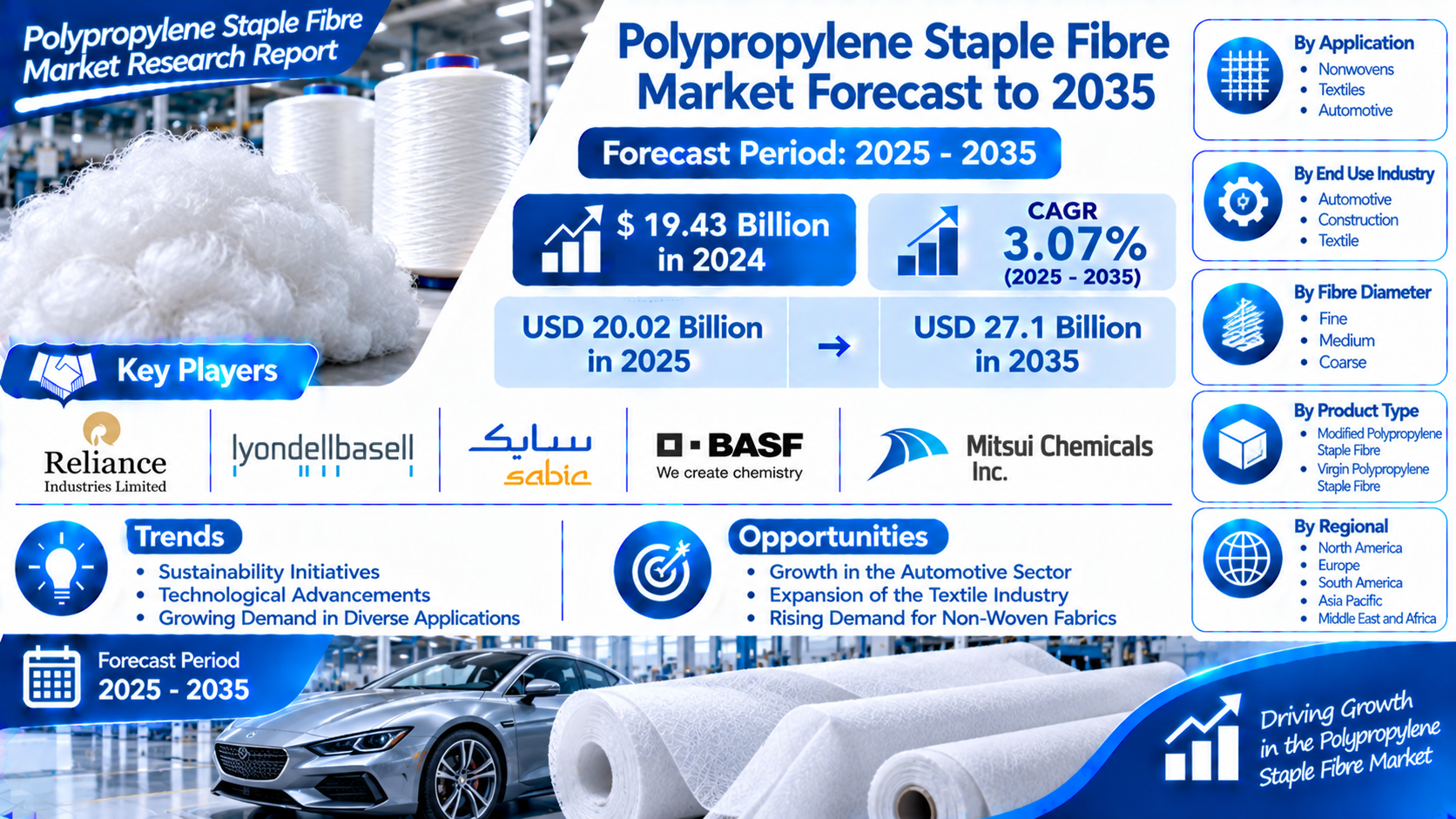
According to Market Research Future® (MRFR), the Polypropylene Staple Fibre Market is forecast to grow from USD 20.02 billion in 2025 to USD 27.1 billion by 2035, reflecting a CAGR of 3.07% over the 2025–2035 period. The market's 2024 value was USD 19.43 billion. Its outlook is linked to demand from nonwovens, textiles, and automotive applications, alongside opportunities arising from automotive sector growth, textile industry expansion, and rising demand for non-woven fabrics. Sustainability initiatives and technological advancements are also identified as important industry trends.
Industry Landscape and Market Performance
Polypropylene staple fibre serves a market that spans multiple industrial and application categories. Its segmentation includes nonwovens, textiles, and automotive applications, while automotive, construction, and textile are identified as the principal end-use industries. This broad structure gives the market exposure to several areas of manufacturing and product demand.
The market's financial outlook indicates gradual growth through 2035. Following a valuation of USD 19.43 billion in 2024, the market is expected to reach USD 20.02 billion in 2025. The forecast value of USD 27.1 billion by 2035 represents continued expansion at a 3.07% CAGR. These figures establish the scale and expected direction of the industry over the forecast period.
Demand from different end-use sectors is important to this outlook. Automotive and construction businesses represent industrial customer categories, while textiles form both an application and an end-use segment. Nonwovens add another distinct application area. The combination of these categories creates a market in which suppliers must address varied specifications and purchasing needs.
Nonwovens, Textiles and Automotive Applications
Nonwovens are one of the three identified applications for polypropylene staple fibre. Rising demand for non-woven fabrics is also listed as a market opportunity, making this segment particularly relevant to the industry's growth prospects. The connection between the application category and the identified opportunity points to the role of nonwovens in the future market landscape.
Textile applications are similarly important. The expansion of the textile industry is recognized as an opportunity for market participants. As the textile sector develops, demand for fibre inputs can be influenced by the requirements of manufacturers and the product specifications they seek. Polypropylene staple fibre suppliers can address this segment through the different product types and fibre diameter categories included in the market.
Automotive applications provide another source of demand. The automotive sector appears in both the application and end-use industry classifications, and its growth is identified as an opportunity. This makes automotive-related demand a significant element of the market's structure. The industry also includes construction as an end-use category, further extending the range of industrial customers.
Product Types and Fibre Diameter Categories
The market's product segmentation distinguishes between modified polypropylene staple fibre and virgin polypropylene staple fibre. These categories provide buyers with two defined product options. Their inclusion in the market structure indicates that product type is an important factor in understanding supply and demand.
Fibre diameter is classified as fine, medium, and coarse. This classification reflects the range of fibre specifications covered by the industry. Different customer requirements may call for different diameter categories, depending on the intended application and product characteristics. The availability of these options allows suppliers to serve a wider range of buyers across nonwovens, textiles, and automotive applications.
For manufacturers, product differentiation is relevant to customer engagement and market positioning. Suppliers must consider the relationship between product type, fibre diameter, and application requirements when developing their offerings. The combination of these segments gives the market a structure that extends beyond a single fibre specification.
Sustainability Initiatives and Technology Trends
Sustainability initiatives are a key trend shaping the polypropylene staple fibre market. The growing attention to sustainability across industrial activity has made material choices and production practices important considerations for manufacturers. For market participants, this trend creates a reason to evaluate how their products and processes align with customer expectations.
Technological advancements are also influencing the industry's direction. Innovation can affect production capabilities and the ability to provide products that meet different technical requirements. As the market serves several application categories, technological progress may be relevant to product development and operational performance.
The third identified trend is growing demand in diverse applications. This reflects the market's presence in nonwovens, textiles, and automotive uses. Rather than being associated with only one end-use sector, polypropylene staple fibre serves a range of industries. This diversity provides the market with multiple demand channels and creates opportunities for suppliers to serve different customer groups.
Regional Coverage and Competitive Participants
The market is organized across North America, Europe, South America, Asia Pacific, and the Middle East and Africa. These regions represent the geographic scope of the industry and provide a framework for assessing its international presence. The regional segmentation also reflects the broad range of markets in which polypropylene staple fibre products are supplied and used.
The key companies identified include Reliance Industries Limited, LyondellBasell Industries N.V., SABIC, BASF SE, and Mitsui Chemicals, Inc. These participants form part of the competitive environment. Companies in this market operate across a landscape shaped by product specifications, application diversity, and changing industrial requirements.
Competition is influenced by the ability to offer suitable fibre products for different customer needs. Modified and virgin polypropylene staple fibre, along with fine, medium, and coarse diameter categories, provide important dimensions for product differentiation. Companies must also consider sustainability initiatives and technological advancements as they respond to the changing requirements of the industries they serve.
Growth Opportunities and Forecast Through 2035
The market's opportunities are closely aligned with its application structure. Growth in the automotive sector is one identified opportunity, reflecting the importance of automotive-related demand. Expansion of the textile industry is another, while rising demand for non-woven fabrics provides a further avenue for market development.
These opportunities complement the industry's broader trends. Sustainability initiatives can influence material and production decisions, while technological advancements may support product development and manufacturing capabilities. Growing demand across diverse applications provides additional scope for suppliers to engage with customers in different sectors.
The forecast points to a market increasing from USD 20.02 billion in 2025 to USD 27.1 billion by 2035, with a CAGR of 3.07%. Its coverage of nonwovens, textiles, automotive, and construction gives the industry a varied demand base. As these end-use categories evolve, the ability to meet different fibre specifications and application requirements will remain central to the market's development.

