

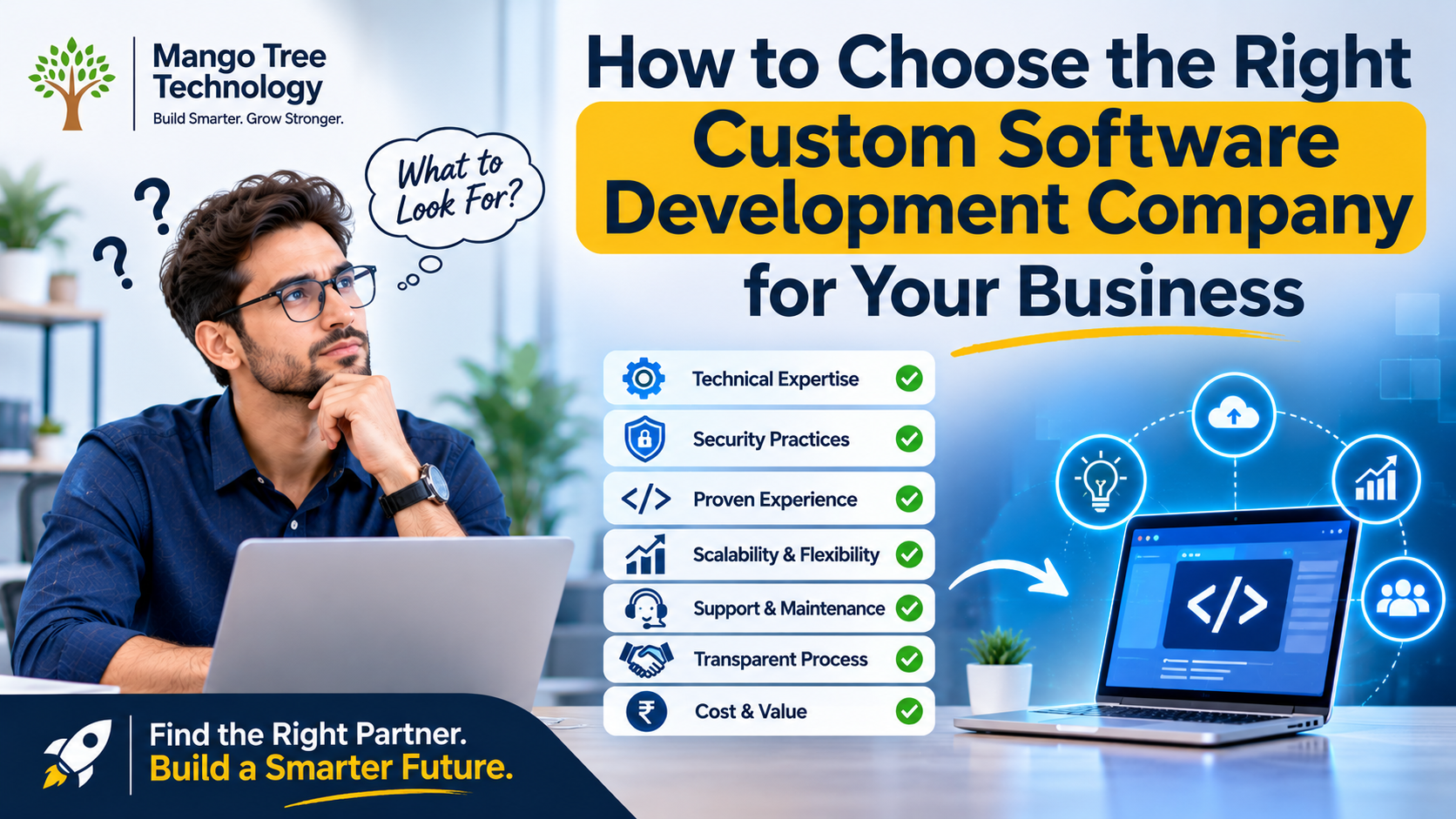
How to Choose the Right Custom Software Development Company for Your Business

Choosing the right Custom software development company is an important decision for any business planning to build or upgrade its digital infrastructure. Whether you need a business management application, customer portal, CRM system, or AI-powered solution, the development partner you select can influence the project's functionality, scalability, security, and long-term maintenance.
With numerous software providers offering different technologies and services, businesses often find it difficult to identify the right partner.
The best approach is to look beyond pricing and focus on technical capabilities, project understanding, development practices, and the ability to deliver a solution that addresses actual business requirements.
What Does a Custom Software Development Company Do?
A custom software development company designs, develops, tests, and maintains applications according to specific business requirements.
Unlike ready-made software, custom applications are developed around an organisation's workflows, users, and operational objectives.
Common custom software development services include:
-
Business Management Software: Applications for managing daily business activities, operations, and internal processes.
-
CRM Development: Custom systems for organising customer information, sales activities, and communication.
-
ERP Development: Integrated applications for managing business functions such as inventory, finance, and operations.
-
Web Application Development: Browser-based applications that provide interactive features and business functionality.
-
Mobile Application Development: Android and iOS applications designed for specific customer or business needs.
-
API Development and Integration: Connecting applications and third-party platforms for structured data exchange.
-
AI-Powered Software Development: Integrating suitable AI capabilities into applications to support intelligent features and automation.
7 Important Factors to Consider Before Hiring a Software Development Company
1. Understand Your Business Requirements
Before approaching a development company, identify the problem your software needs to solve.
Consider the following questions:
-
Which business process needs improvement?
-
Who will use the application?
-
What features are essential?
-
Which existing systems need integration?
-
What are your expected timelines and budget?
A clear requirement document helps developers understand the project and recommend an appropriate technical solution.
2. Evaluate Technical Expertise
Different software projects require different technologies and development approaches.
Depending on your requirements, evaluate the company's knowledge of programming languages, frameworks, databases, cloud platforms, APIs, and software architecture.
For example, a web application may require frontend and backend development, while an enterprise integration project may require database management and API engineering.
The technology stack should be selected according to the application's purpose, performance requirements, security needs, and future maintenance.
3. Review Relevant Projects and Case Studies
Past work can help you understand a development company's practical capabilities.
Ask whether it can share relevant project examples, demonstrations, or case studies.
A useful case study should explain:
-
The business problem.
-
The proposed technical solution.
-
The technologies involved.
-
Important development challenges.
-
The final deliverables and measurable outcomes, where available.
Evaluate actual evidence rather than relying only on marketing claims.
4. Check Software Security Practices
Security should be considered from the planning stage, not added as an afterthought.
Discuss how the development team approaches authentication, authorisation, data encryption, secure API communication, access permissions, and vulnerability testing.
The specific security measures should reflect the application's data sensitivity, users, and regulatory requirements.
5. Understand the Development and Testing Process
A structured development process helps businesses understand project progress and identify potential issues.
A typical software development lifecycle includes:
-
Requirement gathering and analysis.
-
Technical planning and architecture design.
-
UI/UX design and prototyping.
-
Software development.
-
Functionality and security testing.
-
Deployment and implementation.
-
Maintenance and future improvements.
Ask how the company handles feedback, testing, documentation, and changes to project requirements.
6. Evaluate Integration and Scalability
Your software may eventually need to connect with CRM platforms, payment gateways, accounting applications, cloud services, or other business tools.
Discuss integration requirements before development begins.
Also consider future growth. The application architecture should be designed with appropriate flexibility to accommodate expected users, data, features, and system connections.
7. Discuss Post-Development Support
Software development does not end when an application goes live.
Applications may require security updates, bug fixes, performance monitoring, compatibility improvements, and new features.
Before signing an agreement, clarify maintenance responsibilities, support availability, documentation, ownership of source code, and any ongoing costs.
Why Should Businesses Consider Custom Software Instead of Ready-Made Solutions?
Ready-made software is useful when standard features meet business requirements. However, some organisations have specialised workflows or integration needs that existing products cannot fully support.
Custom software offers several potential advantages:
| Factor | Ready-Made Software | Custom Software |
|---|---|---|
| Functionality | Standard features | Designed around business requirements |
| Customisation | Depends on the product | Greater flexibility |
| Integration | Depends on supported options | Can be planned for required systems |
| Initial Investment | Often lower | Depends on project complexity |
| Ownership and Control | Governed by vendor terms | Depends on development agreement |
| Scalability | Depends on product capabilities | Can be planned around business growth |
The right choice depends on the total cost of ownership, required functionality, implementation time, and long-term objectives.
How Is AI Changing Custom Software Development?
Artificial Intelligence is introducing new possibilities in application development and business software.
Businesses can explore AI capabilities such as:
-
AI chatbots and virtual assistants.
-
Intelligent document processing.
-
Natural language search.
-
Predictive analytics.
-
Automated information classification.
-
AI-powered workflow assistance.
For example, a business application can integrate an AI assistant that helps employees retrieve information from approved internal documents.
However, AI integration requires careful consideration of data quality, privacy, accuracy, security, and human oversight. Not every software application needs AI; the technology should solve a clearly defined problem.
Choosing a Custom Software Development Company in Delhi
Businesses searching for a Custom Software Development Company in Delhi should evaluate more than location and pricing.
Look for a provider that understands your industry requirements, communicates technical decisions clearly, and can explain how the proposed application will address your business challenges.
Mango Tree Technology works in custom software development, AI development, and software integration. Businesses exploring digital solutions can consider its services based on their project requirements, technical needs, and operational objectives.
As an IT Services Provider in Delhi, Mango Tree Technology focuses on software and technology solutions that can be planned around specific business needs.
Before selecting any development partner, discuss your requirements, expected deliverables, project scope, security considerations, and ongoing support.
Frequently Asked Questions
1. How do I choose the best custom software development company?
Evaluate technical expertise, relevant project experience, development methodology, security practices, communication, integration capabilities, and post-development support. Choose a company that understands your business requirements and can explain its proposed solution clearly.
2. How much does custom software development cost in Delhi?
The cost depends on application complexity, features, technology stack, integrations, development time, testing, and maintenance. A detailed requirement assessment is necessary to prepare an accurate estimate.
3. How long does custom software development take?
Development time varies according to project scope, functionality, integrations, design requirements, and testing. A small application may take considerably less time than a complex enterprise platform.
4. Is custom software suitable for small businesses?
Yes. Small businesses can use custom software for customer management, inventory, bookings, reporting, and workflow automation. The project scope should match the business's actual requirements and budget.
5. Can custom software integrate with existing applications?
Yes. Custom software can often connect with existing applications through APIs, database integrations, and other supported methods. Integration feasibility depends on the technical capabilities and access provided by the existing systems.
6. What is the difference between custom software development and software product development?
Custom software development focuses on creating an application for a particular organisation or set of requirements. Software product development generally involves building a product intended for use by multiple customers or markets.
Conclusion
Choosing the right custom software development company requires careful evaluation of business requirements, technical expertise, security practices, development processes, and long-term support.
Rather than selecting a provider based only on cost, focus on finding a development partner that understands your challenges and can recommend a practical technical approach.
Whether you need a custom business application, API integration, or AI-powered software, a well-planned development strategy can help create digital solutions that support your organisation's evolving needs.

