

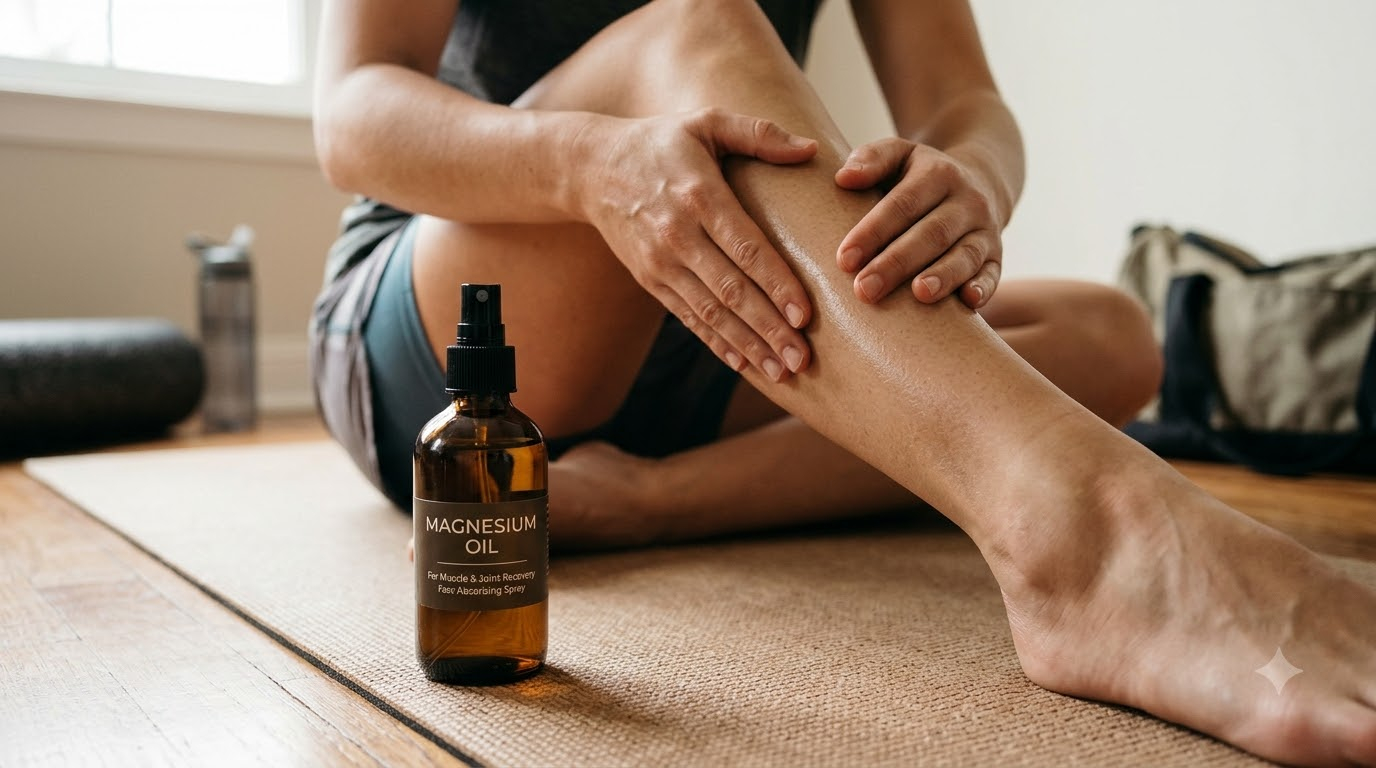

Post-Workout Muscle Tightness: What Topical Magnesium Can and Cannot Do
Muscle tightness after exercise is common, but it does not always mean your body needs another supplement or a stronger massage. The most useful response usually starts with identifying what caused the discomfort, adjusting your recovery routine, and choosing supportive products with realistic expectations. If you are considering using magnesium oil for muscle pain as part of a post-workout routine, it is important to understand what topical magnesium may offer, what remains uncertain, and how to use it without overlooking more effective recovery habits.
A demanding workout can leave muscles feeling stiff, tender, or unusually tired. This may happen after unfamiliar movements, increased training intensity, or exercises that involve lowering a weight slowly. The discomfort often develops several hours after activity rather than immediately. Understanding this pattern helps you decide whether a gentle self-care routine is reasonable or whether the symptoms deserve medical attention.
First, identify what kind of muscle discomfort you have
Not every ache after exercise has the same cause. Treating all discomfort as ordinary soreness can lead to poor recovery decisions.
Delayed-onset muscle soreness, often called DOMS, commonly appears after unfamiliar or strenuous activity. It may become more noticeable the next day and gradually improve over several days. The muscles involved may feel tender when touched or when you repeat the movement that challenged them.
Other discomfort can have a different explanation:
-
General fatigue: Your muscles feel tired after a demanding session, but there may be little tenderness.
-
Temporary tightness: A muscle feels restricted or stiff, particularly after remaining in one position.
-
Possible strain: Pain may be sharper and more localised, sometimes beginning during the exercise itself.
-
Joint discomfort: The pain is centred around a joint rather than within the muscle.
A topical product should not be used to mask an injury. Sudden severe pain, significant swelling, unusual weakness, difficulty moving a limb, or dark urine after intense exercise requires prompt medical assessment. Seek urgent care if symptoms are severe or accompanied by feeling very unwell.
Why recovery can feel harder after certain workouts
Muscle soreness is more likely when a session introduces a new physical demand. For example, someone who usually cycles may experience pronounced thigh soreness after a workout involving squats or lunges.
Several training factors can contribute:
Unfamiliar movements: A new exercise asks your muscles to work in a way they may not be accustomed to.
Sudden increases in volume: Adding many extra repetitions, sets, or training days can make recovery more difficult.
Eccentric loading: Movements in which muscles lengthen while controlling a load, such as lowering into a squat, can produce substantial soreness when unfamiliar.
Insufficient recovery: Repeating demanding sessions without enough rest may leave you feeling persistently fatigued.
Poor preparation: Starting intense activity without an appropriate warm-up can make a session feel more difficult, although warming up does not eliminate all soreness.
The practical lesson is to look at your training pattern before assuming that a particular product is the solution.
Where topical magnesium fits into a recovery routine
Magnesium is an essential mineral involved in normal muscle and nerve function. That role has encouraged interest in topical products, including sprays, oils, and balms containing magnesium salts.
However, an important distinction is often missed: magnesium's role in the body does not automatically prove that applying it to the skin will deliver enough magnesium to affect muscle recovery.
Research on topical magnesium remains limited. A 2025 randomised study examining a commercial magnesium gel after exercise did not find a meaningful difference in muscle soreness or muscle-damage markers compared with a placebo gel under the study conditions. This does not establish that every formulation or use pattern has the same result, but it does mean that strong recovery claims should be treated cautiously.
Someone considering magnesium oil for muscle pain should therefore see it as an optional part of a comfort routine, not as a proven treatment for DOMS, muscle injury, or magnesium deficiency.
A massage or the simple act of applying a product may also feel relaxing. That experience can be useful as part of a wind-down ritual, but it should not be confused with proof that magnesium has entered the body in a clinically meaningful amount.
A practical recovery routine: what to do first
Instead of relying on one product, build a routine around the basics. These measures support ordinary recovery and help you notice when something is not improving as expected.
1. Reduce the next session's intensity
If your legs are noticeably sore after a demanding workout, avoid immediately repeating the same high-intensity leg session. You may still be able to move comfortably, but reduce the load, repetitions, or duration.
For example, replace heavy squats with an easy walk or a lighter mobility session if movement feels comfortable. The goal is not complete inactivity; it is to avoid adding another large demand to muscles that are still recovering.
2. Keep gentle movement in your day
Light activity can help you remain comfortable while recovering. Walking, easy cycling, or gentle range-of-motion exercises may be suitable when symptoms are mild.
Do not force a stretch through sharp pain. Aggressive stretching or deep massage can make an irritated area feel worse.
3. Eat and drink consistently
Recovery depends on more than topical products. Drink fluids according to your activity level, the weather, and your individual needs. Eat regular meals that provide adequate energy, protein, carbohydrates, and a varied range of nutrients.
If you train frequently, under-eating can make it harder to recover between sessions. A restrictive diet is not a shortcut to better muscle definition if it leaves you without enough energy to train and recover.
4. Prioritise sleep
Sleep is an important part of physical recovery. Try to maintain a consistent sleep schedule
and allow enough time for rest, especially after unusually demanding exercise.A relaxing evening routine may help you wind down. Some people include a warm shower, gentle stretching, or a topical balm or oil as part of that routine.
5. Assess the discomfort before applying a product
Check the skin and the affected area first. Avoid applying a topical product to broken, irritated, or recently shaved skin if it causes discomfort. Follow the product label and stop if you experience persistent burning, itching, redness, or a rash.
Choosing between a magnesium spray, oil, or balm
The product format affects how it feels and how easily it fits into your routine. It does not establish that one format is more effective for muscle recovery.
|
Format |
Practical consideration |
What to check |
|
Magnesium spray |
Convenient for applying to selected areas |
Ingredient list and directions |
|
Magnesium oil |
Often used as a massage-style topical product |
Skin tolerance and whether the texture suits you |
|
Magnesium balm |
Solid or creamy format that can be spread over the skin |
Added fragrance, botanicals, and other ingredients |
|
Ordinary moisturiser |
Primarily intended to moisturise skin |
Whether you need skincare rather than a magnesium product |
If you are comparing formats, choose based on comfort, ingredient transparency, ease of application, and your skin's response. A higher price or stronger tingling sensation does not prove better results.
Common mistakes that can make recovery less comfortable
Mistake 1: Treating tingling as proof that a product is working. A tingling or stinging sensation may be related to the formulation or skin sensitivity. It is not a reliable measurement of magnesium absorption or muscle recovery.
Mistake 2: Applying more than the label recommends. Using extra product does not guarantee extra benefit. It may increase the chance of irritation.
Mistake 3: Returning to intense exercise too quickly. Feeling slightly better after a massage or shower does not necessarily mean the muscle is ready for another demanding workout.
Mistake 4: Ignoring recurring pain. If discomfort repeatedly appears in the same place, begins during exercise, or affects normal movement, review your technique and training load. Consider a qualified healthcare professional or physiotherapist.
Mistake 5: Expecting a topical product to correct a nutritional deficiency. If you are concerned about low magnesium intake or deficiency, discuss your diet, symptoms, and appropriate testing with a healthcare professional. A topical product should not replace an assessment.
Two examples of using a more balanced approach
Example 1: A beginner starts strength training
A beginner completes their first lower-body workout and notices thigh soreness the following morning. Instead of repeating the same session, they choose a gentle walk, eat regular meals, hydrate, and allow time before the next demanding leg workout. They may use a topical product if it feels comfortable, but they do not depend on it to remove the soreness.
Example 2: An experienced runner increases weekly mileage
A runner adds several kilometres to their usual weekly distance and begins experiencing persistent calf tightness. They review the increase, reduce the next session's intensity, and check footwear, training surfaces, and rest. If pain is localised, worsening, or affecting their stride, they seek professional advice rather than attempting to manage it only with massage or topical products.
Illustrative Case Study: Building a better post-workout routine
Consider a hypothetical gym member who regularly feels uncomfortable after increasing the weight used during leg exercises. Initially, they respond by applying a topical product and training again the following day. The discomfort keeps returning.
After reviewing the pattern, they make three changes. First, they increase training loads more gradually. Second, they leave more recovery time after challenging lower-body sessions. Third, they use gentle movement and a consistent sleep routine rather than treating topical application as the main solution.
They also decide that magnesium oil for muscle pain is optional: they use it only when the product feels comfortable on their skin and follow its instructions. They do not interpret temporary relaxation as proof that an injury has healed.
The expected lesson is straightforward. A topical product can be one small part of a self-care routine, but adjusting the training load and allowing adequate recovery are more important decisions.
How to decide whether a topical product belongs in your routine
Before purchasing, consider the following questions:
-
Does the product clearly list its ingredients?
-
Are its directions easy to understand?
-
Does it contain fragrance or essential oils that may irritate your skin?
-
Can you test it cautiously on a small area first?
-
Are its claims realistic, or does it promise to cure pain or repair injuries?
-
Can you afford it without replacing more important recovery essentials?
Soul Seed Solutions offers magnesium-focused products alongside other body-care options. You can explore Soul Seed Solutions to review the brand's product range and decide whether a topical format suits your preferences. Read the product description and directions before use; individual skin responses can vary.
Conclusion: Make recovery habits the foundation
Post-workout discomfort is best managed by understanding its likely cause, adjusting exercise intensity, staying gently active when appropriate, eating and drinking adequately, and allowing enough rest. A topical product may add a comforting step to your routine, but it should not replace these fundamentals or delay medical advice when symptoms are concerning.
If you are considering magnesium oil for muscle pain, keep expectations realistic. Evidence for topical magnesium as a way to reduce exercise-related soreness is limited, so choose based on formulation, skin comfort, and transparent directions rather than dramatic promises. Consistent training progression and sensible recovery habits remain the more dependable starting point.
Is topical magnesium proven to relieve muscle soreness?
No. Evidence is limited, and a 2025 study of one commercial magnesium gel did not find reduced soreness compared with placebo under the tested conditions. Results may not apply to every formulation, but strong claims are not established.
Can I apply a magnesium product after every workout?
Follow the specific product's label. Daily use is not automatically necessary, and frequent application may irritate some people's skin. Stop using it if a rash or persistent discomfort develops.
Why does a magnesium topical product sometimes sting?
Stinging can be related to the concentration, formulation, or condition of the skin. It does not prove that the product is working. Avoid applying it to irritated or broken skin and discontinue use if the reaction persists.
Should I use topical magnesium instead of oral supplements?
Do not treat topical products as a proven substitute for dietary magnesium or clinician-recommended supplementation. If you suspect a deficiency or have a medical concern, speak with a healthcare professional.
When should post-workout muscle pain be checked?
Seek assessment for severe or worsening pain, marked swelling, unusual weakness, difficulty moving, pain that began suddenly during exercise, or symptoms that do not follow an ordinary recovery pattern. Dark urine after intense exercise needs urgent medical attention.

