

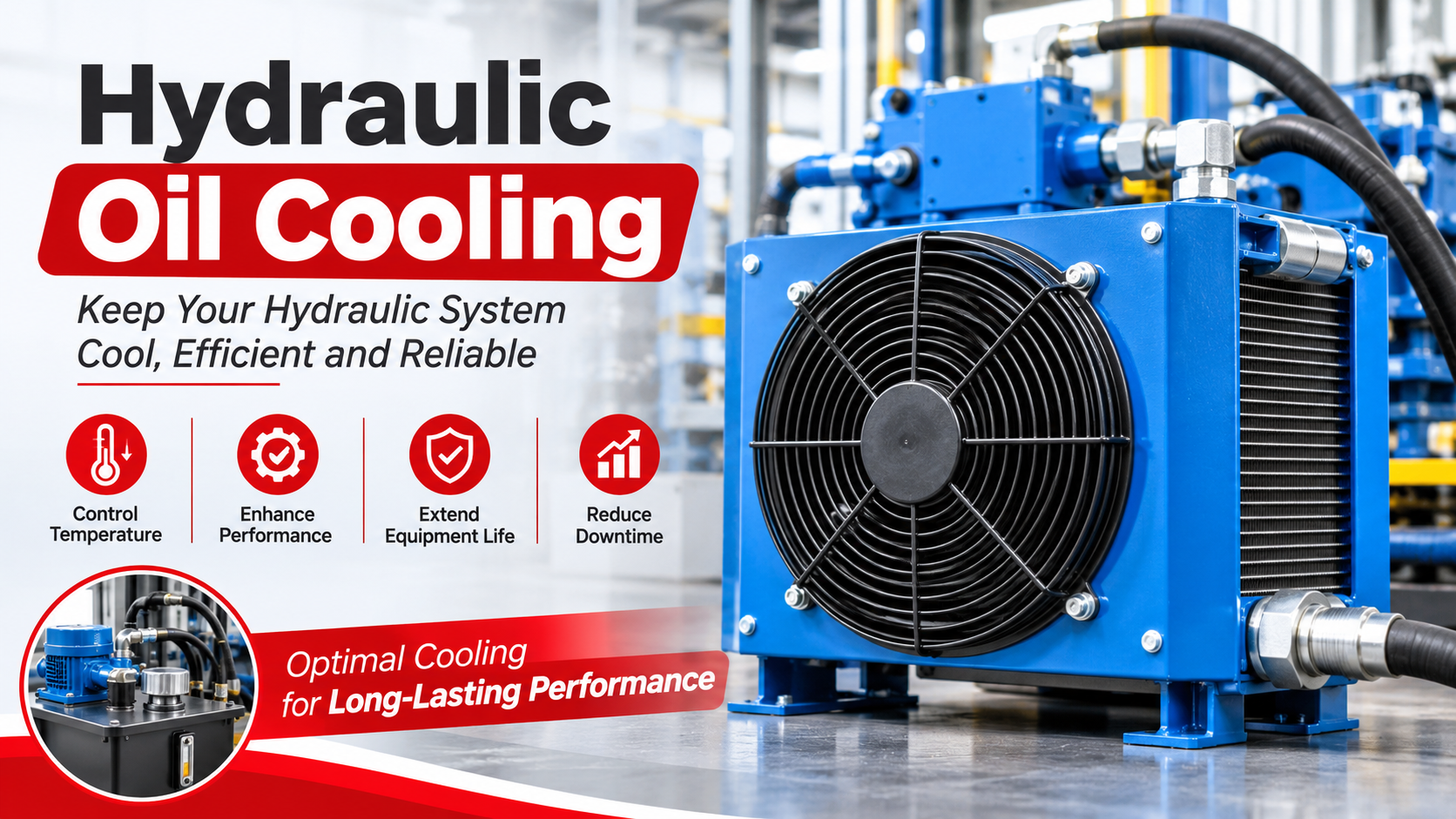
Selecting a hydraulic cooling system requires more than identifying the size of an industrial machine. Hydraulic equipment operates under different pressure conditions, flow rates, temperatures and production schedules. These factors directly influence cooling requirements.
A correctly sized Hydraulic Oil Cooler Heat Exchanger helps maintain suitable fluid temperatures and supports reliable equipment performance. Understanding the technical factors involved in cooler sizing allows engineers and industrial buyers to make better purchasing decisions.
Why Is Correct Hydraulic Oil Cooler Sizing Important?
Every hydraulic system generates heat during operation. Energy losses within pumps, valves and hydraulic circuits contribute to rising oil temperatures.
An undersized cooling system may struggle to remove sufficient heat during demanding operations. On the other hand, an unnecessarily oversized cooler may increase installation costs, space requirements and energy consumption.
Correct sizing helps balance cooling performance with actual operational requirements.
Key Factors That Determine Hydraulic Oil Cooler Size
Several technical parameters must be evaluated before selecting industrial cooling equipment.
Heat Dissipation Requirements
Heat dissipation capacity represents the amount of thermal energy that a cooler can remove under specified operating conditions.
Engineers should estimate heat generation using actual system efficiency, operating loads and duty cycles.
Hydraulic Oil Flow Rate
The cooler must accommodate the expected oil flow without introducing excessive resistance into the hydraulic circuit.
Maximum Ambient Temperature
Outdoor temperatures and indoor manufacturing conditions can influence cooling performance, particularly when using air-cooled equipment.
Hydraulic Oil Properties
Oil viscosity, density and specific heat capacity influence heat transfer and pressure drop.
Experienced Hydraulic Oil Cooler Heat Exchanger Manufacturers can evaluate these parameters when recommending suitable cooling equipment.
How to Estimate Hydraulic System Heat Load
One method of estimating heat transfer involves evaluating oil flow and the temperature difference across the cooler.
The basic heat transfer equation is:
Where:
-
Q represents heat transfer rate.
-
ṁ represents oil mass flow rate.
-
Cp represents the specific heat capacity of hydraulic oil.
-
ΔT represents the temperature difference.
For example, a hydraulic oil mass flow rate of 0.5 kg/s, a specific heat capacity of 2 kJ/kg·K and a temperature reduction of 10°C would represent approximately 10 kW of heat transfer.
This is an illustrative calculation. Final equipment selection should consider actual operating conditions and manufacturer performance data.
Technical Parameters to Check Before Selecting a Cooler
|
Parameter |
Importance |
|---|---|
|
Heat rejection capacity |
Determines cooling capability |
|
Oil flow rate |
Ensures hydraulic circuit compatibility |
|
Maximum operating pressure |
Supports safe operation |
|
Pressure drop |
Influences hydraulic resistance |
|
Ambient temperature |
Affects heat transfer performance |
|
Oil viscosity |
Influences flow and cooling characteristics |
|
Mounting dimensions |
Determines installation compatibility |
Evaluating these specifications together provides a more reliable basis for equipment selection than considering cooling capacity alone.
Should You Choose an Air-Cooled or Water-Cooled System?
Air-cooled systems transfer heat to surrounding air through a finned core and airflow. They are suitable for many facilities where cooling water is unavailable.
Water-cooled systems transfer heat to circulating water. They can support demanding stationary applications where reliable cooling water infrastructure is available.
Professional Hydraulic Oil Cooler Heat Exchanger Suppliers can help buyers compare both configurations according to installation conditions and thermal requirements.
Common Mistakes When Sizing Hydraulic Oil Coolers
Industrial buyers should avoid several common selection mistakes:
-
Selecting equipment based only on motor power.
-
Ignoring maximum operating temperatures.
-
Overlooking hydraulic circuit pressure drop.
-
Underestimating peak production loads.
-
Ignoring future production requirements.
-
Failing to consider ventilation and cooling water availability.
These mistakes can affect cooling performance and increase long-term operating expenses.
Why Equipment Documentation Matters
Technical documentation helps engineers evaluate whether a cooler can perform under actual operating conditions.
Buyers should request performance curves, pressure ratings, dimensional drawings and recommended operating limits. Installation instructions and maintenance requirements should also be reviewed.
Comparing these documents allows procurement teams to evaluate different models more objectively instead of relying entirely on advertised cooling capacities.
Choosing a Reliable Hydraulic Cooling Equipment Partner
Industrial buyers should work with manufacturers that understand hydraulic system requirements and provide relevant technical assistance.
Established Hydraulic Oil Cooler Heat Exchanger Manufacturers in India can support equipment selection based on application requirements, operating conditions and installation limitations.
N.T. Associates & Trading Co. offers hydraulic cooling solutions for industrial equipment, hydraulic power units and manufacturing machinery.
Conclusion
Correct hydraulic oil cooler sizing is essential for effective temperature management. Evaluating heat generation, oil flow, operating pressure and environmental conditions helps industrial buyers identify suitable cooling solutions.
Contact N.T. Associates & Trading Co. to discuss your hydraulic cooling requirements and explore suitable equipment options.
Frequently Asked Questions
1. How do you determine hydraulic oil cooler capacity?
Cooling capacity is determined by evaluating heat generation, oil flow, fluid properties and operating temperatures.
2. Can an oversized hydraulic oil cooler cause problems?
Yes. Unnecessary oversizing may increase costs and could contribute to overcooling without appropriate temperature controls.
3. Does hydraulic oil flow affect cooler selection?
Yes. Oil flow influences heat transfer, pressure drop and overall equipment compatibility.
4. Is motor power sufficient for selecting a hydraulic oil cooler?
No. System efficiency, duty cycle, thermal losses and environmental conditions must also be considered.
5. Why is ambient temperature important for air-cooled systems?
Higher ambient temperatures reduce the temperature difference available for heat transfer, which can affect cooling performance.

